Introduction
Cano Health filed prearranged voluntary Chapter 11 petitions on February 4, 2024, and emerged as a reorganized private company on June 28, 2024. This is a completed restructuring, not an open filing.
The case matters to healthcare operators, lenders, creditors, restructuring professionals, and distressed investors. It shows how fast expansion, risk-bearing contracts, heavy debt, and rising medical costs can end in a court-supervised reorganization.
Below, we cover the business model, the path to distress, the case timeline, the emergence terms, stakeholder effects, and a framework for monitoring similar cases.
Key Takeaways
- Cano used Chapter 11 to convert over $1 billion of funded debt into equity and warrants.
- Distress stemmed from acquisitions, a $1.1 billion 2023 net loss, higher medical costs, and thin liquidity.
- The reorganized company is private and focused on 80 Florida locations.
- Verify every development against SEC filings and court records, not headlines.
Who Was Cano Health and How Did It Expand?
A value-based primary care model
Cano ran a value-based primary care business, largely serving seniors. According to its 2023 Form 10-K, most revenue came from payor contracts paying a recurring per-member-per-month capitation fee. Cano disclosed non-risk, limited-risk, and full-risk arrangements. Under full risk, it took on the financial exposure for covered members' medical costs.
That structure gives predictable revenue, but a spike in medical costs lands directly on the provider. A subsidiary also participated in CMS's ACO REACH program.
Growth through acquisition
Cano grew from a Florida-centered provider into a multi-state platform. Its 2022 investor-day filing described operations in nine states and Puerto Rico. Key deals included:
- University Health Care, announced June 2021 for $540 million cash plus $60 million equity
- Doctors Medical Center, acquired July 2021 for $300 million, adding 18 South Florida centers
- A SPAC merger with Jaws Acquisition Corp., closed June 3, 2021, with NYSE trading starting the next day
Year-end scale, per the 10-K:
| As of December 31 | Members | Medical centers |
|---|---|---|
| 2021 | 227,005 | 130 |
| 2022 | 309,590 | 172 |
| 2023 | 267,917 | 100 |
Member and clinic growth did not deliver profitable growth. More markets brought more contracting, integration, staffing, and medical-cost complexity. A 1-for-100 reverse split in November 2023 and a 30-day average market capitalization of just $44.0 million by December 2023 show how far the equity had fallen.
Why Did Cano Health Face Financial Distress?
The numbers
For 2023, the 10-K reported:
- Revenue of $3.138 billion
- Operating loss of $1.004 billion
- Net loss of $1.099 billion
- Year-end cash and restricted cash of $75.8 million
- Notes payable of $1.157 billion
Liquidity was about $46.0 million on March 15, 2024, which the company said was insufficient for the next 12 months. The 10-K disclosed substantial doubt about going concern, and the filing itself was a default event under certain debt.

Industry pressure
In its Q2 2023 update, Cano reported a $270.7 million net loss and pointed to higher third-party medical costs and lower Medicare risk-adjustment revenue. For a capitated provider, those two forces squeeze both sides of the margin.
Stabilization attempts before filing
- Workforce cuts: about 842 employees (21%) reduced in Q3 2023, split between market exits and restructuring.
- Asset sale: Texas and Nevada senior-care centers sold to Humana's CenterWell, closing September 25, 2023.
- Strategic review: the company explored a sale of the business or substantially all assets.
- Cost targets: about $290 million in reductions by end of 2024. That is a target, not a realized result.
Leadership turnover
CEO Marlow Hernandez resigned effective June 16, 2023, and Mark Kent became interim CEO. The change coincided with the distress, but the filings point to liquidity, losses, and debt as the drivers.
What Happened During Cano Health's Chapter 11 Case?
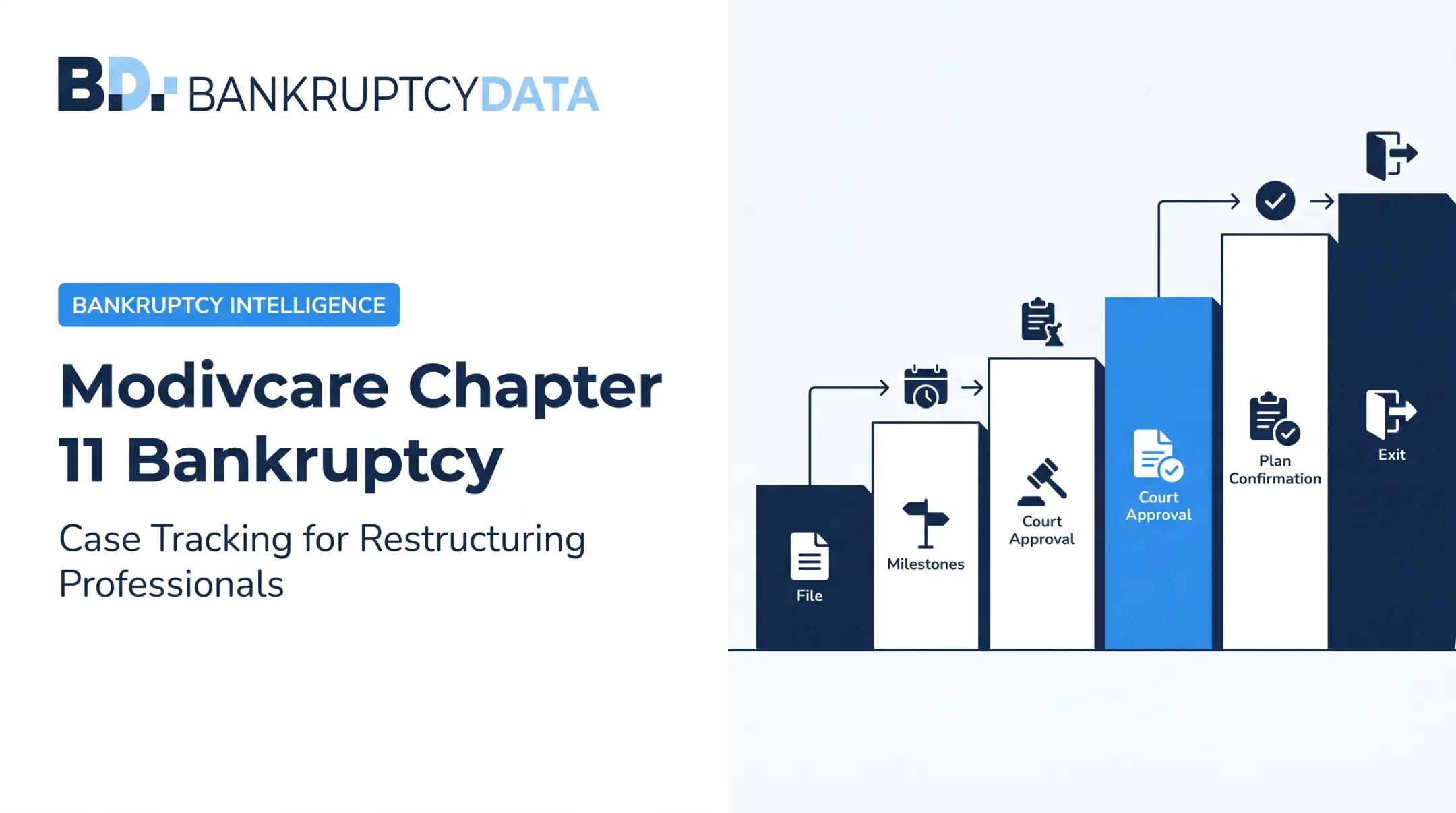
Chapter 11 is a court-supervised process for reorganizing a viable business while claims, contracts, financing, and ownership are resolved. Cano filed in the U.S. Bankruptcy Court for the District of Delaware (Case No. 24-10164).
| Date | Event |
|---|---|
| Feb. 4, 2024 | Petitions and restructuring support agreement filed; holders of about 86% of secured debt and 92% of senior notes supported it |
| Feb. 7, 2024 | Interim DIP order |
| Feb. 21, 2024 | U.S. Trustee appointed the unsecured creditors' committee |
| Mar. 6, 2024 | Final DIP order |
| Apr. 22, 2024 | General bar date |
| June 28, 2024 | Plan confirmed and effective |
DIP financing
The RSA disclosed a $150 million delayed-draw DIP facility: up to $50 million after interim approval and $100 million after final approval. Wilmington Savings Fund Society, FSB served as agent. DIP money funds payroll, suppliers, and clinical operations under court oversight.
Court-approved operational changes
- A motion to reject about 72 medical-center leases was filed February 5, with a docket record dated March 8, 2024
- A second motion covering about 11 contracts and leases was approved April 12
- De minimis asset-sale procedures were approved April 15
A third motion for about 24 contracts was filed April 30. Final approval of that motion is not readily confirmed in public docket records.
How Did Cano Health Emerge and What Changed?
The company announced emergence as a private company on June 28, 2024, reporting that more than $1 billion of prepetition funded debt converted into common stock and warrants. Existing investors committed more than $200 million in new capital.

What the plan itself says
- First lien claims allowed at $468.5 million, receiving 100% of new equity, subject to dilution
- Senior notes claims allowed at $306,406,250
- Warrants for 5% of new equity for unsecured creditors, with a five-year exercise period
- A management incentive plan of 10% of new equity
The plan allowance figures differ from the company's rounded headline of more than $1 billion, so each should be read on its own terms. A single post-emergence debt balance is not readily available from public disclosures, and the full board and ownership roster have not been listed.
A narrower footprint
The reorganized company focuses on Florida, with 80 locations. Earlier filings describe exits from California, New Mexico, Illinois, and Puerto Rico. The $290 million cost-reduction figure remains a management target rather than a confirmed result.
What Does the Bankruptcy Mean for Stakeholders?
Employees and patients
On February 5, 2024, Cano said it was maintaining business-as-usual operations, continuing obligations to affiliated physician groups, and paying wages without interruption. That is the company's statement, not an independent assurance. Court first-day relief covered wages, benefits, and patient privacy.
Patients should check official Cano, payer, and regulatory communications for clinic and provider changes. No case-specific CMS notice or 2024 WARN notice is readily available in the public case record.
Creditors, suppliers, and landlords
- Lease and contract rejections can leave landlords and vendors with unsecured claims
- Bar dates (April 22 general, August 2 governmental) set claim-filing deadlines
- The unsecured creditors' committee included CD Support LLC, Second Wave Delivery Systems LLC, Navina Technologies Ltd., 2380-90 NW 7 Street LLC, and 107 Commercial Property LLC
Industry context
Gibbins Advisors' 2025 report counted 45 Health/Medical Chapter 11 filings in 2025 versus 57 in 2024, for cases with at least $10 million in liabilities.
Bankruptcy does not mean a provider closes immediately. Outcomes depend on financing, operating viability, court orders, payer arrangements, and the plan.
What Should Professionals Monitor in Comparable Healthcare Bankruptcy Cases?
A practical framework
Watch these signals in order:
- Liquidity and going-concern language in 10-K and 10-Q filings
- Debt defaults and covenant issues reported in 8-Ks
- Management changes, market exits, and layoffs
- Asset sales and strategic reviews
- Restructuring support agreements and first-day motions
- DIP financing, committee formation, and bar dates
- Disclosure statements, plan confirmation, and the effective date
Cano's trail shows the pattern: leadership change in June 2023, asset sale in September, going-concern doubt in early 2024, then the filing.

Building a reliable chronology
Build the record from primary sources, not headlines alone:
- Match each news item to an SEC filing, docket entry, plan document, or creditor notice
- Record the date, document type, and status of every development
- Label management projections as projections, then compare them later against realized outcomes
BankruptcyData supports this work for bankruptcy and restructuring professionals. Its platform tracks early distress signals, U.S. filings, first-day motions, court activity, stakeholders, advisors, timelines, and outcomes in one research environment, backed by 600k+ records spanning 45+ years of U.S. bankruptcy activity.
Frequently Asked Questions
When did Cano Health file for bankruptcy?
Cano filed voluntary Chapter 11 petitions on February 4, 2024, in the U.S. Bankruptcy Court for the District of Delaware (Case No. 24-10164).
Why did Cano Health file for Chapter 11?
Filings cite liquidity shortfalls, going-concern doubt, debt defaults, higher medical costs, and lower Medicare risk-adjustment revenue, after pre-filing cuts and asset sales.
Did Cano Health go out of business?
No. It completed a court-supervised reorganization and continues as a private company focused on Florida.
When did Cano Health emerge from bankruptcy?
The plan was confirmed and became effective on June 28, 2024, the date the company announced its emergence.
What happened to Cano Health's debt?
The company reported that over $1 billion of funded debt converted into common stock and warrants. First lien holders received the new equity, subject to dilution.
What does the bankruptcy mean for patients and employees?
Cano said operations and wages continued during the case. Market and facility changes occurred, so check official Cano and payer communications for current local details.