

The Children’s Place
Hand-Me-Downs into Chapter 11
by Howard Wu | Nov 6, 2026, 3:45:11 PM
We’re sure you’ve heard of The Children’s Place before. The Company is the largest pure-play retailer of children’s specialty apparel in North America (514 stores as of August 1, 2026). Its brands include the Children’s Place, Gymboree, Sugar & Jade and PJ Place. It’s a classic brick-and-mortar story exacerbated by falling birth rates and cost inflation. Children’s clothing is a tricky industry. Kids outgrow their clothes in a matter of months and millennial parents are increasingly shopping on Shein and Temu instead. Who wants to spend 15 dollars on a t-shirt that, in one year’s time, will either be too small or not “cool” enough for your child to wear? A shame for the Company that toddlers only have brand loyalty when it comes to candy.
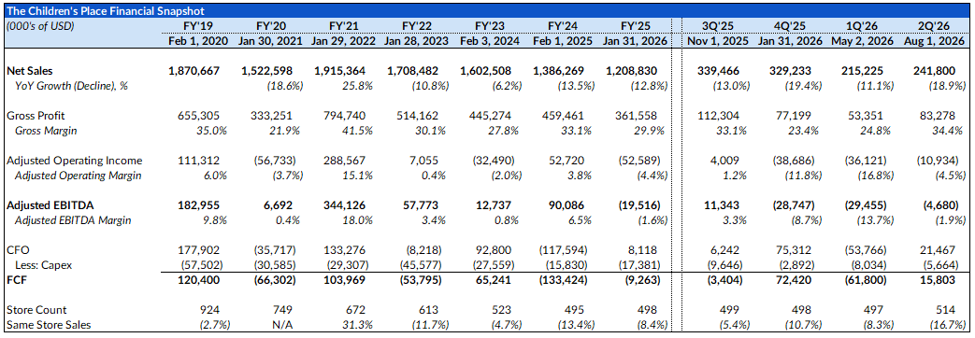
And so, from 2022 to 2025, The Children’s Place has posted annual same-store-sales declines of 11.7%, 4.7%, 13.4%, and 8.4%. By February 2024, the Company had just ~$38mm in total liquidity ($13.6mm in cash and $24.3mm in capacity on their revolver) against $276.7mm of funded debt, consisting of an ABL revolver ($226.7mm drawn) and an ABL term loan ($50mm). The Company needed more liquidity, so they signed a non-binding $130mm term sheet with Gordon Brothers on February 15, 2024. Around the same time, Mithaq Capital, a Riyadh-based investment firm backed by the Al Rajhi family (namesake of one of the world’s largest Islamic bank, Al Rajhi Bank) amassed a 56.1% beneficial ownership in the Company for $97.8mm.
The initial share building might’ve looked hostile but the subsequent engagement actually turned out quite friendly; within a few weeks, Mithaq had extended a $78.6mm term loan split into two tranches (an initial $30mm tranche, and a $48.6mm delayed-draw). It gets better… the loans were interest free, unsecured and subordinated (to an existing ABL facility). A couple of months later in April 2024, Mithaq funded a further $90mm term loan. This time the loan did carry an interest rate (S+400bps) but was still unsecured. This effectively allowed the Company to walk away from the Gordon Brothers term loan that was set to carry a much higher S+900bps interest rate and additional closing and agent fees (the Mithaq loan had none). The Company used the proceeds to repay the $50mm ABL term loan and general corporate purposes.
Alright, so why? Why did this Saudi Arabian family office decide to extend such generous financing and terms to a struggling North American children’s apparel retailer? As Milton Friedman would say, “there’s no such thing as a free lunch.”
Mithaq was an optimist. And as self-described value investors, Mithaq believed they could right-size a struggling retailer through cost cuts and operational changes. In a May 2024 shareholder letter, Turki AlRajhi, Mithaq’s principal and, by then, chairman of The Children’s Place, outlined the plan:
- Debt paydowns along with a rights offering
- Zero-based budgeting cost reductions/efficiencies
- Expansion of the Company’s Alabama distribution center along with higher shipping minimums
- No earnings calls or guidance
Pretty generic stuff. A $90mm rights offering closed in early February 2025 at $9.75/share and Mithaq tendered $60.2mm of its interest-free note (plus $5mm in cash) for ~6.7mm shares, bumping its ownership up to ~62%. The Company raised a total of $29.8mm in cash, with 80% of the proceeds going to prepay the ABL revolver.
That funding carried the business until the end of 2025, which is when the business deteriorated further; customers rejected the higher-priced product lines introduced by Mithaq and cost inflation/tariffs dug into margins. Here’s Mr. AlRajhi in the FY’25 shareholder letter, dated April 10, 2026:
“Our results fell short of what we expect of ourselves. Even so, our teams did the hard, necessary work to strengthen the foundation for better financial performance. While 2025 was a challenging year for most retailers—TCP is no exception—we are not pleased with the results, and we own it.”
And own it they did… Mithaq ponied up an additional $40mm in term loans in mid-to-late 2026 as part of an original commitment agreement signed back in 2024. And that brings us to the present… and if you were to check the till, Mithaq has committed a total of ~$311.5mm into this sinking retailer, consisting of its original $97.8mm position building investment and $213.7mm of new money term loans.
Here’s a recap of what operations have looked like:
And here’s the debt stack:
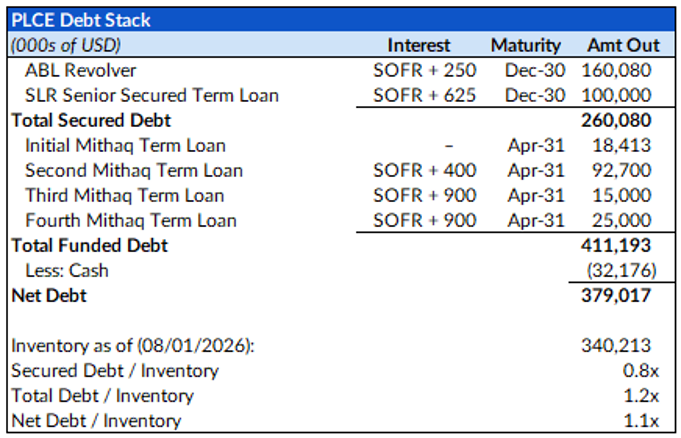
A couple of things to note. The Fourth Mithaq Term Loan was funded on September 24, ten days after the 2Q’26 release. The Company mentioned that it intends to use the proceeds to repay some of the revolver, reduce A/P and fund general corporate uses. For our purposes, we’ve just added it to the 2Q’26 cash number (in reality, a couple of months’ worth of CFO burn likely lowered the number). The SLR Capital Partners, LLC term loan has a first lien on IP and real estate and second liens on everything else after the ABL revolver.
As of 2Q’26, inventory sits at $340mm, plus ~$45mm in receivables. In a liquidation scenario, that should easily cover the ABL revolver and (at the very least) a good portion of the SLR term loan. The good news is, given the imminent filing, any liquidation would run through the holiday season, which is ideal timing for a GOB sale.
Reports indicate that buyers are interested in purchasing at least several stores as a going concern, including Catalyst Brands, which is, reportedly, planning a bid for ~200 stores as well as the brands. Any leftover stores are likely unprofitable and would be liquidated, making the Chapter 11 filing a fun hybrid process. The IP would most likely fetch more when paired with a sale of working stores instead of a standalone sale of the brands, so SLR would stand to benefit more in a combined sale.
Recoveries will also depend on the size of the DIP and who provides it. Any new money from the ABL lenders will sit ahead of SLR’s second liens and erode its coverage. We’re also curious about whether Mithaq participates in the process. If Mithaq decides to bid, we could see a junior DIP from the firm and a subsequent credit bid. After all, a chapter 11 process could be the exact operational and financial restructuring that Mithaq has preached The Children’s Place needed. If Mithaq does put forward a junior DIP, look out for any attempts by Mithaq to roll up its unsecured notes – any unsecured creditors’ committee will fiercely contest that. Or maybe Mithaq avoids the sunk cost fallacy and calls it quits on the two-years long nightmare.