

Leslie’s, Inc.
Judge Pérez Approves Interim DIP Package Providing $45mn of New Money and $225mn ABL Working-Capital Support; Financing Aims to Carry Retailer Through Seasonal Trough and 110-Day Restructuring
by Nick Montgomery | Oct 2, 2026, 11:42:17 AM
October 1, 2026 – Further to an October 1st hearing, Judge Alfredo R. Pérez entered an interim order approving the Debtors’ two-facility debtor-in-possession (“DIP”) financing package, comprising (i) an up to $90.0mn superpriority secured term loan facility, with Alter Domus (US) LLC serving as administrative and collateral agent, and (ii) an up to $225.0mn superpriority secured ABL revolving facility, with Bank of America, N.A. serving as administrative and collateral agent and U.S. Bank National Association serving as co-collateral agent [Docket No. 74].
On an interim basis, the order authorizes immediate access to (i) $45.0mn of new money DIP term loans, funded through Jefferies Capital Services, LLC as fronting lender, and (ii) the up to $225.0mn ABL DIP facility, subject to borrowing-base availability. The remaining $45.0mn of DIP term loans will become available upon entry of a final order and satisfaction of the applicable funding conditions. A final hearing is scheduled for October 27th, with objections due by October 20th.
The interim order also approves the ABL “Creeping Roll Up,” pursuant to which outstanding prepetition ABL bank-product obligations and issued and outstanding letters of credit are deemed exchanged for and issued under the DIP ABL facility, while collections and proceeds of ABL priority collateral are applied, dollar-for-dollar, to reduce prepetition ABL obligations and deemed reborrowed as DIP ABL obligations. Upon entry of a final order granting such relief, all remaining prepetition ABL obligations will be exchanged and converted, on a cashless basis, into DIP ABL obligations.
As approved, the package includes:
- an up to $90.0mn superpriority secured term loan DIP facility, comprising $45.0mn of interim new money loans and an additional $45.0mn of new money loans available upon entry of the final order and satisfaction of the applicable funding conditions; and
- an up to $225.0mn superpriority secured ABL revolving DIP facility, including the interim Creeping Roll Up of prepetition ABL obligations and, subject to entry of the final order, the cashless roll-up of all remaining prepetition ABL obligations.
From the Courtroom (see also our separate first day hearing coverage)
At Thursday’s first-day hearing, John R. Luze of Simpson Thacher, counsel to the Debtors, framed the financing as the bridge to Leslie’s proposed recapitalization, telling Judge Alfredo R. Pérez that the $90.0mn term DIP represents “new money into the company,” with $45.0mn available on an interim basis, while the existing ABL lenders have agreed to roll their borrowing-base facility into Chapter 11 and release reserves imposed ahead of the filing. Luze also corrected the Debtors’ earlier disclosure that approximately $30.0mn was outstanding under the ABL, telling the Court the actual balance is approximately $50.0mn and that the revised DIP order had been updated accordingly.
Presenting the DIP request, Zachary Weiner of Simpson Thacher said Leslie’s is entering the “seasonal low point” for sales and will need working-capital support as it begins buying inventory for the next pool season. He said the Debtors have “no unencumbered assets” available to support a third-party DIP and, after negotiations with their existing lenders, “arrived at the best terms that we could arrive at.” The financing is also integral to the RSA backed by more than 80% of first-lien term debt.
Judge Pérez focused in part on how much additional liquidity the $225.0mn ABL facility could actually provide above the current $50.0mn balance. Weiner said removal of the prepetition reserve would open additional availability and that borrowing capacity could increase as Leslie’s rebuilds inventory, although the company is not yet in its peak inventory season.
The Court also pressed the parties on the 9.5% upfront premium on the term DIP. Benjamin R. Taylor of Akin Gump, appearing for the ad hoc term lender group, clarified that the DIP and related equity financing are open to all term lenders and that the 9.5% premium is earned as each $45.0mn tranche is funded, rather than entirely upon interim approval. Taylor also confirmed there is no separate Jefferies fronting fee. Judge Pérez directed the Debtors to make that treatment clear in the revised order.
The revised order was also required to clean up lender-remedies language and address landlord concerns. Judge Pérez said a provision in paragraph 23 remained inconsistent with changes already made to paragraph 22 and confirmed that a party seeking to exercise remedies following a default must file a motion and obtain a Court order. The Court then approved the DIP on an interim basis, finding that Leslie’s had appropriately secured liquidity to manage the cases and position itself to emerge before the next peak selling season.
DIP Financing Summary
On September 30th, the Debtors filed a motion seeking Court approval of a two-facility debtor-in-possession (“DIP”) financing package providing up to $315.0mn of aggregate commitments and revolving capacity, consisting of (i) up to $90.0mn of new money term loans and (ii) a $225.0mn asset-based revolving facility from the Debtors’ existing ABL lenders that would roll up the prepetition ABL facility and continue providing working-capital liquidity during the Chapter 11 cases [Docket No. 33, with attached DIP Term Loan Credit Agreement and DIP ABL Credit Agreement at Exhibits 1 and 2, respectively].
Specifically, the package includes: (i) an up to $90.0mn senior secured superpriority new money DIP term loan facility, with $45.0mn available upon interim approval and another $45.0mn upon final approval, backstopped by members of the Debtors’ ad hoc group of prepetition term lenders and open to prepetition term lenders for pro rata participation; and (ii) an up to $225.0mn senior secured superpriority ABL DIP revolving facility provided by the Debtors’ existing ABL lenders, which would roll up all outstanding prepetition ABL obligations, preserve access to borrowing-base liquidity and eliminate a $25.0mn restructuring reserve that had constrained availability before the filing.
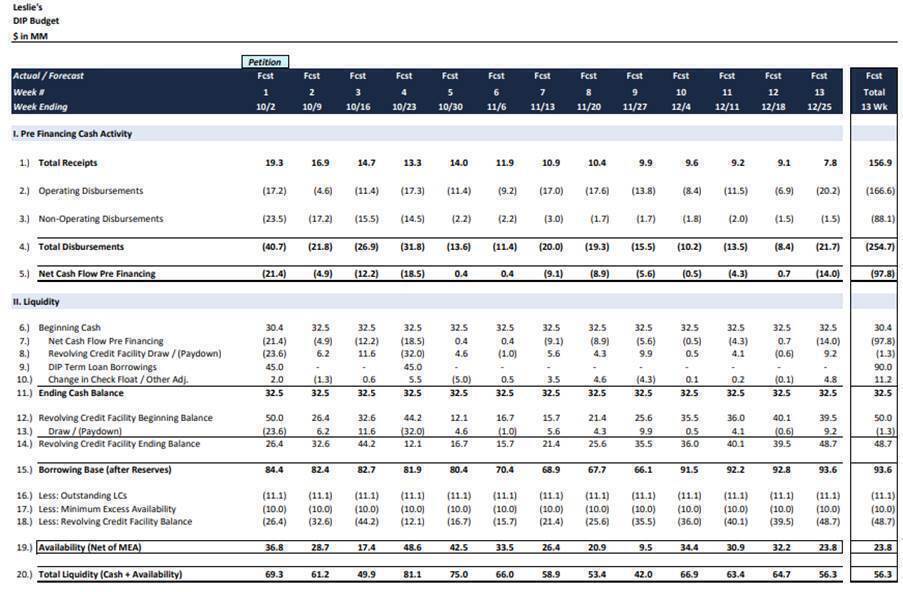
The financing sits at the center of the Debtors’ prearranged restructuring with holders of approximately 81% of their $757.0mn prepetition term loan debt. Leslie’s says the DIP is needed as it enters the low point of its highly seasonal cash cycle: the Debtors project approximately $81.0mn of negative free cash flow during the initial 13-week period, when sales are weakest but inventory purchases ahead of the next pool season accelerate, and say they entered Chapter 11 with considerably less than the $30.0mn to $40.0mn of minimum cash management believes is necessary to maintain vendor relationships and absorb contingencies.
The proposed DIP package provides Leslie’s with up to $315.0mn across two facilities, but the financing serves two distinct functions. The Debtors are seeking $90.0mn of new money term financing to bridge the business through Chapter 11, while a separate $225.0mn ABL revolver from Leslie’s existing ABL lender group would preserve the borrowing-base financing that historically funds the company’s seasonal working-capital requirements and roll the prepetition ABL obligations into the postpetition facility.
The financing follows a multiyear deterioration in Leslie’s operating performance that left the pool and spa retailer carrying approximately $787.0mn of funded debt at filing, including $757.0mn under its prepetition term loan. After pandemic-era demand receded, the Debtors faced weaker discretionary spending, inflation, adverse weather and increased competition, with EBITDA falling from approximately $270.0mn in Q3 2021 to $40.0mn in Q1 2026. The Chapter 11 cases are being pursued under an RSA supported by holders of approximately 81% of the prepetition term loans and are designed to eliminate more than $685.0mn of funded debt.
The liquidity need is intensified by Leslie’s seasonal model. The cases commenced after the primary summer selling season and as the company begins building inventory for the following year; management projects approximately $81.0mn of negative free cash flow during the initial 13-week DIP budget period. Leslie’s says it requires approximately $30.0mn to $40.0mn of minimum cash to maintain vendor relationships and protect against contingencies and had considerably less than that immediately before filing.
First, the Debtors obtained commitments for an up to $90.0mn senior secured superpriority DIP term loan facility, with $45.0mn available upon interim approval and an additional $45.0mn upon final approval. Members of the ad hoc group of prepetition term lenders are backstopping the facility, with participation offered pro rata to the broader prepetition term lender group; Jefferies Capital Services, LLC will initially act as fronting lender and Alter Domus (US) LLC serves as administrative and collateral agent. The facility bears interest at adjusted SOFR + 6.50%, payable in kind, with a 2.00% default-rate premium.
The term DIP carries a 7.0% backstop premium on commitments and a 9.5% upfront premium on funded term loans, each payable in additional DIP loans, as well as a $40k annual agent fee. The 9.5% premium is earned separately as each $45.0mn tranche is funded. At emergence, $75.0mn of the DIP term loans is contemplated to convert into exit term debt and $15.0mn into reorganized equity, while premium loans and certain other DIP term claims also feed into the post-emergence equity structure. The same lender group is supporting a separate $60.0mn exit equity financing.
Second, the Debtors obtained approval on an interim basis for an up to $225.0mn senior secured superpriority ABL DIP revolving facility from their existing ABL lenders, with Bank of America, N.A. serving as administrative agent and co-collateral agent and U.S. Bank National Association as co-collateral agent. The facility is not a $225.0mn new money term-style injection: it continues the Debtors’ existing asset-based working-capital structure, subject to the borrowing base, while rolling prepetition ABL obligations into the DIP facility. The Creeping Roll Up became effective upon entry of the interim order, with the cashless roll-up of all remaining prepetition ABL obligations subject to final approval. 501172-74-1-178155237629
The ABL lenders also agreed to remove a $25.0mn restructuring reserve imposed in July 2026 that had reduced Leslie’s borrowing availability as its liquidity position deteriorated. The DIP preserves the prepetition borrowing-base formula and bears interest at Term SOFR + 3.25% or Base Rate + 2.25%, 25 basis points above the prepetition pricing. It carries a 0.50% upfront fee, $250k arrangement fee, $100k annual administration fee and 0.30% unused-commitment fee, together with customary agency and letter-of-credit fees.
The lender package followed an unsuccessful search for alternatives. Centerview contacted 29 prospective third-party lenders and investors during the prepetition process, with 20 executing NDAs, but the Debtors concluded the out-of-court proposals received did not provide a viable path to refinancing the term loans. Centerview subsequently approached parties from that process about a potential DIP; none expressed interest and no competing DIP proposal was received. The Debtors attribute the lack of alternatives in part to the absence of material unencumbered assets and a capital structure they characterize as already undersecured.
The facilities are tied to the RSA timetable, requiring the Debtors to file a Plan and Disclosure Statement within 20 days, obtain Disclosure Statement approval within 55 days and confirmation within 100 days, with Plan effectiveness and emergence targeted no later than 110 days after the Petition date.
Key Terms of Leslie’s DIP Term Loan Facility
- Borrower: Leslie’s Poolmart, Inc.
- Guarantors: Leslie’s, Inc., RAM Chemical & Supply, Inc., LPM Manufacturing, Inc., Horizon Spa & Pool Parts, Inc., Cortz, Inc., Stellar Manufacturing, LLC, Pool Parts, Inc., SPP Holding Corporation, and Hot Tub Works, LLC.
- DIP Agent: Alter Domus (US) LLC, as administrative agent and collateral agent.
- DIP Lenders: Jefferies Capital Services, LLC (Fronting Lender) and participating term lenders.
- DIP Commitment: Senior secured superpriority DIP term loan facility of up to $90.0mn, comprising $45.0mn upon interim approval and $45.0mn upon final approval.
- Interest Rate: SOFR + 6.50%, payable in kind.
- Roll-up: None
- Default interest rate: 2.00% per annum above otherwise applicable rate.
- Fees:
- Backstop Fee: 7.0% of DIP commitments held by backstop lenders.
- Upfront Fee: 9.5% of DIP Term Loans actually funded, payable in DIP loans.
- Agent Fee: $40k annually.
- Use of Proceeds: The Borrower will only use the proceeds of the DIP Term Loans, subject to the Orders and the Carve Out: (i) for working capital and other general corporate purposes of the Debtors including for the payment of Debtor professional fees incurred in the Chapter 11 Cases consistent with the terms of the Restructuring Support Agreement, (ii) for the payment of the fees, costs and expenses of administering the Chapter 11 Cases, (iii) to pay obligations arising from or related to the Carve Out, (iv) to make payments on account of prepetition claims to the extent permitted by, and as set forth in, the Approved Budget (subject to Permitted Variances) or otherwise approved by the Bankruptcy Court, (v) for the payment of agency fees and the reasonable and documented fees and expenses of the Agents and the DIP Lenders owed under the Loan Documents, (vi) to make payments with respect to the Adequate Protection Obligations pursuant to the terms of the Orders, (vii) to pay Professional Fees to the extent allowed by the Bankruptcy Court and (viii) for any other purposes specifically set forth in the Approved Budget.
- Maturity/Term: Earliest of 6 months after closing, plan effective date, acceleration, or case dismissal/conversion.
- Milestones: The following milestones apply to the Restructuring Transactions:
- no later than three (3) days after the Petition Date, the Debtors shall have delivered the Subscription Procedures and Subscription Form to all Prepetition Term Loan Lenders;
- On October 1, 2026 court entered interim DIP order.
- no later than five (5) Business Days after the Agreement Effective Date, the Transformation Committee shall have been established and shall have held its initial organizational meeting;
- no later than seven (7) Business Days after the Petition Date, the Debtors shall have filed the Omnibus Lease Rejection Motion (as defined below);
- no later than twenty (20) days after the Petition Date, the Debtors shall have filed the Plan and Disclosure Statement;
- October 27, 2026, the Final DIP Order;
- no later than fifty-five (55) days after the Petition Date, the Bankruptcy Court shall have entered the order approving the Disclosure Statement;
- no later than one hundred (100) days after the Petition Date, the Bankruptcy Court shall have entered the order confirming the Plan; and
- no later than one hundred and ten (110) days after the Petition Date, the Restructuring Effective Date shall have occurred
Key Terms of Leslie’s DIP ABL Facility
- Borrowers: Leslie’s Poolmart, Inc., Cortz, Inc., and LPM Manufacturing, Inc.
- Guarantors: Leslie’s, Inc., RAM Chemical & Supply, Inc., Horizon Spa & Pool Parts, Inc., Stellar Manufacturing, LLC, Pool Parts, Inc., SPP Holding Corporation, and Hot Tub Works, LLC.
- DIP Agent: Bank of America, N.A., as administrative agent and co-collateral agent; and U.S. Bank National Association, as co-collateral agent.
- DIP Commitment: Senior secured superpriority ABL revolving facility of up to $225.0mn.
- Roll-Up: Includes a creeping roll-up of prepetition ABL obligations during the interim period and a full roll-up upon final approval.
- Interest Rate: Term SOFR + 3.25% or Base Rate + 2.25%.
- Default Interest Rate: is 2.00% per annum on above the otherwise applicable rate.
- Fees:
- Upfront Fee: 0.50% of commitments.
- Arrangement Fee: $250k.
- Annual Administration Fee: $100k.
- Unused Commitment Fee: 0.30%.
- Customary letter-of-credit, fronting and other agency fees.
- Use of Proceeds: Use the proceeds of the Revolving Credit Loans, Swing Line Loans and the Letters of Credit solely to fund the Chapter 11 Cases in accordance with the Approved Budget, subject to Permitted Variances, on an aggregate basis and for the financing of the Parent Borrower’s and its Subsidiaries’ ordinary working capital, letters of credit and other general corporate needs including certain fees and expenses of professionals retained by the Loan Parties, subject to the Carve-Out, and for certain other Pre-Petition and pre-filing expenses that are approved by the Court and in accordance with the Approved Budget, subject to Permitted Variances.
- Maturity/Term: Earliest of 6 months after closing (subject to extensions), DIP maturity, plan effective date, section 363 sale, or acceleration.
- Milestones: Achieve each of the following milestones (as any such milestone may be extended with the consent of the DIP ABL Agent (in its sole and absolute discretion) for a period of not more than five (5) days or for such longer period with the consent of the DIP ABL Agent (in its sole and absolute discretion), in each case on terms and conditions, and subject to documentation (including, in all cases, forms of all applicable orders) in form and substance, reasonably acceptable to the DIP ABL Agent in all respects.
- On the Petition Date, the Debtors shall file a motion seeking approval of the credit facilities evidenced by the DIP ABL Credit Agreement and the DIP Term Loan Agreement.
- On October 1, 2026 court entered interim DIP order.
- On or before two (2) days after entry of the Interim Order, $45 million shall have been funded by the DIP Term Loan Lenders to the Debtors’ operating account.
- On or before seven (7) days after the Petition Date, the Debtors shall have filed the Omnibus Lease Rejection Motion.
- On or before ten (10) days after the Petition Date, the Debtors shall have filed a motion requesting, and within 35 days after the Petition Date shall have obtained, an order of the Bankruptcy Court extending the lease assumption/rejection period such that the lease assumption/rejection period shall be 210 days.
- On or before thirty-five (35) days after the Petition Date, the Final Order authorizing and approving the facilities evidenced by the DIP ABL Agreement and the DIP Term Loan Agreement on a final basis shall have been entered by the Bankruptcy Court.
- On or before two (2) days after entry of the Final Order, an additional $45 million shall have been funded by the DIP Term Loan Lenders to the Debtors’ operating account.
- On or before twenty (20) days after the Petition Date, the Debtors shall have filed a Chapter 11 plan of reorganization and a disclosure statement
- On or before fifty-five (55) days after the Petition Date, the Debtors shall have obtained an order from the Bankruptcy Court approving the disclosure statement and voting and solicitation procedures for an Acceptable Plan, in form and substance reasonably acceptable to the DIP ABL Agent.
- On or before one hundred (100) days after the Petition Date, the Debtors shall have obtained an order from the Bankruptcy Court confirming an Acceptable Plan, in form and substance reasonably acceptable to the DIP ABL Agent.
- On or before one-hundred-ten (110) days after the Petition Date, the effective date of the Acceptable Plan shall have occurred in accordance with its terms, and the Debtors shall have emerged from the Chapter 11 Cases.
From the Filings
The motion [Docket No. 33] states: “The Debtors are the largest direct-to-consumer brand in the United States pool and spa care industry, serving residential, professional, and commercial customers nationwide. Founded in 1963 as a single retail store in North Hollywood, California, the Debtors have grown into an integrated, nationwide organization comprising more than 900 retail locations, a robust digital platform, and an in-field service network of over 200 pool and spa care professionals providing essential, on-site equipment installation and repair services throughout the United States. The Debtors are headquartered in Phoenix, Arizona and employ more than 3,500 team members. The Debtors commenced these chapter 11 cases to recapitalize their balance sheet, optimize their store footprint, and position themselves for sustainable, long-term growth.
Despite the Debtors’ market-leading position, they have faced significant financial headwinds over the past several years. Beginning in 2023, the U.S. pool and spa care industry experienced a pronounced contraction driven by several macroeconomic and industry-specific factors, including: (i) a normalization of demand following the elevated spending levels observed during the COVID-19 pandemic, when consumers made significant investments in home improvement and outdoor living; (ii) persistent inflationary pressures on input costs, including chemicals, energy, and transportation; (iii) a contraction in consumer discretionary spending as interest rates rose and household budgets tightened; (iv) unfavorable weather patterns in key markets that shortened pool seasons and suppressed demand for maintenance chemicals; and (v) increased competition from big box and online marketplace retailers. As a result, the Debtors experienced deterioration in profitability, including significant net losses in fiscal years 2024 and 2025. The revenue decline, coupled with a highly leveraged capital structure, placed substantial strain on the Debtors’ liquidity position and their ability to service their funded debt obligations.
Over the past several months, the Debtors, along with their advisors Centerview Partners, Simpson Thacher & Bartlett LLP and BRG, LLP, engaged in prepetition marketing efforts with 29 prospective third-party lenders and investors to address the Debtors’ liquidity challenges and long-term capital structure issues. However, given the Debtors’ significant financial leverage, large interest burden, and overall financial performance, the Debtors were unable to obtain any actionable out-of-court financing.
As it became clear that an out-of-court transaction was unlikely, the Debtors pivoted to seeking financing in the form of a DIP financing from its existing stakeholders. Although the Debtors conducted a third-party financing process in parallel to the discussions with the existing stakeholders, they were unable to generate any such interest as a third-party post-petition financing facility would effectively be ‘junior’ financing in an already under-secured capital structure. As time progressed and the Company’s financial performance continued to face significant headwinds, it became clear that the optimal path forward was a holistic restructuring transaction, implemented through an in-court process.
To that end, the Debtors commence these chapter 11 cases having entered into a Restructuring Support Agreement (as defined herein) with the holders of approximately 81.1% of their outstanding first lien funded debt obligations, pursuant to which the lenders pledged their support for a plan of reorganization that reduces the Debtors’ funded indebtedness by more than $685 million, provides for $90 million in new money DIP financing to fund the Company during these chapter 11 cases, and provides for a new $60 million equity investment backstopped by certain of the lenders party to the Restructuring Support Agreement. Debtors’ prepetition ABL lenders have also agreed to roll over the Company’s existing ABL facility into a DIP ABL facility to fund the Debtors’ operations through the chapter 11 cases. The DIP Facilities are the product of an arm’s-length, good faith negotiation process, representing the best currently available post-petition financing option for the Debtors with reasonable terms and conditions under the circumstances.
Critically, the DIP Facilities will allow the Debtors to gain immediate access to liquidity to (i) continue operating in the ordinary course and maintain minimum cash requirements as discussed below, (ii) effectuate the agreed restructuring transactions set out in the Restructuring Support Agreement, and (iii) support the administration of these Chapter 11 Cases. The DIP Facilities are pivotal to the Debtors’ successful reorganization and continued operations.”
The Debtors’ Prepetition Marketing Efforts
The declaration of
In parallel with negotiations with the Prepetition Term Loan Lenders, Centerview conducted a third-party financing process to raise capital to support the Debtors’ growth initiatives and position the business for a future refinancing. Centerview contacted 29 prospective third-party lenders and investors to evaluate a potential investment in the Debtors. 20 parties executed nondisclosure agreements and received access to confidential information, including a long-term business plan, cash flow projections and detailed information on the Debtors’ business and assets. Initial discussions with these lenders focused on potential out-of-court financing solutions.
While several potential lenders submitted indications of interest to provide out-ofcourt financing, the Debtors determined these financings were not actionable given those proposals did not provide a viable path to refinancing the Prepetition Term Loans by its maturity due to the Company’s underperformance.
As it became clear that an out-of-court transaction was less and less likely, the Debtors, with the support of Centerview and the Debtors’ other professionals, began engaging with existing Prepetition Term Loan Lenders and Prepetition ABL Lenders on a comprehensive restructuring and DIP Financings. Both the Ad Hoc Group and the Prepetition ABL Lenders agreed to support the Debtors through their restructuring process by agreeing to provide DIP Financings. Members of the Ad Hoc Group has agreed to backstop a $90 million DIP Term Loan Facility to fund the Debtors through these Chapter 11 Cases and a $60 million equity rights financing to provide additional liquidity upon the consummation of the restructuring. The Prepetition ABL Lenders have also agreed to roll over the Company’s existing ABL facility into a $225 million DIP ABL Facility to fund the Debtors’ operations through these Chapter 11 cases, which will provide critical working capital support to the business through the restructuring process.
Centerview also contacted third parties that had participated in its out-of-court financing process about providing a DIP, focusing on lenders with experience providing debtorin-possession financing who had previously conducted due diligence on the Company. None were interested in providing a DIP and no proposals were received. The Debtors have no material unencumbered assets, and absent the Prepetition Secured Parties’ consent to priming liens, a thirdparty DIP would have been junior to an already undersecured capital structure.
The terms of the DIP Facilities were extensively negotiated with the Ad Hoc Group and the Prepetition ABL Lenders. In those negotiations, the Debtors were able to achieve several improvements to the proposal, including, but not limited to, additional funding, greater operating flexibility, less cash pay interest expense, and the removal of the restructuring reserve from the DIP ABL Facility. In addition, my understanding is that the DIP Term Loan Facility is open to all Prepetition Term Loan Lenders to participate in the DIP financing opportunity on a pro rata basis.
After exchanging multiple proposals, and after extensive good faith arm’s length negotiations, the Ad Hoc Group and the Prepetition ABL Lenders both agreed to provide the DIP Facilities. Given the Debtors’ risk profile, it is my understanding that the Ad Hoc Group and the Prepetition ABL Lenders were only willing to provide financing on the terms set forth in the DIP Documents.”
Initial Approved Budget (See Exhibit 5 of Docket No. 33)
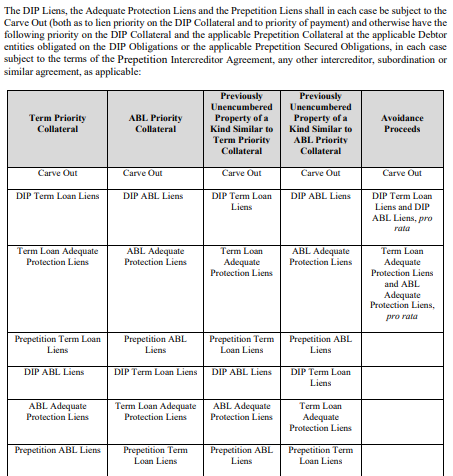
DIP Lien Priorities Chart [see Exhibit 3 of Docket No. 33]
Case Status
The White Declaration [Docket No. 5] provides that the Debtors entered Chapter 11 seeking “a substantial de-leveraging of the Debtors’ balance sheet and the attendant reduction of annual interest expense,” optimization of costs and the store footprint, new capital for working capital and operations and implementation of potential growth initiatives. The RSA provides for a reduction of more than $685.0mn of funded debt and a new $60.0mn equity investment backstopped by certain consenting term lenders, while Leslie’s continues to analyze its lease portfolio.
The proposed restructuring would give holders of prepetition term-loan claims a pro rata share of 10% of new common equity, subject to MIP dilution, while general unsecured creditors would share a $500k cash pool and existing equity would be cancelled for no consideration. DIP term-loan claims are also part of the exit capitalization: $75.0mn would convert dollar-for-dollar into a new term loan, with remaining DIP term claims, including premium loans, converting into new equity.
The Debtors say timing is driven in part by the seasonality of the business. Most sales occur from late spring through early fall, making the beginning of the calendar year the principal inventory-purchasing period. The RSA therefore requires Plan effectiveness no later than 110 days after the Petition date.
Events Leading to the Chapter 11 Filing
In a declaration in support of first day filings (the “White Declaration”) [Docket No. 5], Jeff White, the Debtors’ chief financial officer and treasurer, traces Leslie’s financial deterioration to a sharp post-pandemic correction in pool and spa demand beginning in 2023. Demand normalization coincided with inflation in chemicals, energy and transportation, higher interest rates, weakening consumer purchasing power, reduced housing activity, adverse weather and more aggressive price competition from mass-market and online retailers. The cumulative impact drove EBITDA from approximately $270.0mn in Q3 2021 to $40.0mn in Q1 2026 and produced significant losses and negative free cash flow in fiscal 2024 and 2025.
Leslie’s began a broader operational response in October 2024, cutting corporate headcount, closing underperforming stores, renegotiating vendor contracts, reducing capital expenditures and tightening inventory management. Management committed in November 2025 to close approximately 80 stores and one distribution center, substantially completing the program by January 2026. Leslie’s had meanwhile retained Centerview and BRG and, around August 2025, opened negotiations with an ad hoc term-lender group over a potential maturity extension and new money financing. A third-party financing process ran in parallel during late 2025 and early 2026, but continued operating weakness ultimately caused the lender group to withdraw support for a standalone extension. The parties instead negotiated the in-court restructuring embodied in the September 30th RSA.
Drilling down, White provides: “Following a period of unprecedented demand during the COVID-19 pandemic—driven by increased consumer investment in home improvement and outdoor living amenities, new pool installations, and concerns about product availability … the industry experienced a sharp correction beginning in 2023 as pandemic-era demand normalized and macroeconomic conditions deteriorated…. General economic conditions, including high interest rates, high inflation, uncertain tariffs, declining consumer purchasing power, and consumer confidence have limited the demand for swimming pool and spa related products and services…. many customers generally opted for repairs and not replacements of their products, undercutting potential new sales to the Company’s existing customer base.
Unfavorable weather in key pool markets during fiscal years 2024 and 2025 … shortened pool seasons and suppressed chemical usage…. Heightened competition from mass-market retailers, online marketplaces and regional operators placed pressure on the Debtors’ pricing and market share…. big box and online marketplace retailers have been particularly aggressive on pricing, undercutting the Debtors’ ability to compete. These headwinds had a cumulative and severe impact on the Debtors’ financial performance. The Debtors’ EBITDA declined from a peak of approximately $270 million in Q3 2021 to $40 million in Q1 2026. The Debtors reported significant net losses and negative free cash flow in fiscal years 2024 and 2025.
Working together with counsel, on or around August 2025 the Company and the advisors began engaging with certain holders of the Prepetition Term Loan Lenders … to discuss possible alternatives. Initially, the discussions focused on an out-of-court maturity extension transaction as well as raising new money to capitalize the business and fund growth operations…. As time progressed and the Company’s financial performance continued to face significant headwinds, the Ad Hoc Group was no longer willing to proceed with a standalone maturity extension. It became clear that the optimal path forward was a holistic restructuring transaction, implemented through an in-court process.”
Prepetition Indebtedness
As of the Petition date, the Debtors had approximately $787.0mn in aggregate outstanding principal amount of funded indebtedness, consisting of approximately $30.0mn under the Prepetition ABL Facility and approximately $757.0mn under the Prepetition Term Loan Facility.
- Prepetition ABL Facility. Leslie’s Poolmart, Inc., Cortz, Inc. and LPM Manufacturing, Inc. are borrowers under an October 2012 $250.0mn asset-based revolving credit facility, with Bank of America, N.A. serving as administrative agent and co-collateral agent and U.S. Bank National Association serving as co-collateral agent. The facility matures April 3, 2029, subject to a springing maturity of December 9, 2027 if the term loan has not been extended or repaid. As of the Petition date, approximately $30.0mn was outstanding.
- Prepetition Term Loan Facility. Leslie’s Poolmart is borrower under a March 2021 $810.0mn secured term loan facility, with Alter Domus (US) LLC serving as administrative and collateral agent. The facility matures March 9, 2028 and bears interest at Adjusted Term SOFR plus 2.75% for Term SOFR loans or 1.75% for ABR loans. Approximately $757.0mn of principal was outstanding as of the Petition date.
Under the parties’ intercreditor arrangements, the ABL lenders have first-priority liens on inventory, accounts receivable, deposit accounts, cash, credit-card receivables and related proceeds, while the term lenders have priority over the Debtors’ remaining common collateral.
The Debtors’ list of 30 largest unsecured creditors includes unsecured claims totaling approximately $39.9mn.
About the Debtors According to the Debtors, Leslie’s was founded in 1963 and serves residential customers and pool professionals in the U.S. pool and spa aftermarket through an integrated network of more than 900 physical locations and a digital platform. Its product assortment includes essential pool and spa care products, supported by associates, pool and spa care specialists and service technicians.