FROM THE COURTROOM: First Brands Group, LLC
Judge Lopez Denies Confirmation of FBG Debtors' Plan, Will Enter Case Conversion Order by August 28th
by Caroline Salls | Aug 24, 2026, 6:41:19 PM
August 24, 2026 – Judge Christopher Lopez said in delivering a bench ruling on Monday that he could not confirm the First Brands Group Debtors’ liquidation Plan and that he intends to enter an order by August 28th converting their Chapter 11 cases converted to Chapter 7, finding that the proposed sale of estate litigation claims could not be approved, the Plan was not feasible and no reasonable prospect remained for rehabilitation after, among other factors, the Debtors exhausted substantially all of a roughly $1.0bn DIP facility. Judge Lopez subsequently entered a one-page order formally denying confirmation [Docket No. 3710], incorporating by reference the reasons set out in his bench ruling rather than issuing a separate written opinion. That bench ruling effectively serves as the Court’s opinion: Lopez began by telling the more than 300 parties listening that he had “26 single-spaced pages to read,” before working through his findings and legal analysis on the Plan, which he succinctly summed up:
“This time, there is no doubt that there is cause to convert, and it is in the best interest of the creditors and estate,” Lopez said, citing continuing diminution of the estates and the absence of a reasonable likelihood of rehabilitation. “There was a billion dollar DIP that is basically gone,” he noted.
Lopez also directed the Debtors to submit a proposed conversion order by Wednesday at 5:00 p.m. CT.
Conversion Order Summary
Judge Christopher Lopez has formally denied confirmation of First Brands Group’s Chapter 11 Plan, entering a one-page order that relies on a lengthy bench ruling in which he found the proposed liquidation not feasible and concluded that the Debtors have run out of reasons to remain in Chapter 11.
At the heart of the ruling is the Plan’s reliance on future litigation to pay administrative and priority creditors. First Brands expected to pursue claims associated with roughly $25.0bn of transfers and needed to recover approximately $1.9bn to $2.0bn before administrative creditors could be paid in full, potentially pushing the Plan’s Effective Date into late 2028. Lopez found that recovery case too uncertain. At the same time, confirmation itself would immediately transfer assets to trusts, terminate management, impose releases and lock in other transactions that could not later be unwound. “This plan crosses essentially the point of no return at confirmation,” Lopez said.
Lopez also rejected the proposed sale of the estate’s litigation claims to the DIP lenders. The lenders could credit bid only against assets on which they actually held liens, he ruled—not avoidance actions where their liens attached only to eventual proceeds. He separately found that the claims had not been adequately marketed, particularly given the late disclosure of information supporting the Debtors’ multibillion-dollar transfer analysis.
Two additional defects independently prevented confirmation. DIP roll-up claims could not be used as the necessary impaired voting class for Viceroy and FBG Holdings because they are administrative claims rather than ordinary Plan claims, and Lopez refused to approve a Preference Settlement that could allow a creditor to opt in and later be thrown out based on alleged “adverse conduct” unrelated to its preference exposure.
That left conversion. “There was a billion dollar DIP and it’s basically gone,” Lopez said. First Brands now has no operating business, hundreds of millions of dollars of unpaid administrative expenses, continuing professional fees, no new committed financing and no Plan that can be fixed without substantially rerunning the litigation-asset sale process. “There is no doubt that there is cause to convert,” he concluded.
The ruling also ends the Debtors’ second effort at coming up with a novel Plan construct to push the debtors over the confirmation line.. Lopez stopped an earlier Premier Marketing-only Plan at the Disclosure Statement stage in May because a single Debtor was being used to implement a settlement affecting creditors and assets across the broader First Brands enterprise, while only Premier creditors would vote. With that effort rejected, the Debtors responded with the current Joint Plan which got intense Court scrutiny across a three day hearing after Judge Lopez brushed aside a conversion request noting that the revised Plan still had “a possibility of confirmation.” After a full confirmation trial, he has now concluded that it does not.
From the Courtroom
After telling the more than 300 parties listening in to the bench ruling that he would not confirm the Plan, Judge Lopez directed the Debtors to submit a proposed conversion order and said he intends to enter the order by Friday, August 28th. Judge Lopez found that the current Plan could not simply be “tweaked to provide a viable path,” with no new evidence of available financing and the DIP lenders retaining their rights under the existing DIP order.
The ruling ends, absent further proceedings, an attempted liquidation architecture constructed around settlements among the FBG Debtors, an ad hoc group of DIP lenders and the creditors’ committee. The Plan would have transferred nearly all remaining estate value into trusts on the confirmation date or “as soon as reasonably thereafter,” funded a litigation trust with $75.0mn and relied on future litigation recoveries to generate enough cash to satisfy administrative expense and priority claims. Those creditors were not projected to be paid in full until the trust generated approximately $1.9bn, however, while some of the litigation expected to finance those payments has not yet been filed. Lopez concluded that the mismatch between immediate, largely irreversible Plan transactions and contingent recoveries stretching potentially into late 2028 was fatal to feasibility.
“A great deal happens” on the confirmation date, Lopez said, noting that assets would leave the Debtors, trustees would assume their management and the Plan would become binding, while payment in full of priority claims was “the one primary thing held back” until sufficient cash could be generated.
“All of that is irreversible if I sign the confirmation order,” Lopez said. “It appears that the confirmation date is the true effective date,” because so much of the restructuring would become locked in at that point. Even accepting the Debtors’ proposed structure, he added, “I still don’t think the plan is feasible.”
The record did not contain a detailed collectability analysis for the litigation claims or an analysis of potential setoff rights and other defenses that defendants could assert. Lopez contrasted the record with the Steward Health Care cases, where he permitted a three-year runway because omnibus claim objections were already pending, the Court could evaluate the claims pool on a prima facie basis and witnesses had independently investigated specifically identified claims. First Brands has not even established a bar date.
“First Brands is a much different case than Steward,” Lopez said. Although he credited testimony from litigation trustee candidate Marc Kirschner as reflecting what Kirschner genuinely believed, including his views concerning potential Ponzi-scheme presumptions, Lopez said the First Brands record did not provide the same ability to evaluate individual causes of action and their likelihood of recovery. In Steward, the Court also retained oversight through periodic post-confirmation check-ins. Here, Lopez said, that was not possible because the decisive transactions occur on the confirmation date itself, which he called “essentially the point of no return.”
A separate defect arose from the proposed disposition and financing of estate causes of action, Lopez said. The Plan contemplated a waterfall for DIP A and roll-up claims, fixing roll-up claims at approximately $3.3bn and capping DIP A claims at what Judge Lopez described as “a little over a billion.” Preference-settlement electors would receive different treatment from other general unsecured creditors, while other constituencies would ultimately share pro rata in specified waterfall proceeds.
Lopez rejected the proposition that the DIP lenders could use their secured claims to credit bid for estate assets outside their collateral. Although the DIP lenders have liens on certain avoidance-action proceeds, he distinguished those liens from ownership of the underlying causes of action. “The DIP lenders cannot credit bid on assets that are not their collateral,” Lopez said. “Avoidance actions are not part of the DIP lenders’ liens,” nor are assets belonging to special-purpose-vehicle Debtors, with the judge stating that the Debtors “Can’t move what they don’t own.” The proposed transaction included a stated $75.0mn bid, but Lopez found that only part of that consideration operated as a genuine credit bid. Approximately $25.0mn consisted of restricted cash held by the Debtors under the original DIP arrangements and subject to asserted setoff rights, while the remaining structure could not transform unencumbered estate claims into collateral against which secured debt could be bid.
The Court also called into question the marketing process for the litigation assets. The estates potentially hold claims associated with approximately $25.0bn of transfers, according to testimony from the Alvarez & Marsal team working on the case, yet Lopez said the proposed transaction could effectively dispose of claims potentially worth billions for approximately $25.0mn without sufficient evidence establishing their value. The issue, Judge Lopez said, was ultimately “a sale versus settlement issue.” He found that the transaction had been pursued in good faith but said, “I just can’t approve it,” and declined to grant section 363(m) good-faith protection.
The record supported a finding that the parties emerging from mediation were “trying to put forward the very best option” available to them, Lopez said, but it did not establish “that the market had a real chance to buy these assets or the litigation funding option.” Supporting documents were not placed in the data room until two days after the bid deadline, and the evidentiary record lacked a market-based comparison of competing litigation-finance terms. “The evidentiary basis for a multi-billion dollar valuation on the same day is not enough” to permit meaningful review, Judge Lopez said. Although no third party ultimately submitted a competing bid after receiving the additional information, he noted that did not resolve the issue.
Lopez acknowledged the commercial rationale advanced by the DIP lenders, whose DIP A loans were trading at depressed levels and who had provided approximately $1.0bn of new money while making concessions in the mediated settlement. “I completely understand that DIP lenders who put in a billion in new money … and at the same time agreed to concessions” would seek the exclusive right to provide litigation financing, he said. “But, that argument cuts both ways.” “For these reasons, I find that the estate claims marketing process didn’t work,” Lopez concluded.
The Court separately found voting defects involving Viceroy and FBG Holdings and said their votes did not satisfy the statutory requirements necessary for confirmation. Lopez repeatedly emphasized that the Plan was proposed only by the FBG Debtors and “is not a plan for the First Brands Debtors who are special purpose vehicles,” a distinction that became significant in determining what property could be transferred or subjected to the proposed credit bid.
Despite denying confirmation of the Plan and ordering conversion of the cases, Judge Lopez nevertheless overruled several objections directed at the Disclosure Statement and the mediated settlement process. The U.S. Trustee and other parties argued that materially different projected distribution timelines rendered the Disclosure Statement inadequate, but Lopez found that it “satisfies the standard here.” The Debtors provided an illustrative waterfall showing when creditors might receive distributions, he said, and could not be required to provide certainty concerning litigation proceeds that had not yet been recovered.
He similarly rejected challenges to language allowing the future trustee flexibility to adjust the preference settlement’s modified-new-value methodology. “That’s what it says. That’s the deal … and the text, as I read it, answers the question,” Judge Lopez said. “[Aside from the U.S. Trustee, these] parties have been fully involved in the plan confirmation fight,” and understood the arrangement they were being asked to evaluate.
The Court also rejected arguments from parties that said they were disadvantaged because mediation was limited to certain constituencies. “Based on the record, I don’t believe they were unfairly targeted,” Lopez said. He described the compromises incorporated into the Plan as “each integrated with and dependent” on the others and “necessary and integral to the plan,” representing an effort to consensually resolve “all claims, interests and controversies” without the costs and risks of continued litigation.
Those settlements emerged from what Lopez called “one of the most complicated bankruptcy cases in recent history.” First Brands entered Chapter 11 with more than $9.0bn of debt obligations and approximately $14.0mn of cash. “Just let that sink in as I continue with this ruling,” Lopez said early in Monday's bench ruling. The cases began amid allegations that First Brands had incurred billions of dollars of accounts-receivable and factoring obligations based on invoices that were “fabricated or inflated.” Fraud allegations were present “on day one,” Lopez said, and “some people have been indicted,” although he stressed that the confirmation ruling did not adjudicate the merits of those allegations.
The creditors’ committee, factors and other constituencies continued investigating the transactions while customers faced competing assertions to receivables and concerns that payment to one claimant could leave them exposed to another. “Time was not on the Debtors’ side,” Lopez said.
The Debtors ultimately completed a series of asset sales and wound down businesses they could not sell after the sale process failed to generate the proceeds they had sought. “[There are] o ongoing operations left to reorganize,” Lopez said. “A giant in the automotive industry would no longer exist the way it did when it entered bankruptcy.”
Confirmation Hearing Overview
On August 7, 2026, Judge Lopez took confirmation of First Brands Group’s Chapter 11 Plan under advisement following a multi-day hearing and closing arguments that centered on the Debtors’ proposed delayed Effective Date, the feasibility of recovering roughly $2.0bn from estate litigation by 2028 and a series of objections to the Plan’s litigation funding, credit bid, preference settlement, classification and substantive consolidation provisions. Lopez also took a pending motion to strike the testimony of Marc Kirschner under advisement, telling the parties, “I’m going to get right to work and let the parties know when I’m ready.”
The Debtors argued during closing arguments that confirmation represents the only viable alternative to Chapter 7 after a case that deteriorated sharply early this year as initial DIP financing was exhausted and lenders declined to provide additional funding. Debtors’ counsel Sunny Singh of Weil, Gotshal & Manges LLP said that, although “all of the assumptions and objectives… were essentially ripped out from under us” in January, initial DIP funds had run out and “understandably,” DIP lenders were unwilling to provide more funding, the estates nevertheless avoided a “crash landing into Chapter 7,” completed asset sales generating more than $200.0mn and preserving more than 2,000 jobs and reached a mediated agreement with an ad hoc lender group that became the foundation for the Plan. “Confirmation is the only value-maximizing solution here,” Singh argued, adding that litigation funding is necessary to prosecute the remaining estate claims and that creditors are better positioned under the negotiated litigation waterfall than they would be under the existing DIP order.
The Debtors also leaned heavily on creditor support outside the objecting parties, telling Lopez that more than 55,000 creditors were given an opportunity to object and only 11 did so. Singh said the remaining opposition largely consists of parties facing potential estate litigation and defended the marketing process for litigation funding as an 84-day process that contacted 26 likely financing sources. Although he conceded that it was not a “perfect process,” Singh said it was fair and conducted in good faith and argued that the litigation financing cannot be evaluated separately from the broader settlement struck with the ad hoc group.
“These are the facts, these are the votes, these are the results," Singh told the Court.
Debtors’ counsel Theodore Tsekerides of Weil, Gotshal & Manges LLP said the evidentiary record supports a recovery of approximately $2.0bn by 2028 from what the Debtors contend are approximately $25.0bn of potential estate claims. Tsekerides specifically cited potential claims against Onset, Ed James and Patrick James, telling the Court that the estates have “good claims” against each based on Marc Kirschner’s testimony and his restructuring experience.
The objectors attacked both halves of that proposition. Emil Kleinhaus of Wachtell, Lipton, Rosen & Katz, LLP, arguing for the LAM parties, said the Plan requires a “series of grand slams” rather than a single or “Aaron Judge home run” before it can become effective. The LAM parties contend that the estates must establish a realistic path to paying administrative claims in full, demonstrate feasibility, provide equal treatment to unsecured creditors and justify substantive consolidation and classification across the Debtors. The LAM parties argued that the approximately $1.0bn DIP A debt trades at roughly 18 cents on the dollar and that litigation funders could receive returns approaching 500%, evidence the LAM parties said cuts against the Debtors’ $2.0bn recovery case rather than supporting it.
“Sometimes it’s possible for the whole to be greater for the sum of their parts,”Kleinhaus said in delivering his closing argument. “The Debtors confirmation case, we would submit, is less than the sum of its parts.” He added that issues with Plan go beyond any one particular provision.
The delayed Effective Date drew some of the sharpest criticism. The Carnaby II and III secured lenders argued that substantially all economically significant Plan transactions occur on or shortly after confirmation, including creation of the litigation and collateral trusts, transfer of estate claims, the $75.0mn estate claims credit bid, litigation trust funding, the preference settlement, lender credit bid transactions, releases and appointment of the wind-down administrator. Payment of administrative and priority claims, however, is deferred until the Plan-defined Effective Date. The lenders contend those confirmation-date transactions are irrevocable even if the Effective Date never occurs and that the Plan therefore uses its contractual definition of “Effective Date” to postpone a statutory payment obligation while otherwise putting the Plan into operation.
The feasibility fight was correspondingly tied to the size and timing of litigation recoveries. The objectors noted that the Debtors estimate approximately $222.0mn of administrative claims and $78.0mn of priority claims but have not established an administrative bar date, while additional asserted claims include up to $61.0mn from the Carnaby lenders and at least another $12.0mn filed after the Debtors’ July 6th estimate. Carnaby further argued that additional litigation funding could prime the existing waterfall, pushing the recovery required before the Effective Date above the approximately $2.0bn already contemplated.
Katsumi Servicing similarly attacked the Debtors’ reliance on Kirschner, arguing that the expert adopted the approximately $25.4bn gross-transfer figure without performing a transfer-by-transfer analysis, fully evaluating defenses or analyzing collectability. Katsumi’s argument characterized the Plan as dependent entirely on litigation recoveries, with no non-litigation asset cushion, and claimed that the Debtors’ evidence showed only that recoveries exceeding $2.0bn were “reasonably possible,” rather than reasonably probable. Counsel for former First Brands executive Patrick James separately emphasized testimony that Kirschner did not examine transfers back to the Debtors or analyze the consideration exchanged for each challenged transfer, while First Brands interim chief executive officer Charles Moore acknowledged that approximately $592.0mn had been traced from the Patrick James Trust back to the Debtors during only part of the relevant period.
The opponents also challenged the Plan’s treatment of unsecured creditors. The LAM parties argued that the preference settlement gives selected creditors claim allowance, preference waivers and enhanced defenses in exchange for direct claims against third parties, while excluded creditors receive no equivalent opportunity. Katsumi characterized the structure as a categorical exclusion of specified non-released parties from a settlement offered to other members of the same Class 7 and also alleged that the Debtors separately classified Roll-Up, First Lien, Second Lien and General Unsecured Claims even though those claims share the same tier of the litigation waterfall.
Lisa Laukitis of Milbank LLP, appearing for Onset, said her client was largely ignored in its attempts to negotiate a resolution of its issues and argued that the Plan “benefits one side of the house and harms the other side of the house,” contending that creditors of the SPV and FBG Debtors that would bear the adverse consequences were not given a meaningful vote. Counsel also attacked the absence of a market check for the litigation claims, asserting that another potential funding source expressed interest that was ignored.
“On the record that is before the Court today, this plan cannot be confirmed,” Laukitis said. “This plan goes too far, and the evidence falls short.”
Evolution and the Carnaby lenders joined the attack on the delayed Effective Date, with Evolution counsel Michael Duke arguing that, regardless of nomenclature, a Plan that becomes operative on confirmation is effectively effective at that point: “If it walks like a duck, it quacks like a duck … it is a duck,” Duke argued.
The unsecured creditors’ committee defended the deal as a negotiated settlement rather than a trial on the ultimate merits of billions of dollars of potential claims. Committee counsel Robert H Stark of Brown Rudnick LLP argued that feasibility turns on whether the estates are more likely than not to generate the necessary recoveries within the contemplated period, not whether those recoveries are guaranteed, and strongly defended Kirschner’s qualifications. He also rejected the objectors’ reliance on trading prices as a proxy for litigation value and said the settlement reflected ordinary negotiation: the ad hoc group sought concessions it did not receive, while the committee accepted other elements of the package as part of the overall bargain.
“Mr. Kirschner absolutely knows what he is talking about,” Stark said. “There is no one else in the United States… who knows more, did more, created more law, that has better positioning to be able to tell us all what these [claims are worth] than this man.” Stark further defended the Plan by saying “Sometimes, we don’t market everything. Sometimes, sit in a room and negotiate. Those negotiations reached a conclusion. The ad hoc group wanted certain things, and they could not have it… We have a package of give and takes. We can live with the deal and accept the deal.”
The ad hoc lender group likewise argued that the various objections cannot simply be aggregated into a hypothetical “perfect plan” divorced from the bargain actually reached. Counsel AnnElyse Scarlett Gains of Gibson, Dunn & Crutcher LLP said the existing DIP has been spent and already incorporates releases, waivers and forbearances, while lenders that were themselves “primary victims of this fraud” are making concessions under the same litigation waterfall and funding economics. “Nothing is free,” Gains said, arguing that the Plan satisfies the best-interests test and that the alternatives suggested by objectors would require additional financing, continued professional costs or Chapter 7 administration without establishing a better creditor outcome.
Case Summary
First Brands Group’s Chapter 11 cases have moved from an attempted stabilization of one of the world’s largest automotive aftermarket suppliers into a piecemeal liquidation whose remaining value is concentrated increasingly in litigation. After exhausting approximately $1.0bn of DIP financing, shutting or selling major business lines and failing to find sufficient capital to preserve the North American enterprise, the Debtors are seeking confirmation of a Plan that would transfer estate claims and remaining collateral into a series of trusts and defer payment of administrative and priority creditors until litigation proceeds can fund an Effective Date potentially as late as 2028.
The Cleveland, Ohio-headquartered company and 98 affiliates filed on September 28, 2025, four days after a group of structured-finance SPVs entered Chapter 11 in Houston. The lead petition, Case No. 25-90399 before Judge Christopher M. Lopez in the U.S. Bankruptcy Court for the Southern District of Texas, listed assets of $1.0bn to $10.0bn and liabilities of $10.0bn to $50.0bn. First-day materials described approximately $6.1bn of on-balance-sheet funded debt, another $2.3bn of off-balance-sheet SPV financing, approximately $2.3bn of factoring liabilities and roughly $800.0mn of unsecured supply-chain finance obligations.
The filing followed an acquisition-driven expansion in which First Brands completed more than 15 acquisitions in fewer than 15 years, assembled more than 25 automotive brands and grew annual sales to approximately $5.0bn. The model required substantial debt-funded investment ahead of anticipated integration savings, while tariffs, higher borrowing costs and additional manufacturing investments tightened liquidity during 2025. A Jefferies-led approximately $6.0bn refinancing was paused in August after prospective lenders sought additional diligence, including a quality-of-earnings review, leaving First Brands increasingly dependent on factoring, supply-chain finance and SPV structures as counterparties tightened cash controls. Annual debt service had climbed above $900.0mn before the filing.
An ad hoc group of first- and second-lien lenders initially supplied $1.1bn of new money DIP financing, giving First Brands a runway to continue operations and pursue a value-maximizing transaction. That runway proved substantially shorter than the restructuring contemplated at filing. By January, liquidity was falling by tens of millions of dollars each week, no additional DIP or ABL availability remained and First Brands began shutting Brake Parts Inc., Cardone and Autolite operations after financing and sale efforts failed. The Debtors said the January 26th closure of 17 facilities affected approximately 4,000 employees, with another roughly 13,000 jobs at risk if the remaining North American operations stopped.
Major OEM customers including Ford, General Motors, Stellantis-related FCA, Honda, Nissan, Volkswagen and BMW temporarily became the Debtors’ liquidity providers. Judge Lopez approved a structure under which customers prepaid weekly for production needed to keep specified facilities operating, beginning with approximately $48.0mn for the final week of January. The arrangement bought time for expedited private sales but gave participating customers substantial protections to terminate supply agreements and retrieve tooling and funded inventory if the bridge failed. By March, First Brands was asking to put Brakes, Autolite and Hopkins into a Hilco-managed liquidation after prospective purchasers withdrew and lenders declined to continue funding operations. Walbro had been sold as a going concern, and additional businesses were subsequently sold individually rather than through the whole-company transaction envisioned at filing.
In January, the Debtors sued Onset Financial, Edward James and related parties over financing structures they allege were disguised loans, asserting more than $2.9bn of fraudulent transfers and approximately $3.7bn of obligations incurred for financing allegedly worth no more than about $1.7bn. Evolution Credit separately sued over its $60.5mn factoring claim, asserting a first-priority lien in non-factored receivables even if invoices it purchased are ultimately shown to have been fabricated or inflated.
A Court-appointed examiner later described First Brands, affiliated SPVs and non-Debtor entities as having operated as a “single liquidity generating and value extracting enterprise,” identifying more than $720.0mn of transfers to founder Patrick James, his trust and related entities and flagging potential claims involving asset transfers, off-balance-sheet financings, substantive consolidation and veil piercing. James disputed the characterization, arguing that the report failed to establish his personal direction of any fraud and did not adequately account for transfers back into First Brands-related entities, consideration exchanged or lender conduct.
With the operating restructuring largely gone, mediation before Judge Marvin Isgur produced the architecture now underlying the Plan: a Litigation Trust to prosecute estate claims, separate DIP and ABL collateral trusts and a settlement waterfall negotiated principally among the Debtors, the ad hoc lender group and the unsecured creditors’ committee. An initial April Plan proposed through Premier Marketing Group drew substantial objections because it would have implemented estate-wide transfers through a single-debtor Plan. The U.S. Trustee moved to convert the cases to Chapter 7 or dismiss them, arguing that approximately $223.0mn of administrative claims could not be paid on the Effective Date and that the proposed Global Settlement would strip value from numerous Debtor estates while leaving their liabilities behind.
Judge Lopez declined even conditional approval of that Disclosure Statement on May 26th, citing due process concerns and the compressed timetable. The Debtors responded by replacing the Premier-only structure with a joint Plan for the FBG Debtors, embedding the settlement directly into the Plan, narrowing creditor-exclusion provisions, protecting disputed SPV and factoring assets from transfer absent agreement or final order and extending the solicitation timetable. On June 12th, Lopez conditionally approved the revised Disclosure Statement and denied the U.S. Trustee’s conversion motion, but warned that feasibility would be a confirmation issue. At that stage the estates reported approximately $145.0mn of unpaid postpetition accounts payable, more than $200.0mn of administrative expenses and potentially approximately $300.0mn of administrative and priority claims.
Confirmation has since become principally a dispute over litigation value and timing. After trial and closing arguments, Judge Lopez took confirmation under advisement on August 7th. The Debtors told the Court that they had generated more than $200.0mn through asset sales, preserved more than 2,000 jobs and avoided the immediate Chapter 7 liquidation that appeared likely when DIP funding ran out in January. They now contend that approximately $25.0bn of potential estate claims can produce roughly $2.0bn of recoveries by 2028, sufficient to fund the Plan’s delayed Effective Date and pay the claims that must be satisfied before the Plan can become effective.
Objectors argue that the Plan requires litigation outcomes the evidentiary record does not support. The LAM parties characterized the approximately $2.0bn recovery requirement as a “series of grand slams,” while Katsumi, Onset, Evolution and the Carnaby lenders challenged the Debtors’ valuation work, litigation-funding economics, classification, preference settlement and the decision to consummate substantial Plan transactions at confirmation while postponing administrative and priority payments until the later Effective Date. The Debtors estimate approximately $222.0mn of administrative claims and $78.0mn of priority claims, although objectors contend additional claims and future litigation funding could raise the amount that must be recovered before effectiveness.
The Debtors, committee and ad hoc lenders have defended the structure as the negotiated alternative to a Chapter 7 conversion in which the estates would retain the same litigation risks but lose the funding, governance and waterfall negotiated during mediation. More than 55,000 creditors received notice and only 11 objected, according to the Debtors, while the committee has argued that feasibility requires a probable path to the necessary recoveries rather than certainty over individual lawsuits. Judge Lopez has taken both confirmation and a motion challenging litigation expert Marc Kirschner’s testimony under advisement.
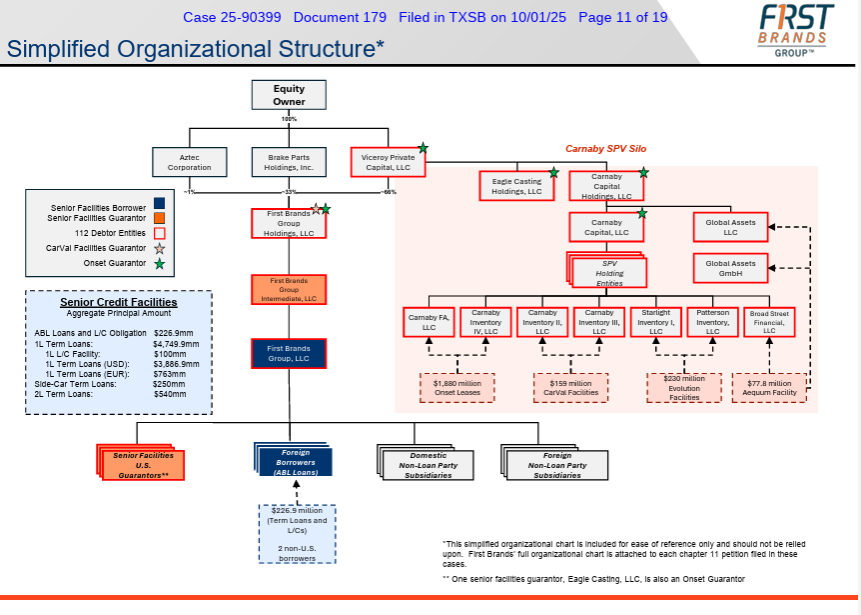
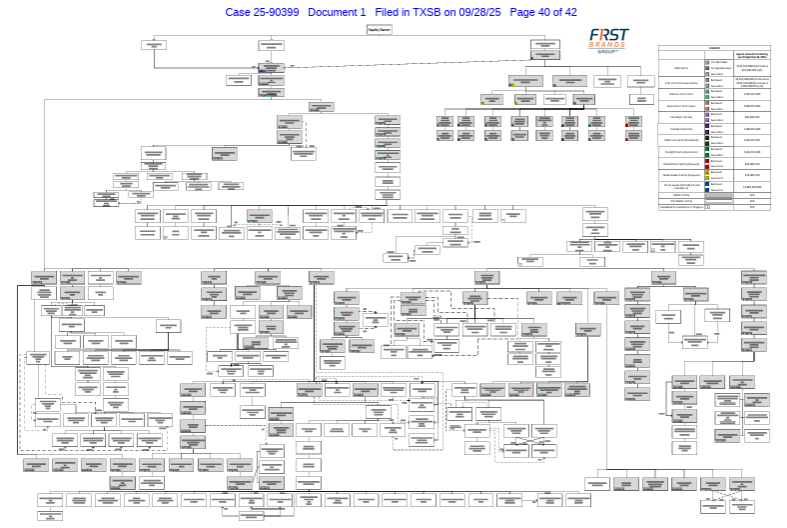
Case Status About the Debtors According to the Debtors: “First Brands Group™ is a global automotive parts company that develops, markets and sells premium products through a portfolio of market-leading brands including: Raybestos® complete brake solutions, Centric Parts® replacement brake components, StopTech® performance brakes, FRAM® filtration products, Luber-finer® filtration products, TRICO® wiper blades, ANCO® wiper blades, Michelin® licensed wiper blades, Carter® fuel and water pumps, Autolite® spark plugs, StrongArm® lift supports, Carlson® brake hardware, CARDONE® new and remanufactured replacement parts, and our towing & trailering portfolio composed of REESE®, DRAWTITE®, BULLDOG®, TEKONSHA®, FULTON®, Westfalia® along with Hopkins® universal owned and licensed brands and Philips® licensed aftermarket lighting. The First Brands Group™ portfolio of world-class brands offers best-in-class technology, industry-leading engineering capabilities and superior customer service.” Simplified Structure (see Docket No. 179) Corporate Structure Chart (attached to lead Petition)