FIRST DAY INTELLIGENCE: Leslie's, Inc.
Pool and Spa Retailer Files Chapter 11 With 80%+ Lender Support, $315mn DIP; RSA Cuts Funded Debt by $685mn, Closes 76 Stores
by Caroline Salls | Sep 30, 2026, 3:01:01 PM
September 30, 2026 – Leslie’s, Inc. and nine affiliated debtors (NASDAQ: LESL, together “Leslie’s” or the “Debtors”) filed for Chapter 11 protection with the U.S. Bankruptcy Court for the Southern District of Texas, lead case No. 26-90795 (Judge Alfredo R. Pérez). The filing schedule identifies Cortz, Inc., Horizon Spa & Pool Parts, Inc., Hot Tub Works, LLC, Leslie’s Poolmart, Inc., LPM Manufacturing, Inc., Pool Parts, Inc., RAM Chemical & Supply, Inc., SPP Holding Corporation and Stellar Manufacturing, LLC as the other Debtors.
The Debtors, a Phoenix-based pool and spa care retailer serving residential customers and pool professionals through more than 900 physical locations and a digital platform, are represented by Charles A. Beckham, Jr. of Haynes and Boone, LLP. Further Board authorized appointments include: (i) Simpson Thacher & Bartlett LLP as bankruptcy counsel, (ii) Centerview Partners LLC as financial advisor and investment banker, (iii) Berkeley Research Group, LLC as financial advisor, (iv) Hilco Real Estate, LLC as real estate consultant and advisor and (v) Kroll Restructuring Administration LLC as claims, noticing and solicitation agent.
In a press release announcing the filing, the Debtors said the RSA provides for a “reduction of approximately $685 million, or 90%, of the Company’s outstanding funded debt.” The restructuring is supported by more than 80% of Leslie’s existing lenders and includes commitments for $90.0mn of new money DIP financing and $60.0mn of equity financing, with the latter fully backstopped by certain RSA parties. Leslie’s expects to emerge from Chapter 11 in early 2027 under majority ownership of a group of its existing lenders.
Chief executive officer Jason McDonell added: “Leslie’s is here to stay.”
Petition Date Highlights
- Leslie’s, Inc., Phoenix-based pool and spa care retailer with more than 900 locations across 38 states, files with approximately $787.0mn of funded debt, comprising $757.0mn of term loans and $30.0mn drawn under its ABL facility.
- Debtors cite post-pandemic demand normalization, inflation, higher interest rates, weaker discretionary spending, adverse weather and increased big-box and online competition; EBITDA fell from approximately $270.0mn in Q3 2021 to $40.0mn in Q1 2026, with negative free cash flow in fiscal 2024 and 2025.
- Debtors file with RSA supported by holders of approximately 81% of prepetition term loans; restructuring would reduce funded debt by more than $685.0mn and provides for a $60.0mn backstopped equity financing.
- Out-of-court efforts included negotiations beginning around August 2025 over a term-loan maturity extension and new capital and a parallel third-party financing process; worsening performance ultimately led the ad hoc lender group to abandon a standalone extension in favor of an in-court restructuring.
- Debtors have commitments for a $90.0mn new money DIP term loan, including $45.0mn available on an interim basis, plus a $225.0mn DIP ABL facility from existing ABL lenders; the ABL facility rolls up the approximately $30.0mn of prepetition ABL borrowings.
- RSA milestones target confirmation within 100 days and effectiveness within 110 days of the Petition date, ahead of Leslie’s principal early-year inventory buying season.
Filing Date Summary
Leslie’s, Inc. and nine affiliates filed a prearranged Chapter 11 after a multiyear deterioration in the pool and spa market reduced profitability and strained liquidity against approximately $787.0mn of Petition-date funded debt. Beginning in 2023, the Debtors say demand corrected sharply from pandemic-era levels as inflation, higher interest rates and tighter household budgets constrained discretionary spending, unfavorable weather shortened pool seasons and big-box and online competitors became more aggressive on price. EBITDA fell from approximately $270.0mn in Q3 2021 to $40.0mn in Q1 2026, while the company generated negative free cash flow in fiscal 2024 and 2025.
Leslie’s began cost reductions in October 2024, including store rationalization, headcount reductions, vendor renegotiations, inventory initiatives and reduced capital expenditures. An approximately 80-store and one-distribution-center closure program launched in November 2025 was substantially completed by January 2026. Meanwhile, Leslie’s and its advisors began discussions with an ad hoc group of term lenders around August 2025 regarding an out-of-court maturity extension and new capital and ran a parallel third-party financing process. As performance continued to weaken, the lenders declined to pursue a standalone extension, and the negotiations shifted to a broader in-court restructuring.
Those discussions culminated in a September 30th RSA with holders of approximately 81% of term-loan claims. The proposed restructuring would eliminate more than $685.0mn of funded debt, provide $90.0mn of new money DIP term financing and $60.0mn of backstopped new equity, while existing ABL lenders provide a $225.0mn DIP ABL facility. The Debtors are targeting emergence within 110 days to position the business for its early-2027 inventory purchasing cycle.
Goals of the Chapter 11 Filing
The White Declaration [Docket No. 5] provides that the Debtors entered Chapter 11 seeking “a substantial de-leveraging of the Debtors’ balance sheet and the attendant reduction of annual interest expense,” optimization of costs and the store footprint, new capital for working capital and operations and implementation of potential growth initiatives. The RSA provides for a reduction of more than $685.0mn of funded debt and a new $60.0mn equity investment backstopped by certain consenting term lenders, while Leslie’s continues to analyze its lease portfolio.
The proposed restructuring would give holders of prepetition term-loan claims a pro rata share of 10% of new common equity, subject to MIP dilution, while general unsecured creditors would share a $500k cash pool and existing equity would be cancelled for no consideration. DIP term-loan claims are also part of the exit capitalization: $75.0mn would convert dollar-for-dollar into a new term loan, with remaining DIP term claims, including premium loans, converting into new equity.
The Debtors say timing is driven in part by the seasonality of the business. Most sales occur from late spring through early fall, making the beginning of the calendar year the principal inventory-purchasing period. The RSA therefore requires Plan effectiveness no later than 110 days after the Petition date.
DIP Financing
The Debtors have lined up two DIP facilities with aggregate stated commitments or capacity of up to $315.0mn, consisting of a $90.0mn new money DIP term loan and a $225.0mn asset-based revolving DIP facility.
The $90.0mn DIP term loan is drawable in two $45.0mn tranches, with the first available upon entry of the interim DIP order and the second following the final DIP order. Jefferies Capital Services, LLC may initially fund the commitments as fronting lender, with the facility backstopped by participating first lien lenders. The DIP carries a 7% backstop premium on commitments and a separate 9.5% upfront premium on amounts actually funded, in each case payable in the form of additional DIP term loans.
Term SOFR borrowings bear interest at Adjusted Term SOFR plus 6.5%, while ABR borrowings bear interest at the applicable base rate plus 5.5%. Accrued interest is payable in kind and added to principal during the cases.
The $225.0mn DIP ABL facility is being provided by Leslie’s prepetition ABL lenders. Under the RSA, the approximately $30.0mn of prepetition ABL borrowings will roll into the DIP on a creeping basis following interim approval and in full upon entry of the final DIP order. At emergence, the DIP ABL is contemplated either to convert into a $225.0mn exit ABL facility or be refinanced by a third-party ABL lender.
White says the Debtors project approximately $81.0mn of negative free cash flow during the DIP’s initial 13-week budget period because the cases commenced during the low-sales, high-inventory-build portion of their annual cycle. The Debtors estimate they need $30.0mn to $40.0mn of minimum cash to maintain vendor relationships and absorb contingencies and had been operating with “considerably less” before filing.
At emergence, $75.0mn of DIP term claims would convert into a new term loan, with the remaining DIP term claims, including premium loans and accrued or capitalized interest, converting into 30% of new common equity, subject to MIP dilution. The separate $60.0mn equity financing would purchase 55.8% of new common equity, with a 7.5% backstop premium payable in equity representing another 4.2%, each subject to MIP dilution.
Events Leading to the Chapter 11 Filing
In a declaration in support of first day filings (the “White Declaration”) [Docket No. 5], Jeff White, the Debtors’ chief financial officer and treasurer, traces Leslie’s financial deterioration to a sharp post-pandemic correction in pool and spa demand beginning in 2023. Demand normalization coincided with inflation in chemicals, energy and transportation, higher interest rates, weakening consumer purchasing power, reduced housing activity, adverse weather and more aggressive price competition from mass-market and online retailers. The cumulative impact drove EBITDA from approximately $270.0mn in Q3 2021 to $40.0mn in Q1 2026 and produced significant losses and negative free cash flow in fiscal 2024 and 2025.
Leslie’s began a broader operational response in October 2024, cutting corporate headcount, closing underperforming stores, renegotiating vendor contracts, reducing capital expenditures and tightening inventory management. Management committed in November 2025 to close approximately 80 stores and one distribution center, substantially completing the program by January 2026. Leslie’s had meanwhile retained Centerview and BRG and, around August 2025, opened negotiations with an ad hoc term-lender group over a potential maturity extension and new money financing. A third-party financing process ran in parallel during late 2025 and early 2026, but continued operating weakness ultimately caused the lender group to withdraw support for a standalone extension. The parties instead negotiated the in-court restructuring embodied in the September 30th RSA.
Drilling down, White provides: “Following a period of unprecedented demand during the COVID-19 pandemic—driven by increased consumer investment in home improvement and outdoor living amenities, new pool installations, and concerns about product availability … the industry experienced a sharp correction beginning in 2023 as pandemic-era demand normalized and macroeconomic conditions deteriorated…. General economic conditions, including high interest rates, high inflation, uncertain tariffs, declining consumer purchasing power, and consumer confidence have limited the demand for swimming pool and spa related products and services…. many customers generally opted for repairs and not replacements of their products, undercutting potential new sales to the Company’s existing customer base.
Unfavorable weather in key pool markets during fiscal years 2024 and 2025 … shortened pool seasons and suppressed chemical usage…. Heightened competition from mass-market retailers, online marketplaces and regional operators placed pressure on the Debtors’ pricing and market share…. big box and online marketplace retailers have been particularly aggressive on pricing, undercutting the Debtors’ ability to compete. These headwinds had a cumulative and severe impact on the Debtors’ financial performance. The Debtors’ EBITDA declined from a peak of approximately $270 million in Q3 2021 to $40 million in Q1 2026. The Debtors reported significant net losses and negative free cash flow in fiscal years 2024 and 2025.
Working together with counsel, on or around August 2025 the Company and the advisors began engaging with certain holders of the Prepetition Term Loan Lenders … to discuss possible alternatives. Initially, the discussions focused on an out-of-court maturity extension transaction as well as raising new money to capitalize the business and fund growth operations…. As time progressed and the Company’s financial performance continued to face significant headwinds, the Ad Hoc Group was no longer willing to proceed with a standalone maturity extension. It became clear that the optimal path forward was a holistic restructuring transaction, implemented through an in-court process.”
Prepetition Indebtedness
As of the Petition date, the Debtors had approximately $787.0mn in aggregate outstanding principal amount of funded indebtedness, consisting of approximately $30.0mn under the Prepetition ABL Facility and approximately $757.0mn under the Prepetition Term Loan Facility.
Prepetition ABL Facility. Leslie’s Poolmart, Inc., Cortz, Inc. and LPM Manufacturing, Inc. are borrowers under an October 2012 $250.0mn asset-based revolving credit facility, with Bank of America, N.A. serving as administrative agent and co-collateral agent and U.S. Bank National Association serving as co-collateral agent. The facility matures April 3, 2029, subject to a springing maturity of December 9, 2027 if the term loan has not been extended or repaid. As of the Petition date, approximately $30.0mn was outstanding.
Prepetition Term Loan Facility. Leslie’s Poolmart is borrower under a March 2021 $810.0mn secured term loan facility, with Alter Domus (US) LLC serving as administrative and collateral agent. The facility matures March 9, 2028 and bears interest at Adjusted Term SOFR plus 2.75% for Term SOFR loans or 1.75% for ABR loans. Approximately $757.0mn of principal was outstanding as of the Petition date.
Under the parties’ intercreditor arrangements, the ABL lenders have first-priority liens on inventory, accounts receivable, deposit accounts, cash, credit-card receivables and related proceeds, while the term lenders have priority over the Debtors’ remaining common collateral.
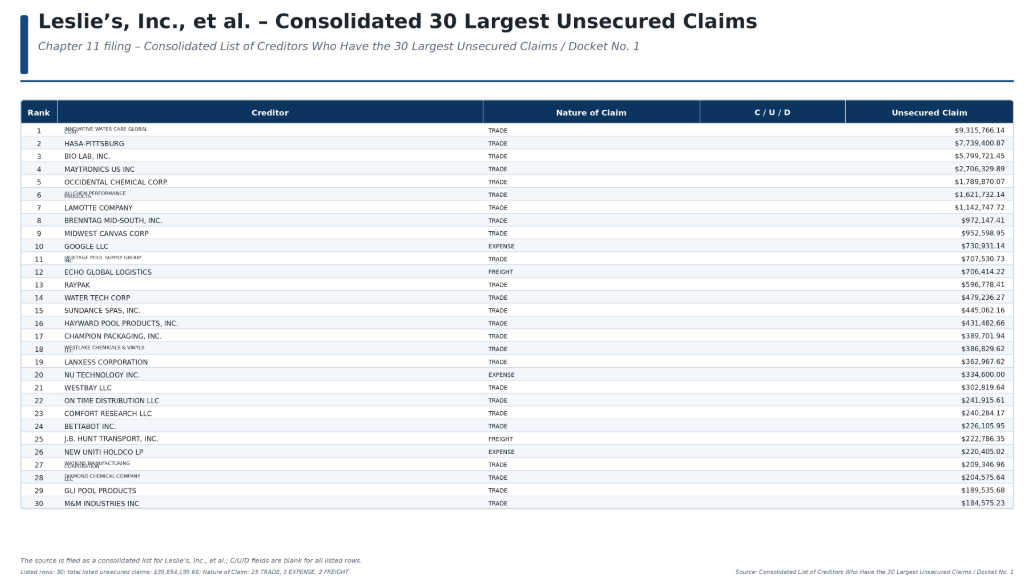
The Debtors’ list of 30 largest unsecured creditors includes unsecured claims totaling approximately $39.9mn.
About the Debtors
According to the Debtors, Leslie’s was founded in 1963 and serves residential customers and pool professionals in the U.S. pool and spa aftermarket through an integrated network of more than 900 physical locations and a digital platform. Its product assortment includes essential pool and spa care products, supported by associates, pool and spa care specialists and service technicians.