First Brands Group, LLC
Debtors File Proposed Chapter 7 Conversion Order Following Plan Denial; DIP Challenge Period Extended for Trustee
by Caroline Salls | Aug 27, 2026, 6:45:27 PM
August 27, 2026 – First Brands Group, LLC and its debtor affiliates have filed a proposed order implementing Judge Christopher M. Lopez’s August 24 bench ruling denying confirmation of their proposed Plan and directing conversion of the cases to chapter 7 [Docket No. 3722].
The proposed order indicates that the U.S. Trustee has agreed to the form of the proposed order, while the creditors’ committee, ad hoc group, ABL lenders, the independent manager of the SPV Debtors and other confirmation objectors have reserved their rights as the parties continue negotiating its terms. The Debtors said they expected to file an amended proposed order by 5 p.m. CT on August 27th. Judge Lopez said during his bench ruling denying confirmation that he planned to enter the conversion order by August 28th.
The proposed order would convert 108 First Brands-related debtors to chapter 7 immediately upon entry. Four additional entities, Patterson Inventory, Patterson Inventory Holdings, Starlight Inventory I and Starlight Inventory Holdings I, were previously converted in April. Within 30 days after appointment of an interim Chapter 7 trustee, the Debtors would be required to provide access to their remaining books, records, emails, financial and operational information and documents relating to estate litigation claims. The trustee would be required to preserve those records, while certain payments necessary to maintain them could be made from DIP cash collateral, following notice and agreement with the relevant parties, subject to an aggregate $2.0mn cap.
A separate notice filed August 27th by the prepetition secured parties extends the challenge period under the final DIP order through the appointment of a chapter 7 trustee [Docket No. 3726]. The creditors’ committee agreed that, in exchange for the extension, it will not bring a challenge against the prepetition secured parties or their representatives before the committee disbands. The extension expressly does not bind the chapter 7 trustee, whose challenge period will continue for 30 calendar days following appointment. Challenge rights for all other parties have expired.
The creditors’ committee would automatically dissolve on the conversion date, although its professionals would retain standing to seek final compensation. Kroll would wind down its role as claims and noticing agent after transferring claims information and creditor matrices to the bankruptcy court. The Debtors would have 21 days to file supplemental schedules reflecting changes in estate property or creditor lists and 30 days to submit their final chapter 11 report to the U.S. Trustee.
The proposed order would preserve the DIP lenders’ position after conversion. Neither the Debtors nor the chapter 7 trustee could continue using DIP cash collateral or DIP loan proceeds without the DIP Agent’s written consent, while the DIP liens, superpriority claims and other protections granted under the final DIP order would remain in place. Any excess remaining in the professional-fee escrow after allowed professional claims are paid would be returned to the DIP Agent and applied against DIP obligations.
The proposed order also establishes a 45-day deadline after conversion for final chapter 11 professional fee applications. A cap on certain post-conversion professional fees remains blank in the filed form, indicating that element of the conversion mechanics had not yet been finalized when the proposal was submitted.
Upon conversion, independent directors Neal Goldman, William L Transier and Benjamin Duster, together with officers Charles Moore, Daniel Jerneycic, Guarav Malhotra and Paul Kosturos, would be deemed to have resigned or withdrawn from their positions. Pending qualification of a permanent chapter 7 trustee and for 45 days thereafter, contested matters, including administrative-expense requests and adversary proceedings involving the converting Debtors, would be stayed unless Judge Lopez orders otherwise. Existing chapter 11 orders would remain effective unless subsequently modified.
Plan Denial and Conversion Ruling Background
On August 24, 2026, Judge Christopher Lopez said in delivering a bench ruling that he could not confirm the First Brands Group Debtors’ liquidation Plan and that he intends to enter an order by August 28th converting their Chapter 11 cases to Chapter 7, finding that a proposed sale of estate litigation claims could not be approved, the Plan was not feasible and no reasonable prospect remained for rehabilitation after, among other factors, the Debtors exhausted substantially all of a roughly $1.0bn DIP facility. Judge Lopez subsequently entered a one-page order formally denying confirmation [Docket No. 3710], incorporating by reference the reasons set out in his bench ruling rather than issuing a separate written opinion. That bench ruling effectively serves as the Court’s opinion: Lopez began by telling the more than 300 parties listening that he had “26 single-spaced pages to read,” before working through his findings and legal analysis on the Plan, which he succinctly summed up:
“This time, there is no doubt that there is cause to convert, and it is in the best interest of the creditors and estate,” Lopez said, citing continuing diminution of the estates and the absence of a reasonable likelihood of rehabilitation. “There was a billion dollar DIP that is basically gone,” he noted.
Lopez also directed the Debtors to submit a proposed conversion order by August 26th at 5 p.m. CT.
Conversion Order Summary
Judge Christopher Lopez has formally denied confirmation of First Brands Group’s Chapter 11 Plan, entering a one-page order that relies on a lengthy bench ruling in which he found the proposed liquidation not feasible and concluded that the Debtors have run out of reasons to remain in Chapter 11.
At the heart of the ruling is the Plan’s reliance on future litigation to pay administrative and priority creditors. First Brands expected to pursue claims associated with roughly $25.0bn of transfers and needed to recover approximately $1.9bn to $2.0bn before administrative creditors could be paid in full, potentially pushing the Plan’s Effective Date into late 2028. Lopez found that recovery case too uncertain. At the same time, confirmation itself would immediately transfer assets to trusts, terminate management, impose releases and lock in other transactions that could not later be unwound. “This plan crosses essentially the point of no return at confirmation,” Lopez said.
Lopez also rejected the proposed sale of the estate’s litigation claims to the DIP lenders. The lenders could credit bid only against assets on which they actually held liens, he ruled—not avoidance actions where their liens attached only to eventual proceeds. He separately found that the claims had not been adequately marketed, particularly given the late disclosure of information supporting the Debtors’ multibillion-dollar transfer analysis.
Two additional defects independently prevented confirmation. DIP roll-up claims could not be used as the necessary impaired voting class for Viceroy and FBG Holdings because they are administrative claims rather than ordinary Plan claims, and Lopez refused to approve a Preference Settlement that could allow a creditor to opt in and later be thrown out based on alleged “adverse conduct” unrelated to its preference exposure.
That left conversion. “There was a billion dollar DIP and it’s basically gone,” Lopez said. First Brands now has no operating business, hundreds of millions of dollars of unpaid administrative expenses, continuing professional fees, no new committed financing and no Plan that can be fixed without substantially rerunning the litigation-asset sale process. “There is no doubt that there is cause to convert,” he concluded.
The ruling also ends the Debtors’ second effort at coming up with a novel Plan construct to push the debtors over the confirmation line.. Lopez stopped an earlier Premier Marketing-only Plan at the Disclosure Statement stage in May because a single Debtor was being used to implement a settlement affecting creditors and assets across the broader First Brands enterprise, while only Premier creditors would vote. With that effort rejected, the Debtors responded with the current Joint Plan which got intense Court scrutiny across a three day hearing after Judge Lopez brushed aside a conversion request noting that the revised Plan still had “a possibility of confirmation.” After a full confirmation trial, he has now concluded that it does not.
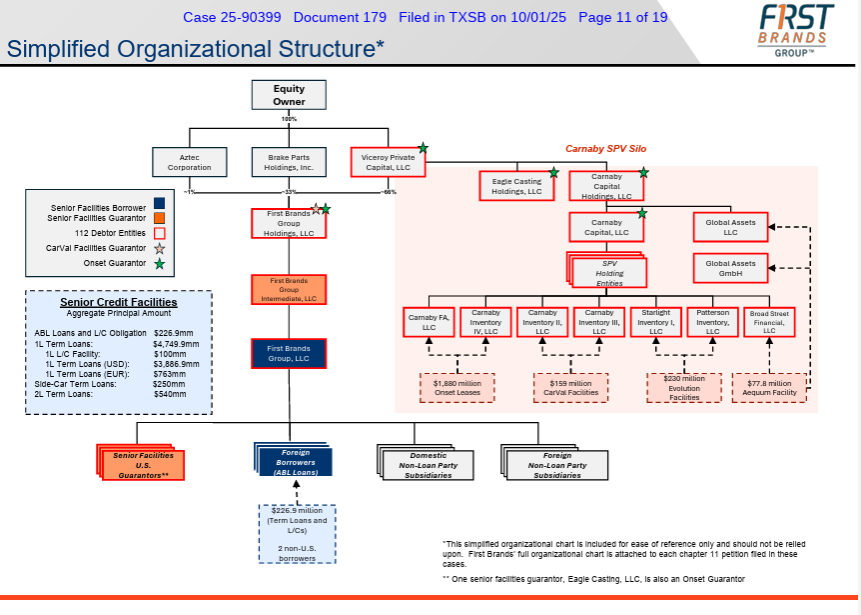
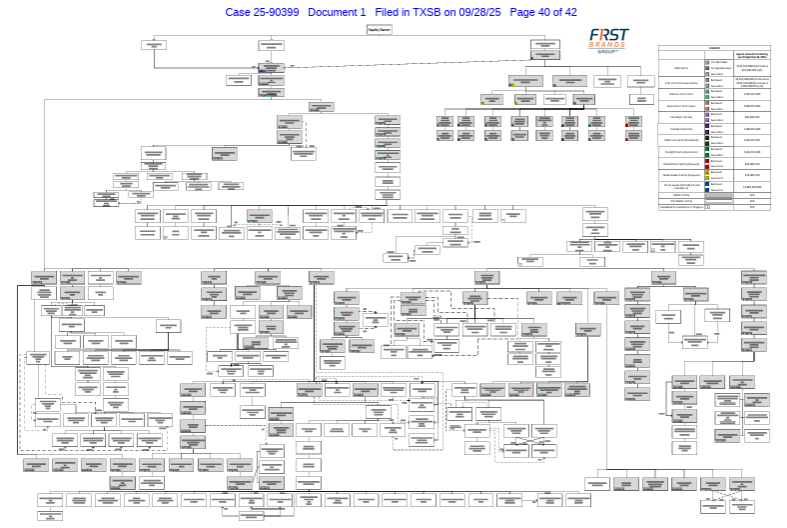
Case Status About the Debtors According to the Debtors: “First Brands Group™ is a global automotive parts company that develops, markets and sells premium products through a portfolio of market-leading brands including: Raybestos® complete brake solutions, Centric Parts® replacement brake components, StopTech® performance brakes, FRAM® filtration products, Luber-finer® filtration products, TRICO® wiper blades, ANCO® wiper blades, Michelin® licensed wiper blades, Carter® fuel and water pumps, Autolite® spark plugs, StrongArm® lift supports, Carlson® brake hardware, CARDONE® new and remanufactured replacement parts, and our towing & trailering portfolio composed of REESE®, DRAWTITE®, BULLDOG®, TEKONSHA®, FULTON®, Westfalia® along with Hopkins® universal owned and licensed brands and Philips® licensed aftermarket lighting. The First Brands Group™ portfolio of world-class brands offers best-in-class technology, industry-leading engineering capabilities and superior customer service.” Simplified Structure (see Docket No. 179) Corporate Structure Chart (attached to lead Petition)