

The Road to Chapter 11: When Distress Signals Start to Stack Up
by Ben Schlafman | Aug 27, 2026, 1:22:54 PM
A Chapter 11 petition tells you where a company ended up. It doesn't necessarily tell you how it got there.
Companies can spend months, and sometimes years, working through financial problems before reaching bankruptcy court. Debt gets amended or extended, assets are sold, lenders agree to forbear and a company may complete an exchange or another liability management transaction. Advisors come in, employees are cut, bonds and loans begin trading down and litigation starts showing up in state or federal court. Some companies fix the problem. Some buy more time. Others eventually file.
BankruptcyData looked at its 2026 Priority Chapter 11 cases alongside companies already being tracked in our distress database to see what those paths look like and where financial pressure is showing up today.
For this review, Priority cases are BankruptcyData cases with $10 million or more in assets and/or liabilities at the time of filing that we identify for a higher level of tracking and coverage. From January 1st through August 26th, the population included 448 Priority Chapter 11 cases.
We also reviewed our distress data covering January 2, 2025 through August 26, 2026. The dates need some explanation. A distress situation does not necessarily begin on the date of the current record in our database. Companies can move through a distress cycle for 18 months, two years or longer, and a company can accumulate a number of different indicators during that period.
For that reason, we aren't trying to say a company's distress began 30, 60 or 90 days before Chapter 11 simply based on the date attached to its current distress record. We are looking instead at what was happening around these companies as their problems developed and what types of signals had begun to accumulate before they ultimately filed.
Those signals can include debt defaults and forbearances, going-concern warnings, creditor talks, advisor hires, refinancing activity, exchange offers and other LMEs, asset sales, workforce reductions, strategic alternatives, litigation, receiverships and assignments for the benefit of creditors. We also look at debt and loan trading prices, BDC portfolio reporting and state-level court activity.
There isn't one road into Chapter 11, and a lot of the distress activity we track can act as a bridge, or a prolonged effort, to avoid getting there.
Saks Global had accumulated a long list of distress indicators before its filing, including a debt default, creditor talks, refinancing activity, advisor hires, an exchange offer, an asset sale, balance sheet restructuring, rating activity and a bankruptcy warning. Trinseo also had a broad mix, including a debt default, creditor talks, a going-concern warning, refinancing and debt amendment activity, liability management transactions, strategic alternatives, asset sales and workforce reductions.
Cumulus Media showed balance sheet restructuring, creditor talks, debt issuance, distressed trading, financial performance issues, management changes, rating activity and both exchange and hybrid liability management transactions. Pretium Packaging had a default, creditor talks, forbearance, refinancing, an exchange offer and an uptier, while U.S. TelePacific had creditor talks, a debt default, exchange offer and rating activity.
West Marine had been identified for BDC distress along with balance sheet restructuring, refinancing, an exchange offer, uptier and rating activity. STG Logistics had BDC distress, a balance sheet restructuring, drop-down and exchange offer among its indicators.
Other companies followed very different paths. Uncle Nearest had been placed into receivership before Chapter 11. Pat McGrath Cosmetics, Brass Works Urban Renewal, 727 Lofts Best Living and 1-800-Doctors had appeared in connection with assignments for the benefit of creditors, while Lourdes University had been identified for a winddown.
Sleep Number had a going-concern warning, bankruptcy warning and restructuring advisor hire among its signals. GoHealth showed balance sheet restructuring, a debt amendment, delisting and going-concern warning. Nine Energy Service had distressed debt trading, financial performance issues, rating activity, a delisting and management changes. Braskem Idesa had a default, forbearance, creditor talks, distressed trading and a bankruptcy warning. DISH DBS had appeared for distressed debt trading and rating activity, while Hughes Satellite Systems had distressed trading, an advisor hire, M&A activity and rating activity ahead of its filing.
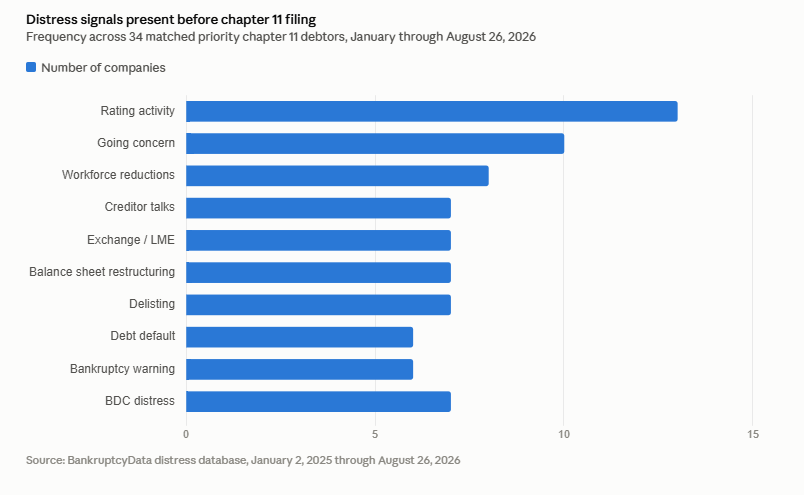
None of these combinations is a formula for bankruptcy. Companies cure defaults, exchange offers work (occasionally 😊), lenders extend maturities, assets get sold and new capital comes in. A receivership or ABC can resolve a situation without Chapter 11, and restructuring advisors can be hired specifically to keep a company out of court.
What gets more interesting is when different parts of the business and capital structure begin telling the same story. Loans are trading at distressed levels, a BDC is marking down its investment, a lender grants forbearance, advisors have been hired, creditors are talking, assets are being marketed or the company is attempting an LME. At some point those stop looking like isolated events.
Private credit gives us another window
Private companies have always been more difficult to follow because they don't leave the same public trail as SEC filers or companies with publicly traded debt, but BDC reporting is changing some of that.
All seven BDC-financed companies identified in our 2026 Priority filing population had previously appeared in BankruptcyData's distress data. The group includes BFG Supply, Carbon Health, STG Logistics, West Marine and Inotiv, among others. The seven-company population was matched at the debtor-family level, including affiliates and subsidiaries, because the company financed by the BDC is not necessarily the lead debtor when a corporate family ultimately files bankruptcy.
Seven companies is a small sample, and we wouldn't suggest that a BDC markdown predicts bankruptcy. What it does show is why BDC reporting has become another useful place to look for private-company distress. A private borrower may disclose almost nothing publicly while a publicly reporting BDC is valuing its investment every quarter. Changes in fair value, nonaccrual status, PIK interest, amendments and approaching maturities can provide another look into what is happening at the borrower, particularly when that information lines up with a lender dispute, layoffs, an advisor hire, a maturity problem or debt restructuring.
The market doesn't always speak through a court filing
Debt and loan trading can provide another signal. A loan moving from the 90s into the 70s or 60s doesn't mean the borrower is going bankrupt, and neither does a bond trading at 50. But the market is putting a very different price on that company's risk. Combine that with an approaching maturity, missed payment, advisor hire or creditor negotiations and there may be more to look at.
State courts provide another view. Lender lawsuits, supplier litigation, foreclosure actions, collection cases and receiverships can show financial pressure that doesn't necessarily appear first in an SEC filing or federal court. For smaller and private companies, those filings can be one of the few public windows into what is happening. The usefulness of each signal also changes depending on the industry.
Real estate is its own animal
Real Estate accounted for 153 of the 448 Priority Chapter 11 cases through August 26th, more than one-third of the population we reviewed. That doesn't mean the problems suddenly appeared in 2026.
Commercial real estate has been working through a much longer distress cycle. Banks and other lenders have repeatedly extended and modified troubled loans rather than immediately foreclosing. Much of that lender behavior grew out of the COVID period and continued as higher interest rates, refinancing problems and changes in office and commercial property values created another set of problems. A troubled real estate loan can therefore remain troubled for years before it produces a foreclosure, receivership or bankruptcy.
Someone actively watching CMBS may have seen the problem much earlier. A maturity gets extended, a loan transfers to special servicing, debt-service coverage deteriorates, occupancy falls or a property fails to refinance, only for the lender to extend again rather than foreclose. In that market, those can be much more flagrant distress signals than waiting for a state or federal court filing to appear.
This is also why looking at real estate over a relatively short period can be misleading. The foreclosure or bankruptcy may be recent, while the underlying problem may have been developing since 2020 or 2021. An operating company can look very different, where a supplier lawsuit, debt price move, lender action or going-concern warning may be one of the first public indications that liquidity has become a serious problem. There isn't one signal that works equally well across every industry.
Where bankruptcy has hit and where distress is showing up
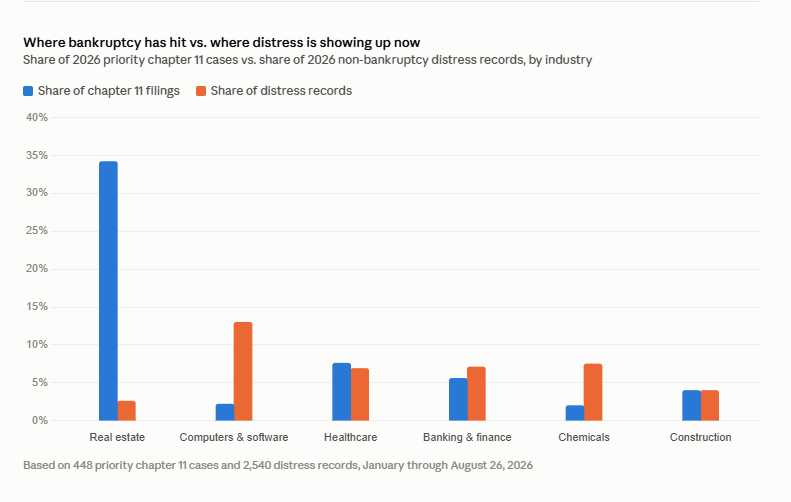
The industry mix outside bankruptcy looks different from what has already arrived in Chapter 11.
Real Estate represents 34.2% of the 2026 Priority Chapter 11 population we reviewed, but only 2.6% of the 2,540 non-bankruptcy distress records dated in 2026 through August 26th.
Computers and Software is almost the reverse. The industry represents only 10 of the 448 Priority Chapter 11 cases, or 2.2%, but 330 of the 2026 distress records, or approximately 13%. Chemicals and Allied Products represents nine Priority Chapter 11s, or 2%, compared with 191 distress records, or 7.5%.
Healthcare and Medical is elevated on both sides, with 34 Priority Chapter 11s and 176 distress records. Banking and Finance similarly accounts for 25 Priority Chapter 11s and 180 distress records, while Construction and Supplies is much closer, representing approximately 4% of both populations.
We would not use that comparison to predict which industries are going to produce the next wave of bankruptcies. The two populations are different, and companies leave distress for all kinds of reasons. Some refinance, some complete an LME, some sell themselves or assets, some receive new capital and others improve operationally. Some may remain distressed for years without ever filing.
It does give us a look at where financial pressure is showing up today versus where it has already resulted in Chapter 11. Computers and Software currently has far more representation in the distress data than in the Priority Chapter 11 population, as does Chemicals and Allied Products. Healthcare and Banking and Finance remain active on both sides, while Real Estate is the outlier in the other direction. The long workout cycle between commercial real estate borrowers and lenders helps explain at least some of that difference.
The question over the next several quarters is how much of the distress currently being handled outside court can actually be resolved there.
Buying time isn't always fixing the problem
Companies have more options available today before filing Chapter 11. Private credit can provide new money when other financing is unavailable, existing lenders can extend maturities or amend covenants, and LMEs can raise priority capital, exchange existing debt or change where value sits in the capital structure. Companies can also sell assets, negotiate directly with creditors or bring in new equity.
Sometimes these transactions solve the problem, while other times they simply buy another year or two. A company can complete a restructuring transaction and still be distressed. It can avoid a payment default without fixing its leverage or extend a maturity only to face the same refinancing problem when the new maturity comes due.
That is why we aren't trying to turn every distress signal into a bankruptcy prediction. The better question is what the company is trying to solve, what options remain available and whether those options are expanding or narrowing.
A default, debt or loan trading at distressed levels, a BDC markdown, another maturity extension, a state-court lawsuit or the hiring of restructuring advisors can all tell us something. None necessarily means much on its own, but when several begin appearing around the same company, the story becomes harder to ignore.
That is ultimately what we are trying to identify. Bankruptcy is an outcome, while distress is a process, and by the time a Chapter 11 petition is filed, we may have been watching that process develop for quite some time.
.
Methodology: BankruptcyData reviewed 448 Priority Chapter 11 cases filed between January 1 and August 26, 2026. Priority cases for this analysis include cases with $10 million or more in assets and/or liabilities at the time of filing that BankruptcyData identifies for a higher level of tracking and coverage. The distress dataset reviewed spans January 2, 2025 through August 26, 2026. Distress profiles can accumulate multiple indicators over a company's distress life, and the date associated with a current distress record should not necessarily be interpreted as the date the company's distress began or the date each individual indicator first occurred. BDC-financed companies were matched at the debtor-family level, including subsidiaries and affiliates, because the BDC-financed entity is not necessarily the lead debtor in a jointly administered case.