

Restaurant Bankruptcies in 2026: Rising Costs, Weaker Traffic and a Consumer Running Out of Room to Spend
by Ben Schlafman | Nov 6, 2026, 6:59:26 PM
Restaurant bankruptcies are having another significant year, and the numbers are becoming difficult to ignore. So, apparently, are the requests from mainstream reporters who don't always seem to understand what they're looking at when it comes to bankruptcy filings. But I digress.
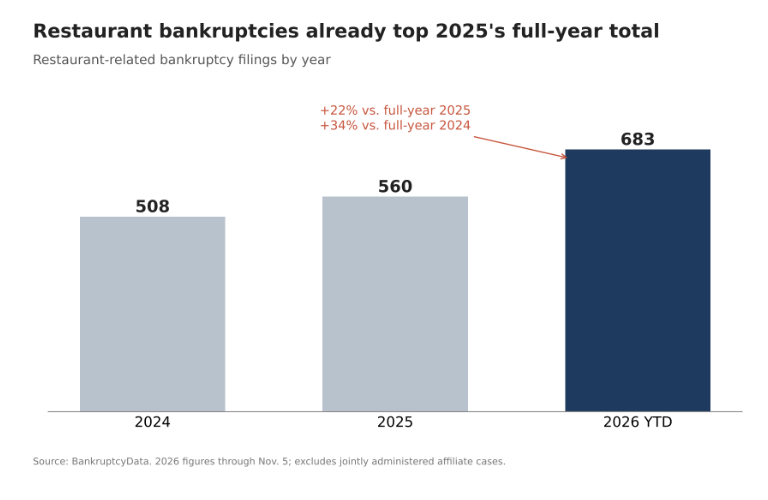
According to BankruptcyData, 683 restaurant-related bankruptcy filings were recorded between January 1 and November 5, 2026, compared with 560 during all of 2025 and 508 in 2024. The 2026 year-to-date total is already approximately 22% above the full-year 2025 figure and 34% above 2024, with nearly two months remaining in the year.
The numbers are not particularly surprising when you look at what has been happening across the restaurant industry and, perhaps more importantly, with consumer behavior. There are certainly more dining choices today, particularly in fast casual, where new concepts have continued to enter the market and established operators have expanded their footprints. But there is only so much money consumers can spend. Restaurant prices have increased considerably over the past several years, and at some point the customer either runs out of disposable income, runs out of available credit or simply decides that eating out is no longer worth the cost. The industry is dealing with higher wages, food costs, rent and borrowing expenses, but passing those increases along to customers only works for so long.
That pressure is showing up in both large franchise organizations and smaller independent restaurants. Of the 683 restaurant filings recorded in 2026, just 23 are classified by BankruptcyData as priority cases, defined as companies reporting $10mn or more in assets and/or liabilities. The remaining 660 involve nonpriority cases, including smaller restaurant businesses, independent operators and local franchise companies. While the larger cases attract the headlines, the filing numbers suggest the financial pressure is considerably more widespread.
Data Note: The 683 restaurant filings and 23 priority cases referenced throughout this report exclude additional jointly administered debtor cases associated with priority-level bankruptcies. Including those jointly administered cases increases the priority-level case count to 289 and the overall restaurant bankruptcy count to 950. For consistency, the analysis and accompanying charts use the original 683-case dataset. The expanded count reflects additional affiliated debtor cases and should not be interpreted as 950 separate restaurant businesses or independent restructuring situations.
Franchise Operators Face Mounting Pressure
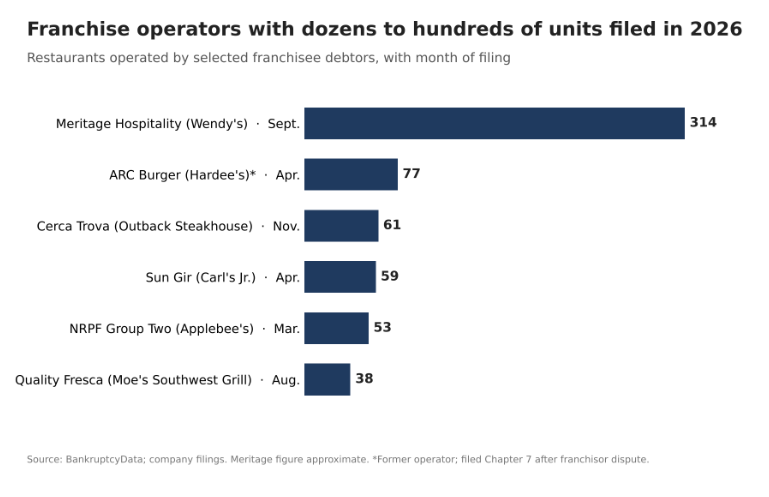
Some of the more significant restaurant bankruptcies this year have involved franchise operators with dozens or even hundreds of locations. These businesses have the benefit of operating under established national brands, but they also carry substantial obligations involving franchise royalties, advertising contributions, leases, payroll and debt service. Declining customer traffic can quickly become a problem when much of that expense remains fixed, particularly for operators that borrowed heavily to acquire restaurants or expand into additional markets.
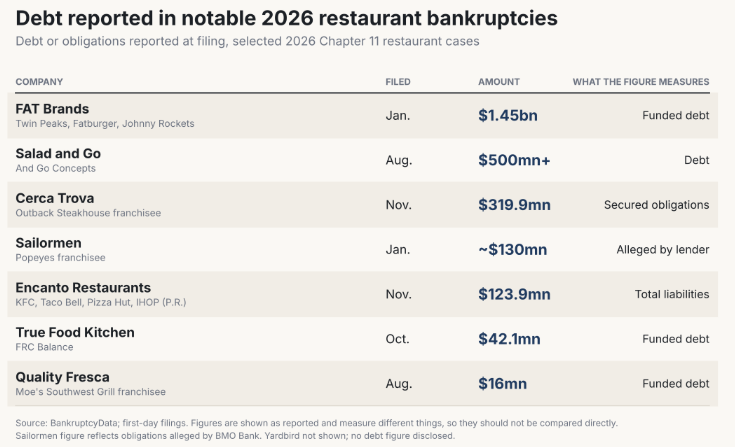
One of the latest restaurant bankruptcies came on November 5, when Encanto Restaurants, Inc., a Puerto Rico-based operator of approximately 180 restaurants under the KFC, Taco Bell, Pizza Hut and IHOP brands, filed Chapter 11 reporting $123.9mn in liabilities against just $29.8mn in assets. The company, which employed more than 3,000 people, entered bankruptcy only three days after Yum! Brands terminated its franchise relationship with Encanto, resulting in the closure of KFC and Taco Bell restaurants throughout Puerto Rico and disruptions to its other restaurant operations. Yum! Brands cited Encanto's inability to meet its operating standards and announced that it was seeking replacement franchise operators.
Encanto's financial problems had been mounting well before the filing. Banco Popular de Puerto Rico holds an $85mn secured claim, representing approximately 69% of the company's scheduled liabilities. Based on the reported collateral value of $29.8mn, the debtor identified a $55.2mn unsecured deficiency claim. Other significant obligations include $3mn owed to advertising provider Arco Publicidad, $3mn to LUMA Energy, $2.5mn to food and paper supplier Plaza Warehousing & Realty Corp., $2.3mn in KFC franchise royalties, $1.1mn in Taco Bell royalties and approximately $1.1mn in Pizza Hut-related royalties. The company also reported outstanding tax obligations, unpaid rent and other operating expenses.
The bankruptcy followed months of collection litigation and landlord disputes, with local reporting identifying more than 70 legal proceedings involving the company during 2026, primarily related to unpaid debts and eviction matters. Encanto's board authorized chief executive officer Humberto Rovira to pursue potential debtor-in-possession financing with Banco Popular and other lenders, negotiate the use of cash collateral and solicit proposals for a possible asset sale. No committed DIP financing facility was identified in the initial filing materials.
On November 2, Cerca Trova Restaurant Group Holdings, Inc., the H.I.G. Capital-backed operator of 61 Outback Steakhouse restaurants, filed Chapter 11 in Delaware with approximately $319.9mn of secured obligations. The company's debt included approximately $129mn of outstanding loan principal and another $190.9mn of accrued and capitalized interest, fees and other obligations. According to its first-day declaration, declining customer traffic, rising labor expenses in California, food inflation and mounting interest obligations placed significant pressure on the business. Covenant EBITDA had fallen to approximately $6.3mn for the twelve months ended August 23, 2026.
An affiliate of Outback Steakhouse franchisor Bloomin' Brands has proposed acquiring substantially all of Cerca Trova's restaurant assets through a $26.3mn stalking horse transaction, while providing up to $5.5mn in debtor-in-possession financing to support operations during the bankruptcy process. The proposed transaction remains subject to court approval and competing bids.
Meritage Hospitality Group Inc., which operated approximately 314 Wendy's restaurants, filed Chapter 11 in September after experiencing declining transactions, rising food and labor expenses and pressure from its lenders and franchisor. The company had previously disclosed significant operating losses and negative cash flow, while its financial difficulties resulted in defaults and negotiated forbearance arrangements. Wendy's has since disclosed a letter of intent with Meritage and its lenders to acquire up to 163 restaurants, subject to a definitive agreement, competing offers and bankruptcy court approval.
In January, Sailormen, Inc., a Popeyes franchise operator, filed Chapter 11 after BMO Bank sought the appointment of a receiver. The bank alleged obligations approaching $130mn, while the debtor attributed its difficulties to inflation, higher borrowing costs, labor shortages and weaker restaurant performance. Sailormen had previously attempted to improve its financial position through restaurant sales, but those efforts were insufficient to resolve its broader liquidity problems.
In March, NRPF Group Two, LLC and affiliated Applebee's franchise operators entered bankruptcy while operating 53 restaurants across Florida, Georgia and Alabama. The debtors cited years of declining customer traffic, pandemic-related disruption, inflation and unsuccessful attempts to sell the business outside of bankruptcy. The operators had closed nine restaurants in 2025 and another five during the first quarter of 2026. A prepetition sale process contacted more than 83 potential purchasers but failed to produce a workable transaction involving the business, its leases and franchise agreements.
In April, Sun Gir Incorporated and affiliated Carl's Jr. operators filed Chapter 11 with a portfolio of 59 California restaurants employing approximately 1,000 people. The debtors reported approximately $19.9mn of net sales during the first three months of 2026 but nevertheless incurred more than $2mn of losses. Management cited California's higher fast-food minimum wage, substantial occupancy expenses and franchise-related obligations among the factors contributing to its financial difficulties. Also in April, ARC Burger, LLC, a former operator of 77 Hardee's restaurants, filed Chapter 7 following a dispute with its franchisor. Hardee's had previously alleged millions of dollars in unpaid royalties, rent and other fees, while the company's assets were also the subject of secured creditor enforcement activity.
Debt and Expansion Strategies Come Under Scrutiny
The expansion strategies pursued by restaurant companies over the past several years are also worth examining. During periods of relatively inexpensive financing and strong consumer spending, operators opened new restaurants, entered additional markets and acquired competing businesses. Some of those investments have not produced the sales or profitability anticipated when they were made, leaving operators with debt obligations and restaurant portfolios that are increasingly expensive to maintain.
FAT Brands Inc., the parent of restaurant brands including Twin Peaks, Fatburger, Johnny Rockets, Round Table Pizza and Smokey Bones, filed Chapter 11 in January with approximately $1.45bn of funded debt. The company attributed its financial difficulties to macroeconomic pressures, rising costs and problems involving its whole-business securitization financing structure. The restructuring involved a complex corporate capital structure spanning multiple restaurant brands and financing arrangements. A liquidation plan ultimately became effective July 31, following transactions that transferred various restaurant brands and assets to lenders and other purchasers.
And Go Concepts, LLC, the operator of the Salad and Go chain, filed Chapter 11 in August with more than $500mn of debt after an unsuccessful expansion into Texas and Oklahoma. The company had expanded beyond its established Arizona market, but new locations failed to generate the customer traffic and profitability anticipated by management. The debtor ultimately closed more than 70 Texas and Oklahoma restaurants and pursued the sale of leasehold interests associated with 51 Arizona and Nevada locations to Dutch Bros.
Yardbird Group LLC, operator of the Southern dining concept Yardbird, filed Chapter 11 in September following debt-financed expansion, pandemic-era disruption and losses at individual restaurant locations. The debtors sought to pursue a going-concern sale supported by $5.4mn of debtor-in-possession financing from their prepetition secured lenders, whose affiliate also agreed to serve as stalking horse bidder. According to the first-day materials, the company's financial difficulties reflected capital-intensive growth, changing customer traffic patterns, location-specific losses and mounting debt obligations. The company had attempted to market its business before filing, but the offers received were insufficient to satisfy its secured debt.
FRC Balance, LLC, the operator of True Food Kitchen, entered Chapter 11 in October with approximately $42.1mn of funded debt. The company had closed 12 of its 46 restaurants, leaving 34 locations operating across 14 states. Management attributed the filing to underperforming locations, unsuccessful investments outside the core restaurant business, pandemic-related challenges and mounting financial obligations. The debtors had also increasingly relied on merchant cash advance financing before seeking bankruptcy protection.
There is also a question of how much additional restaurant capacity the consumer can support. The fast casual market in particular has become crowded, with operators competing for many of the same customers while charging prices that have moved considerably higher than they were just a few years ago. A family that once viewed a quick restaurant meal as an inexpensive alternative to cooking at home may now be looking at a bill that is difficult to justify. When customers begin cutting back on visits, even restaurants that were performing reasonably well can find themselves struggling to cover rising costs.
Smaller Restaurant Operators Account for Most Filings
Although the largest cases involve hundreds of restaurants and substantial debt obligations, the overwhelming majority of restaurant bankruptcies in 2026 involve smaller businesses. BankruptcyData's 660 nonpriority restaurant filings through November 5 account for approximately 96.6% of the year's restaurant-related cases under the primary counting methodology used in this report. These filings receive far less public attention than the bankruptcies of national restaurant groups, but the numbers are significant, particularly when viewed alongside the increase in larger franchise filings.
Recent examples include Woodbelly Pizza LLC, a Montpelier, Vermont restaurant business that filed Chapter 7 on November 4, reporting estimated assets of $50k to $100k and liabilities of $500k to $1mn. Lumiere Bar LLC, a Brooklyn, New York business, also filed Chapter 7 on November 4, reporting less than $50k in assets and liabilities between $1mn and $10mn. Meanwhile, JPrieto Hospitality LLC, a San Antonio, Texas hospitality operator, filed a Subchapter V Chapter 11 case on November 5, reporting estimated assets of $500k to $1mn and liabilities of $100k to $500k. The petition information alone does not establish the specific circumstances that caused these businesses to seek bankruptcy protection.
For independent restaurant operators, there is generally less room to absorb rising expenses or prolonged declines in customer traffic. They often lack the purchasing power, financial reserves and access to capital available to larger chains, while still facing higher wages, food costs, insurance and rent. Many smaller restaurants also depend heavily on the owner being involved in daily operations, and a relatively small change in sales can have an outsized effect on the business. With restaurant prices continuing to rise, the challenge is not simply attracting customers but getting them to return often enough to support the economics of the business.
The Role of Franchisors and Lenders
Several of the larger restaurant cases have involved franchisors participating directly in proposed asset sales or negotiating with lenders over the future of restaurant locations. Cerca Trova's proposed sale to a Bloomin' Brands affiliate and Wendy's proposed acquisition of a substantial portion of Meritage's restaurants are two examples. These transactions remain subject to the applicable agreements and bankruptcy court approvals.
In other cases, disputes with franchisors have added to existing financial difficulties. Quality Fresca I, LLC, a Moe's Southwest Grill franchisee operating 38 restaurants, filed Chapter 11 in August with approximately $16mn of funded debt. The debtor cited declining customer traffic, higher food and shipping costs, labor constraints and inflation, while its franchisor had previously notified the company that it was in default under its franchise agreements. ARC Burger's bankruptcy similarly followed litigation with Hardee's involving alleged unpaid franchise obligations and the termination of its franchise relationship.
Outlook
I don't think the restaurant filing numbers are particularly surprising given the broader pressure on consumers. There will always be restaurant bankruptcies, and there will always be operators that expand too quickly, take on too much debt or simply fail to execute. But the increase in filings this year is occurring across a wide range of restaurant concepts, from major franchise groups to small independent businesses.
What I find particularly interesting is the consumer side of the equation. Restaurants have spent years passing along higher labor, food and occupancy costs, and in many cases they have had little choice. But consumers have limits, too. There are more choices than ever in fast food and fast casual, yet those choices are competing for a customer who may already be stretched by housing, groceries, insurance and other household expenses. At some point, the consumer either runs out of available credit, runs out of cash or decides to eat at home rather than spend another $15 or $20 on a quick meal.
The larger Chapter 11 cases will continue to involve asset sales, franchise transfers, debt restructurings and restaurant closures. At the same time, the 660 nonpriority filings suggest that the financial pressure is not limited to companies with large debt burdens or aggressive expansion strategies. With 683 filings already recorded through November 5, restaurant bankruptcies have surpassed their full-year 2025 total with nearly two months remaining in 2026.
BankruptcyData will continue to monitor restaurant bankruptcies, along with filings across all industries, asset sales, closures and restructuring developments as we move into 2027.