FROM THE COURTROOM: The Children's Place, Inc.
Debtors Win Interim DIP Relief and December Sale Timetable at First Day Hearing
by Zach Russell | Nov 10, 2026, 5:05:47 PM
November 10, 2026 – Judge Stacey Meisel granted The Children’s Place, Inc. interim approval of DIP financing and cash collateral use and approved a December sale timetable at their first day hearing. The Court approved the financing package, comprising up to $166.0mn in ABL commitments and a $116.0mn term facility, including refinancing of prepetition debt, over the U.S. Trustee’s roll-up objection. The relief supports ongoing inventory liquidation sales while the Debtors seek buyers for all or portions of their business, with a sale hearing scheduled for December 15 and landlord rent and backup-bidder assignment issues remaining unresolved.
From the Courtroom
Gregory Pesce of White & Case, representing the Debtors, opened with an overview of The Children's Place and the events leading to the filing. He described a North American business with 512 stores and approximately 7,200 employees that had faced declining sales, inflation, tariffs, and pressure from its substantial lease portfolio. Earlier refinancing efforts had not prevented liquidity from deteriorating. Pesce said the Debtors were pursuing buyers for all or portions of the business while conducting inventory liquidation sales, with stores able to be removed from the liquidation process if a buyer emerged. He outlined the proposed December 9 bid deadline, December 11 auction and December 15 sale hearing. Approximately 50 parties had been contacted, generating 10 potentially actionable proposals. The Debtors' fee-based arrangements with Tiger Capital Group, SB360 Capital Partners and GA Retail Solutions were intended to "maximize profit and optionality," he said, while taking advantage of the holiday selling season. Pesce also previewed the Wells Fargo and SLR DIP financing arrangements and said the budget provided for case administration and winddown costs. He offered the declarations of Co-Chief Restructuring Officer Rudolph Morando and Cascadia Capital's Lorie Beers into evidence and made both available as witnesses.
The Court first approved joint administration, complex case treatment, and Omni Agent Solutions' retention. Meisel then approved the consolidated creditor list and related service relief. On the requested extension for schedules and statements, Fran Steele, appearing for the U.S. Trustee, sought a shorter deadline. Meisel approved a December 11 deadline. The Section 341 meeting was identified as December 17 at 10:00 a.m. Eastern Time. Amanda Parra Criste of White & Case next presented trading procedures intended to preserve the Debtors' tax attributes, including approximately $79.1mn of federal net operating loss carryforwards [Docket No. 8]. The Court approved the procedures without objection. Meisel then approved relief confirming the worldwide application of the automatic stay [Docket No. 9], followed by designation of The Children's Place as foreign representative for the Canadian recognition proceedings [Docket No. 10]. Counsel reported that an interim stay had already been obtained in Canada and that the recognition hearing was scheduled for Friday. The Court next considered continuation of customer programs [Docket No. 11], subject to the store-closing modifications. Steele welcomed the provision allowing gift cards to be redeemed for 30 days. The Court approved the motion. The proposed closing-store policies provide for gift cards and My Place Rewards to be honored for 30 days from entry of the store-closing order. Turning to claims bar date procedures [Docket No. 63], counsel said the Debtors expected to file their schedules by December 7 despite requesting a December 11 deadline out of caution. The discussion addressed additional time for creditors affected by amended schedules and clarified that landlords would not need to file proofs of claim before lease rejection. Judge Meisel approved the motion. The Court then approved the continuation of insurance programs and cash management motions. The Court next considered vendor relief [Docket No. 15]. Steele said the U.S. Trustee had reviewed the motion and received the list of critical vendors proposed for payment. Judge Meisel approved the motion without objection. The relief includes authority for up to $3.5mn of critical vendor claims and $6.5mn of lien claims, subject to applicable financing and budget restrictions. Debtors’ counsel then presented the utilities motion, including a $300,000 adequate assurance deposit representing approximately half a month of utility expenses. Judge Meisel approved the motion without objection. On taxes and fees, counsel for a purchaser of certain tax receivables requested language permitting turnover of refunds that were not estate property. The Debtors agreed to submit revised language, and Judge Meisel approved the relief with that modification.
The Court next considered prepetition wages, salaries and benefits. Debtors’ counsel said the Debtors needed their approximately 7,200 employees to continue inventory sales. Counsel also described a separate, approximately $3.8mn store-level retention program providing tiered, one-time payments of $750 to $4,000 for management-level store employees who remain through February, with that relief sought under the store-closing motion. Steele reserved comments on the retention program, and Judge Meisel approved the wages and benefits motion. White & Case's Andrew O'Neill then addressed the retention payments under the store-closing motion, characterizing the proposal as a rank-and-file program. Steele did not oppose the relief but requested additional language identifying eligible employee categories and corresponding payment amounts. The Debtors agreed, and Judge Meisel directed that the additional language be included.
O'Neill next outlined changes to the proposed bidding and contract procedures. The revised process separates sale approval from contract and lease assumption and assignment issues, providing for notices identifying assignees and cure amounts, a December 21 objection deadline and a December 29 hearing for unresolved disputes. Counsel said the timetable was intended to permit closing before December 31. Landlord counsel reserved concerns about applying those procedures to backup bidders. Counsel also clarified that standalone lease sales fall outside the bidding procedures; leases may be acquired alongside a purchaser's acquisition of other assets. Cascadia is handling the asset sale process, with a separate real estate adviser handling the lease portfolio.
Returning to the store-closing motion [Docket No. 62], O'Neill sought assumption of the liquidation consulting agreement and approval of the sale guidelines. Landlord counsel reported agreement on the conduct of liquidation sales. Other landlord counsel raised unpaid November stub rent and sought adequate protection, objecting to deferral of rent until the end of the cases. Meisel directed the parties to confer before the final hearing. Counsel for the liquidation consultants then requested deletion of language concerning customer information and privacy obligations. The Debtors agreed to revise the language.
The Court then took up the bidding procedures [Docket No. 61]. O'Neill described a framework for selecting one or more stalking-horse bidders, with agreements to be entered into by November 17, and provisions permitting landlords to monitor the auction remotely. Landlord counsel challenged the requirement to litigate adequate assurance and assignment issues for a backup bidder before that bidder became the successful purchaser. They argued that preparing separate evidentiary records for successful and backup bidders would impose unnecessary costs, particularly with a potential hearing between Christmas and New Year's, and sought to defer the backup-bidder process unless the successful bidder failed to close. O'Neill defended the proposal as providing bidders certainty and avoiding a chilling effect on bidding. He ultimately proposed carving out the backup-bidder issue for a later filing. Judge Meisel directed that an objection cutoff be moved from 5:00 p.m. to 3:00 p.m. and approved the bidding procedures with the backup-bidder issue reserved.
The Court next approved revised procedures for rejecting executory contracts and unexpired leases [Docket No. 60]. The procedures provide notice and objection rights for counterparties to contracts or leases the Debtors propose to reject.
Turning to scheduling, O'Neill said the lenders agreed to combine the sale and second day hearings on December 15, and Judge Meisel confirmed a 1:00 p.m. Eastern Time start. At landlords' request, she also scheduled a tentative status conference for November 23 at 9:30 a.m. Eastern Time.
Finally, White & Case's Andrew Zatz presented the DIP motion [Docket No. 66]. The package comprises an ABL facility of up to $166.0mn with Wells Fargo as agent and a term loan facility of up to $116.0mn with Crystal Financial LLC d/b/a SLR Credit Solutions as agent. The commitments include refinancing of prepetition secured debt. The ABL facility is expected to provide approximately $11.0mn of initial net borrowing availability, while the term facility provides $16.0mn of new money, of which $15.0mn must pay down prepetition ABL borrowings. The interim package also rolls $16.0mn of prepetition term loan principal into DIP obligations and provides for a creeping roll-up of prepetition ABL debt through collateral proceeds. The remaining prepetition ABL and term obligations would be refinanced into the respective DIP facilities upon final approval, subject to preserved challenge rights. Steele objected to the roll-ups and asked that they be deferred to the final hearing. Zatz acknowledged the limited review time but said the interim roll-ups were necessary to obtain financing and consent to cash collateral use. He characterized the $16.0mn interim term roll-up as "fairly modest." Judge Meisel questioned whether only $1.0mn of new term funding was directly available for liquidity after the required $15.0mn ABL repayment. Zatz responded that paying down the prepetition revolver would create additional availability under the DIP ABL facility. He said the overall package avoided a contested cash collateral proceeding as liquidation proceeds came in. Judge Meisel emphasized the absence of an alternative funding source and the Debtors' immediate need for cash collateral. "It's not the best deal, but it's not the worst deal," she said before approving the DIP motion on an interim basis.
DIP Financing Summary
The Debtors are seeking approval of two senior secured superpriority DIP facilities totaling $282.0mn, provided by their existing secured lender groups under Wells Fargo Bank and SLR Credit Solutions. As of the Petition Date, approximately $110.6mn in principal borrowings and $19.3mn in outstanding letters of credit were reported under the prepetition Wells Fargo ABL facility, alongside $100.0mn outstanding under the SLR term loan. The Debtors also owe approximately $151.1mn under four unsecured, subordinated term loans provided by their controlling shareholder, Mithaq Capital SPC, which is not participating in the proposed DIP financing. The new facilities would refinance the existing secured obligations, with an interim creeping roll-up of the ABL debt and a separate, staged roll-up of the SLR term loan.
The $166.0mn DIP ABL provides revolving commitments subject to inventory and receivables borrowing bases, including a $20.0mn letter-of-credit sublimit and a $16.0mn Canadian revolving credit ceiling. Initial net availability is estimated at approximately $11.0mn, subject to borrowing-base calculations, reserves and minimum availability requirements. The $116.0mn DIP Term Facility comprises $16.0mn in new-money funding and the proposed refinancing of the existing $100.0mn SLR term loan. Upon interim approval, SLR would advance the new money, with $15.0mn applied directly to the prepetition Wells Fargo revolver, while $16.0mn of its existing term loan principal would be converted into DIP obligations. Upon entry of the Final DIP Order, the remaining prepetition term loan balance would be rolled up, together with the refinancing of any remaining prepetition ABL obligations, subject to preserved challenge rights.
The ABL financing incorporates a creeping roll-up tied directly to the Debtors' liquidation receipts. Proceeds from inventory and other ABL priority collateral will be applied first to repay prepetition Wells Fargo obligations, releasing borrowing capacity under the DIP ABL, subject to its borrowing-base limitations. Both DIP facilities require daily cash sweeps into lender-controlled concentration accounts, with proceeds subsequently applied to outstanding DIP obligations according to the applicable repayment waterfalls. The Debtors may reborrow under the revolving facility to fund budgeted expenses, but that availability remains dependent on eligible collateral, borrowing-base reserves and other lending conditions. As merchandise is liquidated, the inventory supporting the borrowing base will also decline, potentially constraining further borrowing notwithstanding repayments generated by the sales. Proceeds from dispositions of SLR's first-priority collateral, including intellectual property and real estate, are subject to separate repayment requirements under the DIP term loan and intercreditor arrangements.
The financing is intended to support an enterprise-wide liquidation program that began November 6th, two days before the Chapter 11 filing, while preserving the possibility of a going-concern asset sale. The Debtors retained Tiger Capital Group, SB360 Capital Partners and GA Retail Solutions to conduct the store-closing sales, with the consulting arrangement subsequently syndicated to Hilco Merchant Resources and Gordon Brothers Retail Partners. Liquidation activities encompass merchandise at all remaining retail locations, warehouses and distribution facilities, together with applicable e-commerce channels. The Debtors expect the resulting cash proceeds and reductions in operating expenses to finance the Chapter 11 process and improve secured creditor recoveries, while continuing to market the business, brands and other assets to prospective purchasers. The proposed DIP financing will fund employee, occupancy, distribution, critical vendor, inventory-sale and case-administration expenses under an approved budget, rather than provide substantial unrestricted capital to maintain existing operations.
The limited incremental funding and the reliance on inventory realizations reflect the Debtors' deteriorating liquidity position. According to co-chief restructuring officer Rudolph Morando, the secured lenders imposed restructuring reserves of $15.0mn against availability under each of the ABL and term loan facilities around October 7th, followed by additional $5.0mn reserves under each facility on October 21st, October 28th and November 4th, totaling $60.0mn in cumulative reserves. Beginning in September, the Debtors retained Berkeley Research Group as financial advisor, Cascadia Capital as investment banker and White & Case as restructuring counsel to explore alternatives. Cascadia subsequently contacted 11 prospective third-party DIP lenders, none of which offered unsecured or junior-lien financing or sufficient funding to refinance the existing secured debt. Wells Fargo and SLR also refused to consent to a third-party facility priming their liens, leaving the proposed financing from the existing secured lenders as the only actionable option, according to Cascadia managing director Lorie Beers [Docket No. 55].
The Debtors contend that the roll-ups and related adequate protection were required by the secured lenders as conditions to providing the financing and consenting to the use of cash collateral. The DIP ABL bears interest at the applicable base rate plus 3.50%, while the DIP Term Facility bears interest at three-month Term SOFR plus 8.25%, subject to a 2.00% SOFR floor. Default interest generally adds 2.00%. The ABL facility matures on the earliest of January 29, 2027, the effective date of a Chapter 11 plan, completion of a sale of substantially all assets, failure to obtain final approval within 30 days of the Petition Date, or dismissal or conversion of the cases. The term loan has similar termination provisions, with March 1, 2027 as its outside maturity date.
The DIP facilities also impose an expedited timetable for the parallel liquidation and asset sale processes. The Debtors must obtain interim approval of the financing, bidding procedures and store-closing consulting agreement by November 10th, and final DIP and liquidation agreement approvals by December 8th. The financing milestones contemplate binding bids by December 10th, completion of an auction by December 14th and entry of sale approval orders by December 17th, with any sale to close by December 31st. The bidding procedures motion proposes slightly earlier dates of December 9th for bids, December 11th for an auction and December 15th for a sale hearing. The DIP milestones require sale proceeds to meet minimum amounts acceptable to the secured lender agents, with the lenders retaining consent rights over winning bidders and transaction terms. The combination of limited new liquidity, mandatory cash sweeps, accelerated roll-ups and year-end sale milestones finances the ongoing inventory liquidation while leaving the Debtors a narrow window to secure a purchaser for some or all of the remaining business.
Key Dates
- November 17, 2026: Deadline to enter into stalking-horse agreements, if any.
- November 23, 2026, at 9:30 a.m. ET: Tentative status conference.
- December 9, 2026: Bid deadline.
- December 11, 2026: Auction, if necessary; deadline to file schedules and statements.
- December 15, 2026, at 1:00 p.m. ET: Sale and second day hearings.
- December 17, 2026, at 10:00 a.m. ET: Section 341 meeting.
- December 21, 2026: Deadline to object to contract and lease assumption and assignment.
- December 29, 2026: Hearing on unresolved assumption and assignment objections.
Key Terms of DIP Financing
DIP Term Facility (SLR Credit Solutions)
- DIP Borrowers: The Children’s Place, Inc. (“TCP”), as lead borrower, and the remaining Debtors as borrowers or guarantors, as specified in the applicable DIP Loan Documents.
- DIP Term Lender/Agent: Crystal Financial LLC d/b/a SLR Credit Solutions, serving as administrative and collateral agent under the DIP Term Facility.
- Commitment: An up to $116.0mn senior secured superpriority term loan facility, comprising $16.0mn of new-money financing and the proposed refinancing and roll-up of $100.0mn in prepetition SLR term loan principal.
- New Money: $16.0mn in new-money term loan financing, to be funded on the Closing Date. Of this amount, $15.0mn must be applied immediately toward repayment of prepetition Wells Fargo ABL borrowings, creating additional revolving borrowing capacity under the DIP ABL Facility. The remaining $1.0mn is available for other permitted uses, subject to the DIP Loan Documents.
- Roll-Up / Refinancing:
- Interim Approval: $16.0mn of prepetition SLR term loan principal will be rolled up into the DIP Term Facility upon entry of the Interim DIP Order, alongside the $16.0mn new-money advance.
- Final Approval: The remaining prepetition term loan secured obligations will be converted into DIP Term Loans upon entry of the Final DIP Order, subject to preserved challenge rights under the Interim DIP Order.
- Accrued prepetition interest, fees, expenses and other amounts due under the prepetition term loan facility will be paid in cash on the Closing Date.
- Interest Rate: Three-month Term SOFR plus 8.25% per annum, subject to a 2.00% SOFR floor. Interest is calculated on a 360-day year and payable in arrears on the first day of each calendar month, upon prepayment of principal and on the Termination Date.
- Default Interest Rate: 2.00% per annum above the otherwise applicable interest rate, subject to the default-interest provisions of the DIP Term Credit Agreement.
- Fees:
- DIP Term Fees: Payable in the amounts and at the times specified in the applicable Fee Letter. Such fees are fully earned when paid and nonrefundable.
- Professional Fees and Expenses: Reasonable and documented fees and expenses of the DIP Agent and lenders are payable in accordance with the DIP Loan Documents and Interim DIP Order, subject to the specified invoice-delivery and objection procedures.
- Maturity: The earliest of (i) March 1, 2027, (ii) the effective date of a Chapter 11 plan in any of the cases, (iii) the closing of a sale of all or substantially all of the Loan Parties’ assets, (iv) 30 days after the Petition Date if the Final DIP Order has not been entered by such date, or (v) dismissal or conversion of any of the Chapter 11 cases.
- Use of Proceeds: The $16.0mn new-money advance will be used primarily to repay prepetition ABL obligations, with $15.0mn specifically allocated to that purpose. Remaining proceeds, together with available cash collateral and permitted DIP ABL borrowings, will support budgeted operations, employee compensation, occupancy and distribution expenses, inventory liquidation and store-closing activities, critical vendor payments, professional fees, case administration costs, permitted prepetition payments and adequate protection obligations. The financing will also support continued marketing of the Debtors’ operating assets and intellectual property for potential going-concern transactions.
- Cash Management / Liquidation Proceeds: Cash receipts are subject to daily sweeps into lender-controlled concentration accounts. Proceeds attributable to term loan priority collateral, including specified intellectual property and real estate assets, are subject to separate application and mandatory prepayment provisions under the DIP Term Credit Agreement and applicable intercreditor arrangements. Certain asset disposition proceeds require repayment of 100% of applicable net proceeds within three business days. The DIP Term Facility is non-revolving, and amounts repaid or prepaid cannot be reborrowed.
- Minimum Liquidity / Availability Requirements: Minimum Excess Availability of $35.0mn, subject to a cumulative reduction equal to 50% of cash net proceeds received from certain DIP Term Agent-approved intellectual property or real estate dispositions, with a zero floor. This reduction does not reduce the separate minimum availability requirement under the DIP ABL Facility.
- Budget and Variance Reporting: The DIP Term Facility requires a 13-week budget, updated every fifth week, together with weekly variance reporting. The variance tests generally require operating receipts of at least 85% of budget, operating disbursements not exceeding 110% of budget (subject to specified professional-fee exclusions), and cumulative professional fees and expenses not exceeding 115% of budget. The DIP Term Facility also includes an additional cumulative net cash flow variance test.
- Milestones: The DIP Facilities require compliance with the following deadlines:
- Pleadings & Interim Relief:
- Petition Date (Nov. 8, 2026): File DIP motion, Cash Management motion and Chief Restructuring Officer (“CRO”) retention motion.
- November 10, 2026 (2 days post-petition): Court entry of the Interim DIP Order and Interim Cash Management Order.
- November 20, 2026 (12 days post-petition): File motion to extend the lease assumption/rejection deadline to 210 days; file motions to retain a real estate broker for the Fort Payne, Alabama property and an intellectual property sales consultant, the latter subject to agreement regarding funding and budgetary implications.
- November 30, 2026 (22 days post-petition): Court entry of the Final Cash Management Order.
- December 8, 2026 (30 days post-petition): Court entry of the Final DIP Order and order approving CRO retention.
- December 18, 2026 (40 days post-petition): Obtain order extending the lease assumption/rejection period to 210 days.
- Sale & Liquidation Milestones:
- November 9, 2026: File the bidding procedures motion and motion approving the Specified Liquidation Agreement. The DIP milestone language also references designation of a stalking horse bidder, although none had been selected when the bidding procedures motion was filed.
- November 10, 2026: Court entry of an interim order approving the Specified Liquidation Agreement and entry of the Bidding Procedures Order.
- December 8, 2026: Court entry of a final order approving the Specified Liquidation Agreement and stalking horse designation, if applicable.
- December 10, 2026 (32 days post-petition): Outside deadline for submission of binding bids under the DIP milestones and delivery of copies of all bids to DIP and prepetition agents. The bidding procedures motion proposes an earlier December 9th bid deadline.
- December 14, 2026 (36 days post-petition): Outside deadline to complete the auction and declare winning and back-up bidders, subject to lender consent. The bidding procedures motion proposes a December 11th auction.
- December 17, 2026 (39 days post-petition): Obtain Court order(s) approving the sale and, to the extent not previously approved, the store-closing sales; execute purchase agreement and other definitive documentation. The bidding procedures motion proposes a December 15th sale hearing.
- December 31, 2026 (53 days post-petition): Consummate the applicable sale transaction or transactions.
- Within 2 Business Days after non-approval of a sale or termination of the purchase agreement: Consummate the back-up sale, if any.
- Canadian Recognition Milestones:
- Within 2 Business Days of Interim Order: Commence CCAA recognition proceedings and apply for the Canadian Initial Recognition Order, Canadian Supplemental Order and Canadian Interim DIP Recognition Order.
- Within 5 Business Days of Interim Order: Obtain those Canadian recognition orders.
- Within 2 Business Days of Final Order: File motion for Canadian Final DIP Recognition Order.
- Within 7 Business Days of Final Order: Obtain the Canadian Final DIP Recognition Order.
- Pleadings & Interim Relief:
DIP ABL Facility (Wells Fargo)
- DIP Borrowers: Same as in respect of the DIP Term Facility above.
- DIP ABL Lender/Agent: Wells Fargo Bank, National Association, serving as administrative and collateral agent under the DIP ABL Facility.
- Commitment: An up to $166.0mn senior secured superpriority asset-based revolving credit facility, subject to borrowing-base limitations, applicable reserves and other borrowing conditions. The facility includes a $20.0mn letter-of-credit sublimit, including a $1.0mn Canadian LC sublimit, and a $16.0mn Canadian revolving credit ceiling.
- New Money / Availability: Up to $166.0mn in revolving commitments, with estimated initial net availability of approximately $11.0mn based on current borrowing-base estimates. Availability is further supported by the application of $15.0mn in new-money proceeds from the SLR DIP Term Facility toward repayment of prepetition ABL borrowings, subject to applicable borrowing-base and minimum availability requirements. The $166.0mn commitment is not equivalent to $166.0mn of incremental cash.
- Roll-Up / Refinancing:
- Interim Approval: The facility incorporates a creeping roll-up under which collections of ABL priority collateral proceeds are applied first toward repayment of prepetition Wells Fargo obligations, releasing availability under the DIP ABL Facility subject to borrowing-base conditions. Existing letters of credit, cash-management obligations and bank-product obligations under the prepetition ABL Facility will become DIP ABL obligations.
- Final Approval: Any remaining prepetition ABL secured obligations will be refinanced into DIP revolving loans upon entry of the Final DIP Order, subject to preserved challenge rights under the Interim DIP Order.
- Accrued prepetition interest, fees, expenses and other amounts due under the prepetition ABL facility will be paid in cash on the Closing Date.
- Interest Rate: Applicable Base Rate plus 3.50% per annum, with a 0% floor on the SOFR adjustment.
- Default Interest Rate: 2.00% per annum above the otherwise applicable interest rate, subject to the default-interest provisions of the DIP ABL Credit Agreement.
- Fees:
- Unused Commitment Fee: 0.375% per annum where average daily unused commitments during the immediately preceding quarter are equal to or less than 50% of aggregate commitments, and 0.250% per annum where average daily unused commitments exceed 50% of aggregate commitments.
- Commercial Letter-of-Credit Fee: 1.75% per annum.
- Standby Letter-of-Credit Fee: 3.50% per annum.
- LC Fronting Fee: 0.125% per annum, plus customary issuer charges.
- Professional Fees and Expenses: Same as in respect of the DIP Term Facility above, subject to the applicable DIP ABL Loan Documents and Interim DIP Order.
- Maturity: The earliest of (i) January 29, 2027, (ii) the effective date of a Chapter 11 plan in any of the cases, (iii) the closing of a sale of all or substantially all of the Loan Parties’ assets, (iv) 30 days after the Petition Date if the Final DIP Order has not been entered by such date, or (v) dismissal or conversion of any of the Chapter 11 cases.
- Use of Proceeds: The facility will provide revolving borrowing capacity to fund budgeted operations, employee and occupancy expenses, inventory liquidation and store-closing activities, critical vendor payments, professional fees, case administration costs, permitted prepetition payments and adequate protection obligations. The facility will also finance the continued marketing of the Debtors’ business and assets for potential going-concern transactions. The availability of DIP ABL borrowings is tied to eligible inventory and receivables and applicable borrowing-base and reserve requirements.
- Cash Management / Liquidation Proceeds: Store-closing and other ABL collateral receipts will be swept daily into lender-controlled concentration accounts. During the interim period, proceeds will be applied first to repay prepetition ABL obligations under the creeping roll-up. Following repayment or refinancing of those obligations, subsequent collections will reduce outstanding DIP revolving borrowings in accordance with the applicable waterfall. The Debtors may reborrow to fund budgeted expenses, subject to borrowing-base availability, reserves and other conditions. As inventory is liquidated, the collateral base supporting additional borrowings may also decline.
- Minimum Liquidity / Availability Requirements: Minimum Excess Availability equal to the greater of 10% of the Global Line Cap and $35.0mn. Unlike the DIP Term Facility, this requirement is not reduced by proceeds from approved intellectual property or real estate dispositions.
- Budget and Variance Reporting: Same as in respect of the DIP Term Facility above, including the 13-week budget, five-week update cycle and weekly reporting requirements, except that the additional cumulative net cash flow variance test described above applies specifically to the DIP Term Facility.
- Milestones: Same as in respect of the DIP Term Facility above, including the December 8th Final DIP Order deadline, December 17th outside deadline for sale approval orders and December 31st sale consummation deadline. The proposed bidding procedures contemplate earlier dates for bids, the auction and sale hearing.
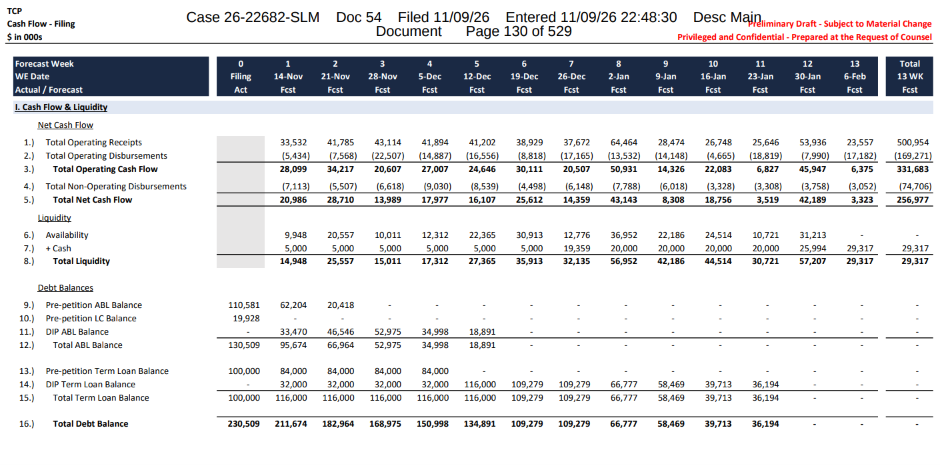
Initial Budget [see Exhibit B of Docket No. 66]
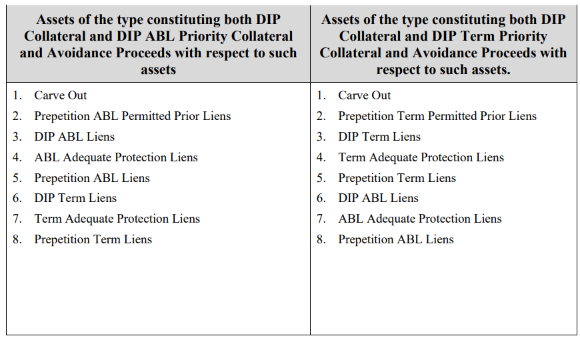
Lien Priority Chart [see Exhibit A of Docket No. 66]