FIRST DAY INTELLIGENCE: Tasty Chick'n, LLC
Triton Pacific-Backed, Plano, Texas-Based Operator of 84 KFC and KFC/Taco Bell Restaurants Across 10 States Files Chapter 11 Facing Yum! Termination Threat
by Nick Montgomery | Nov 17, 2026, 2:58:23 PM
November 16, 2026 – Tasty Chick’n, LLC and three affiliated debtors (together, “Tasty Chick’n” or the “Debtors”) filed for Chapter 11 protection with the U.S. Bankruptcy Court for the Southern District of Texas, lead case No. 26-90831 (Judge Christopher M. López). The Debtors, a Plano, Texas-based operator of 84 KFC and KFC/Taco Bell restaurants across 10 states, are represented by Jason S. Brookner of Gray Reed. Further board-authorized appointments include: (i) Levene, Neale, Bender, Yoo & Golubchik L.L.P. as bankruptcy co-counsel, (ii) Province, LLC as financial advisor, (iii) Peak Franchise Capital and GuideBoat Advisors as investment bankers and (iv) Epiq Corporate Restructuring, LLC as claims agent.
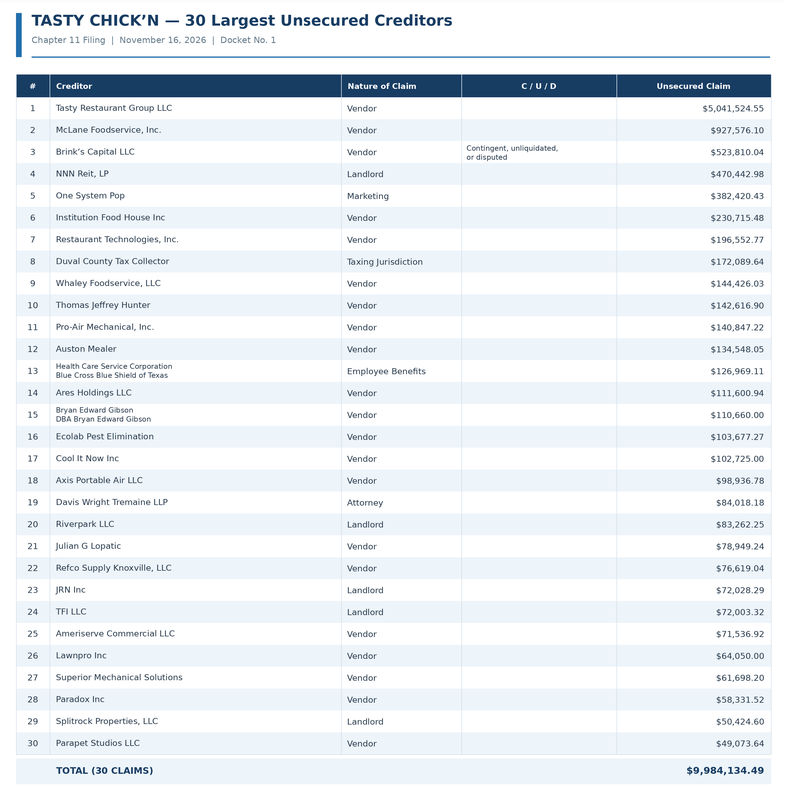
The Debtors’ lead Petition notes between 200 and 999 creditors; estimated assets between $50.0mn and $100.0mn; and estimated liabilities between $100.0mn and $500.0mn. The Debtors report approximately $72.9mn in prepetition borrowing obligations, comprising $67.2mn owed under a MidCap Financial credit agreement, including accrued interest, a $5.0mn subordinated promissory note and $717k owed under a real estate loan. Documents filed with the Court list the Debtors’ three largest unsecured creditors as (i) Tasty Restaurant Group LLC ($5.0mn vendor claim), (ii) McLane Foodservice, Inc. ($928k vendor claim) and (iii) Brink’s Capital LLC ($524k vendor claim, identified as contingent, unliquidated or disputed). The Debtors’ list of 30 largest unsecured creditors includes claims totaling approximately $10.0mn (see below).
Petition Date Highlights
- The Plano, Texas-based KFC franchise group, affiliated with Triton Pacific Capital Partners, files with 84 restaurants across 10 states, approximately $72.9mn in borrowing obligations and Petition-listed liabilities between $100.0mn and $500.0mn.
- Restaurant sales declined 15.6% between fiscal 2023 and fiscal 2026, with restaurant-level margins falling from 11.8% to 4.0% and trailing 12-month store-level EBITDA declining from $12.4mn to $7.1mn.
- The Debtors owe Yum! approximately $15.7mn in unpaid franchise-related obligations and received a September 15, 2026 notice of intent to terminate their franchise agreements. The filing follows unsuccessful efforts to reach a consensual resolution with Yum! and MidCap.
- The Debtors intend to pursue a Court-supervised sale of substantially all their restaurant assets, building on marketing efforts launched in July 2026 and expanded in October. Restaurants are being marketed as a single portfolio, by market and in various combinations.
- MidCap Financial, the Debtors’ prepetition senior secured lender, proposes a $20.0mn DIP facility comprising $5.0mn of new money ($2.5mn available on an interim basis) and a $15.0mn roll-up of prepetition debt, effective only after final approval and funding of the additional new money.
- DIP milestones contemplate bidding procedures approval by December 10th, a January 10th bid deadline, January 19th auction and January 22nd sale approval, with closing required within 21 days. The facility also requires rejection of leases and franchise agreements covering 19 restaurants, including closure of 10 locations by December 24th.
- Yum! Brands moves against another major franchisee following its November 2nd termination of Puerto Rico-based Encanto Restaurants' KFC and Taco Bell agreements, three days before Encanto's Chapter 11 filing. The actions come as Yum! concentrates on KFC-led chicken growth and Taco Bell, emphasizing adequately capitalized franchise operators capable of meeting its operating standards.
Recent Financial Performance
The Debtors report a sustained deterioration in restaurant-level performance since fiscal 2023, with sales declining 11.4% in fiscal 2024, a further 1.4% in fiscal 2025 and 2.8% through fiscal 2026, representing an aggregate decline of approximately 15.6% over the three-year period. Rising labor, operating and rent costs compounded the revenue decline, reducing restaurant-level margins from 11.8% in fiscal 2023 to 4.0% in fiscal 2026. Store-level EBITDA fell approximately 42.7%, from $12.4mn for the trailing 12-month period in fiscal 2025 to $7.1mn for the comparable period in fiscal 2026. The Debtors also face substantial capital expenditure requirements, with approximately 37 restaurants subject to remodel, renewal-upgrade or refresh obligations through 2029. The operating portfolio has contracted to 84 restaurants at filing, compared with 154 locations acquired through transactions completed in 2021 and 2024, although the Debtors have not provided a reconciliation of the reduction.
Filing Date Summary
Tasty Chick’n, a Triton Pacific-affiliated operator of KFC and KFC/Taco Bell restaurants, filed Chapter 11 on November 16, 2026, following a prolonged deterioration in restaurant performance and a threatened termination of its franchise agreements by Yum! Brands. The four Debtors operate 84 restaurants across 10 states and enter bankruptcy with approximately $72.9mn in borrowing obligations, including $67.2mn owed under a senior secured credit agreement with MidCap Financial.
The filing follows two major acquisitions: 90 restaurants purchased from Fowler Foods and affiliates in December 2021 and another 64 acquired from JRN and affiliates in May 2024. A June 2024 investor report identified a portfolio of 162 restaurants, which had declined to 146 by May 2025, adjusted for anticipated closures and divestitures. Commercial real estate marketing materials citing Tasty Restaurant Group reported 145 restaurants as of January 2026, compared with just 84 at the November filing, a net reduction of 61 locations during 2026. The Debtors have not provided a detailed reconciliation of the portfolio contraction. Meanwhile, declining sales and rising labor, food, operating and occupancy costs have sharply reduced profitability. Restaurant-level margins fell from 11.8% in fiscal 2023 to 4.0% in fiscal 2026, while trailing 12-month store-level EBITDA declined from approximately $12.4mn to $7.1mn..
The Debtors began deferring franchise payments in mid-2025 and generally stopped making them that November. Yum! issued a default notice in December 2025 and followed with a September 2026 termination notice asserting approximately $15.7mn in unpaid royalties, advertising contributions and other charges. The Debtors also face approximately 14 landlord-related lawsuits involving claims exceeding $2.0mn.
Tasty Chick’n's filing follows the November 5th Chapter 11 filing of Puerto Rico-based Encanto Restaurants, which operated approximately 180 KFC, Taco Bell, Pizza Hut and IHOP locations before Yum! terminated its KFC and Taco Bell agreements, triggering widespread closures. Unlike Encanto, Tasty Chick’n enters bankruptcy with its franchise agreements subject to a notice of intent to terminate rather than an effective termination. The two filings come as Yum! sharpens its focus on KFC-led chicken growth and Taco Bell, following its disposal of Pizza Hut, while taking an increasingly assertive position toward financially distressed franchise operators.
Having failed to reach an out-of-court resolution with Yum! and MidCap, the Debtors intend to pursue a Court-supervised sale of substantially all their operating assets while continuing to consider standalone restructuring alternatives. MidCap is providing a proposed $20.0mn DIP facility, including $5.0mn in new money and a $15.0mn roll-up, to finance operations and the sale process.
Goals of the Chapter 11 Filing
The Scott Declaration (defined below) provides: “The Debtors filed these chapter 11 cases to preserve the going-concern value of the Restaurants and to conduct a Court-supervised sale of their assets. At the same time, the Debtors will explore other stand-alone restructuring alternatives.”
The Scott Declaration further provides: “The Debtors commenced these chapter 11 cases to address the defaults under the Relationship Agreement and the Franchise Agreements and the threatened termination of the Franchise Agreements. The automatic stay preserves the Franchise Agreements and the going-concern value of the Restaurants and halts the Landlord Actions. Chapter 11 also allows the Debtors to reject burdensome leases for closed and winding-down locations, complete the 7 Pack sale described below, and conduct an orderly, Court-supervised sale process or plan transaction with the Prepetition Lenders for the benefit of their creditors and other stakeholders.”
DIP Financing
The Debtors seek approval of a $20.0mn senior secured, superpriority priming DIP term loan facility from MidCap Financial Trust and/or affiliates, comprising $5.0mn of new money and up to $15.0mn in prepetition debt rolled into the DIP facility [Docket No. 16]. MidCap is also the administrative agent and a lender under the Debtors’ existing May 2024 credit agreement, under which approximately $67.2mn was outstanding at filing, including accrued interest.
The facility provides for an initial $2.5mn new money draw following interim approval, with the remaining $2.5mn available through further draws consistent with an approved budget and the financing conditions. Following entry of the final DIP order and funding of the final new money draw, up to three times the aggregate new money borrowings, or $15.0mn, of prepetition principal debt will be exchanged for DIP obligations. No roll-up is requested on an interim basis.
The DIP loans bear interest at 14.0% annually, capitalized monthly and added to principal, increasing to 16.0% following a termination event, subject to applicable law. The facility carries a 1.0% commitment fee and, subject to final approval, a 1.0% exit fee, each calculated exclusively on the $5.0mn new money commitment. The DIP matures upon the earliest of February 12, 2027, closing of a sale of substantially all the Debtors’ assets, effectiveness of a Chapter 11 Plan or certain other termination events. The proposed financing is secured by priming liens on substantially all assets of the borrower group and superpriority administrative claims, subject to agreed exclusions and the carve-out. The DIP lender, as prepetition lender, has consented to the priming of its existing liens.
The facility also provides for continued use of cash collateral, subject to an approved budget, with aggregate disbursements permitted to exceed budgeted amounts by no more than 15%, excluding professional fees. The Debtors must provide biweekly budget updates and variance reports to MidCap and the Yum! Parties.
The DIP establishes the following sale milestones: bidding procedures approval by December 10, 2026; binding bids due January 10, 2027; an auction by January 19th; entry of sale approval orders by January 22nd; and closing no later than 21 days after entry of the applicable sale order. The milestones are subject to lender consent for modification or extension.
The financing also incorporates restaurant closure and lease rejection requirements. To obtain the final draw, the Debtors must file motions to reject leases and franchise agreements associated with nine restaurant locations effective as of the Petition Date, and another 10 locations effective December 31st, with those 10 stores to be closed by December 24th. The proposed DIP makes failure to obtain the corresponding rejection orders by November 23rd and December 15th, respectively, an event of default.
Events Leading to the Chapter 11 Filing
In a declaration in support of first day filings (the “Scott Declaration”) [Docket No. 22], Thomas M. Scott, the Debtors’ president and CEO, attributes the filing to declining restaurant revenues, rising operating expenses, franchise-related capital requirements and escalating defaults under the Debtors’ agreements with Yum! Brands and MidCap Financial.
Scott details a decline in restaurant-level profitability beginning in 2023, with sales falling approximately 15.6% over three fiscal years and margins contracting by nearly eight percentage points. The deterioration left the Debtors unable to meet franchise payment obligations, which they largely stopped paying in late 2025. Yum! subsequently threatened to terminate their franchise agreements over $15.7mn in unpaid obligations, while the Debtors faced existing financial covenant defaults under their MidCap credit facility and approximately 14 landlord-related lawsuits. Attempts to negotiate a consensual resolution with Yum! and MidCap failed ahead of the filing.
Drilling down, Scott provides:
Operational and Financial Pressures. The Debtors’ store-level profitability has been declining since 2023, beginning with falling sales. The Restaurants’ sales fell 11.4% in fiscal year 2024, fell another 1.4% in fiscal year 2025, and have fallen 2.8% so far in fiscal year 2026. Taken together, sales at the Restaurants have declined by approximately 15.6% over this three-year period. As sales fell, the Debtors’ costs rose. As a result, restaurant margins shrank from 11.8% in fiscal year 2023 to 4.0% so far in fiscal year 2026. Over the trailing twelve-month period of fiscal year 2026, store-level EBITDA declined from approximately $12.4 million for the comparable trailing twelve-month period in fiscal year 2025 to approximately $7.1 million. Over the same period, labor costs, operating expenses, and rent all increased.
The broader KFC system has also experienced decline. KFC’s greater United States system sales declined 6.0% in the third quarter of 2026, and net restaurant growth in the country was negative 2.8% in the first half of 2026. At the same time, the Operating Debtors face substantial capital requirements under the Franchise Agreements. Currently, approximately 37 Restaurants have substantial remodel, renewal-upgrade, or refresh obligations through 2029.
In response to these pressures, the Operating Debtors began deferring Royalty payments in mid-2025 and generally ceased paying Royalties starting in November 2025. Consequently, as of September 2026, the Operating Debtors had failed to pay more than $15.6 million in Royalties to the Yum! Parties, culminating in the Original Default Notice and the Notice of Intent to Terminate. Termination of the Franchise Agreements would end the Operating Debtors’ right to operate the Restaurants under the KFC and Taco Bell brands and would constitute an event of default under the Credit Agreement. Because the Operating Debtors’ business consists of operating franchised Restaurants, termination would eliminate the going-concern value of the business and the value that a buyer or the Prepetition Lenders could otherwise realize.
Landlord and Other Litigation. As of the Petition Date, the Debtors are defendants in approximately 14 real estate related actions pending in state and federal courts in Illinois, Florida, Kentucky, Tennessee, and Virginia (collectively, the “Landlord Actions”). Based on my review of the pleadings and my discussions with the Debtors’ management and advisors, I understand that the Landlord Actions generally arise from the Debtors’ nonpayment of rent and other charges under leases for Restaurant locations, including several locations that the Debtors closed or were in the process of closing before the Petition Date. The plaintiffs in the Landlord Actions seek, among other things, past-due rent, accelerated rent and other lease damages, attorneys’ fees and costs, and possession of the leased premises.
The most significant Landlord Actions are: (a) a lease default action relating to the Robinson, Illinois location, Case No. 3:26-cv-00050-SPM, pending in the U.S. District Court for the Southern District of Illinois, in which the plaintiff seeks approximately $1,800,505.00 in damages; and (b) a lease default action relating to the Magnolia, Tennessee location, Case No. 3-183-26, pending in the Circuit Court of Knox County, Tennessee, in which the plaintiff seeks approximately $134,009.27 in damages. I understand that the aggregate amount asserted against the Debtors in the Landlord Actions exceeds approximately $2 million.
Several of the Landlord Actions relate to closed or winding-down locations subject to leases that the Debtors seek to reject or may seek to reject. Others relate to Restaurants that the Debtors continue to operate and that I believe may be important to preserving the going-concern value of the Debtors’ business. Absent the protection of the automatic stay, the continued prosecution of the Landlord Actions would require the Debtors to divert limited cash and management time to defending multiple suits across several jurisdictions, could result in judgments for possession that would force the closure of operating Restaurants, and could trigger additional defaults under the Franchise Agreements and the Credit Agreement.
Prepetition Indebtedness
As of the Petition Date, the Debtors had approximately $72.9mn in borrowing obligations, including accrued interest on their principal senior secured facility, comprising obligations under the following financing arrangements.
- MidCap Credit Agreement. The Operating Debtors are party to a May 16, 2024 credit and guaranty agreement with MidCap Financial Trust serving as administrative agent and lender, alongside MidCap Financial Investment Corporation, MidCap Funding Franchise Finance Trust, MidCap Funding VI Trust and Athora Lux Invest NL. The credit agreement provides for three facilities: (i) a $58.0mn original principal term loan, (ii) a $30.0mn development line of credit and (iii) a $10.0mn revolving letter of credit facility. The term loan matures May 16, 2029, with development line and letter of credit commitments expiring on the same date. The loans bear interest at Term SOFR plus 5.75% to 6.25%, subject to a 1.0% SOFR floor, or an applicable base rate plus 4.75% to 5.25%, depending on leverage. As of the Petition Date, the loans bore interest at approximately 10.02%, with default interest accruing at an additional 2.0%. Obligations are secured by substantially all personal property of the Operating Debtors. Approximately $25.0mn of the original term loan proceeds were used to refinance a Western Alliance loan that had replaced seller financing associated with the 2021 Fowler acquisition. The balance supported the 2024 JRN acquisition. As of the Petition Date, approximately $67.2mn in principal and accrued interest was outstanding under the MidCap credit agreement, plus additional costs and fees. The Debtors had experienced multiple financial covenant defaults, including breaches of fixed-charge coverage and leverage ratios, and MidCap issued a reservation of rights letter in September 2025.
- JRN Subordinated Note. In connection with the May 2024 JRN acquisition, Tasty Chick’n issued a $5.0mn unsecured subordinated promissory note in favor of JRN, Inc. The note is subordinated to obligations under the MidCap credit agreement. Approximately $5.0mn in principal remained outstanding at filing.
- 7 Pack Loan Agreement. Debtor VRE Tasty 7 Pack, LLC is party to a May 15, 2024 commercial loan agreement with The American National Bank of Texas, originally providing $4.7mn in financing for the acquisition of real estate underlying seven KFC restaurants. The loan bears interest at 6.80%, subject to applicable usury limits, and matures May 16, 2027. Following sales of six properties, only a parcel in Cave City, Kentucky remains. As of the Petition Date, approximately $717k was outstanding under the 7 Pack loan.
- Unsecured and Franchise-Related Debt. In addition to funded borrowing obligations, the Debtors report approximately $15.7mn in unpaid obligations to the Yum! Parties as of September 2026, comprising franchise royalties, advertising contributions, digital and technology fees, rent-related charges and KFC Foundation fees. The Debtors’ list of 30 largest unsecured creditors includes claims totaling approximately $10.0mn, led by the $5.0mn claim of non-debtor management company Tasty Restaurant Group LLC. The list also includes significant vendor, landlord and other operating claims [Docket No. 1].
Key Prepetition Shareholders
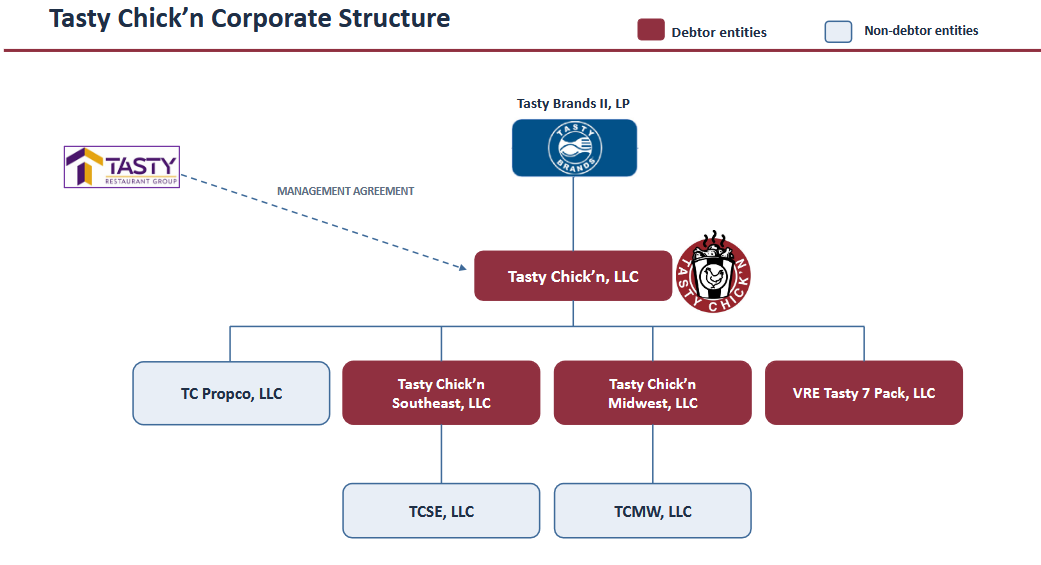
The equity security holder list attached to the lead Petition identifies Tasty Brands II, LP as the largest direct equity holder of Tasty Chick’n, LLC, with 69.62% of its interests.
Tasty Fund Manager II, LLC holds a further 20.00%, while Tasty Brands II Blocker, LP holds 8.78%. The remaining interests are distributed among smaller holders, including Craig Faggen, Ivan Faggen and Thomas M. Scott.
The Scott Declaration identifies Tasty Brands II, LP as Tasty Chick’n’s managing member, with Tasty Fund Manager II, LLC serving as general partner of Tasty Brands II.
Tasty Chick’n is associated with Triton Pacific Capital Partners, whose affiliate acquired the 64-unit JRN KFC portfolio in May 2024. The June 2024 acquisition announcement identified the purchase as an addition to Triton Pacific’s existing Tasty Chick’n platform.
Top Unsecured Creditors
About the Debtors
According to the Scott Declaration: “The Operating Debtors currently own and/or operate 84 KFC and KFC/Taco Bell co-branded Restaurants under Franchise Agreements with the Yum! Parties....Of the 84 restaurants, 75 operate under the KFC brand and nine are co-branded KFC/Taco Bell restaurants. The locations are spread across Florida, Tennessee, Virginia, Arkansas, Kentucky, Illinois, Missouri, Alabama, Mississippi and Indiana....The Debtors were formed in 2021 and expanded through two principal acquisitions. The first was the December 2021 acquisition of 90 restaurants from Fowler Foods and affiliates, followed by the May 2024 acquisition of 64 restaurants from JRN and affiliates....Non-debtor Tasty Restaurant Group provides management, financial, accounting, human resources, vendor management, real estate and other corporate services under a December 2021 management services agreement. The Debtors pay an agreed management fee equal to 3.0% of gross revenue, although only 1.0% is currently paid in cash, with the remaining 2.0% subordinated to the prepetition lenders and accruing on the Debtors’ books...The agreement also provides for a termination fee following a sale or other specified capital event, calculated at six times the monthly management fee for the last completed calendar month, prorated in the case of a partial asset sale."
Corporate Structure Chart (see Scott Declaration, Exhibit A, page 21 [Docket No. 22]).