FIRST DAY INTELLIGENCE: Getty Images Holdings, Inc.
Global Visual Content Licensor Files Prepackaged Chapter 11 to Restructure $1.47bn Debt Stack, Pay Unsecured Noteholders $170.2mn and Preserve Getty Family–Koch Control Through $143.0mn Insider DIP Financing
by Nick Montgomery | Oct 21, 2026, 9:09:03 AM
Getty Images Holdings, Inc. and six affiliated debtors (OTCPK: GETY; together, “Getty Images” or the “Debtors”) filed for Chapter 11 protection on a prepackaged basis with the U.S. Bankruptcy Court for the District of Delaware, lead case No. 26-11643 (Judge J. Kate Stickles) [Docket No. 1].
The Debtors, a Seattle, Washington-based global visual content licensing and distribution group operating through the Getty Images, iStock and Unsplash brands, are represented by Justin R. Alberto of Cole Schotz P.C. Further Board-authorized professional appointments include: (i) Simpson Thacher & Bartlett LLP as general bankruptcy counsel, (ii) Alvarez & Marsal North America, LLC as financial advisor, (iii) Guggenheim Securities, LLC as investment banker and (iv) Kroll Restructuring Administration LLC as claims and noticing agent.
The Debtors’ lead Petition lists more than 100,000 creditors; estimated assets between $1.0bn and $10.0bn; and estimated liabilities between $1.0bn and $10.0bn. The publicly traded parent reported assets of $3.1bn and total debts of $2.6bn as of June 30, 2026, while the prepetition Disclosure Statement identifies approximately $1.46bn of funded debt outstanding at filing, including approximately $1.19bn of secured loans and notes and $270.0mn of unsecured notes. The June 30th balance sheet predates the redemption of $628.4mn of merger-financing notes following the termination of Getty's proposed combination with Shutterstock.
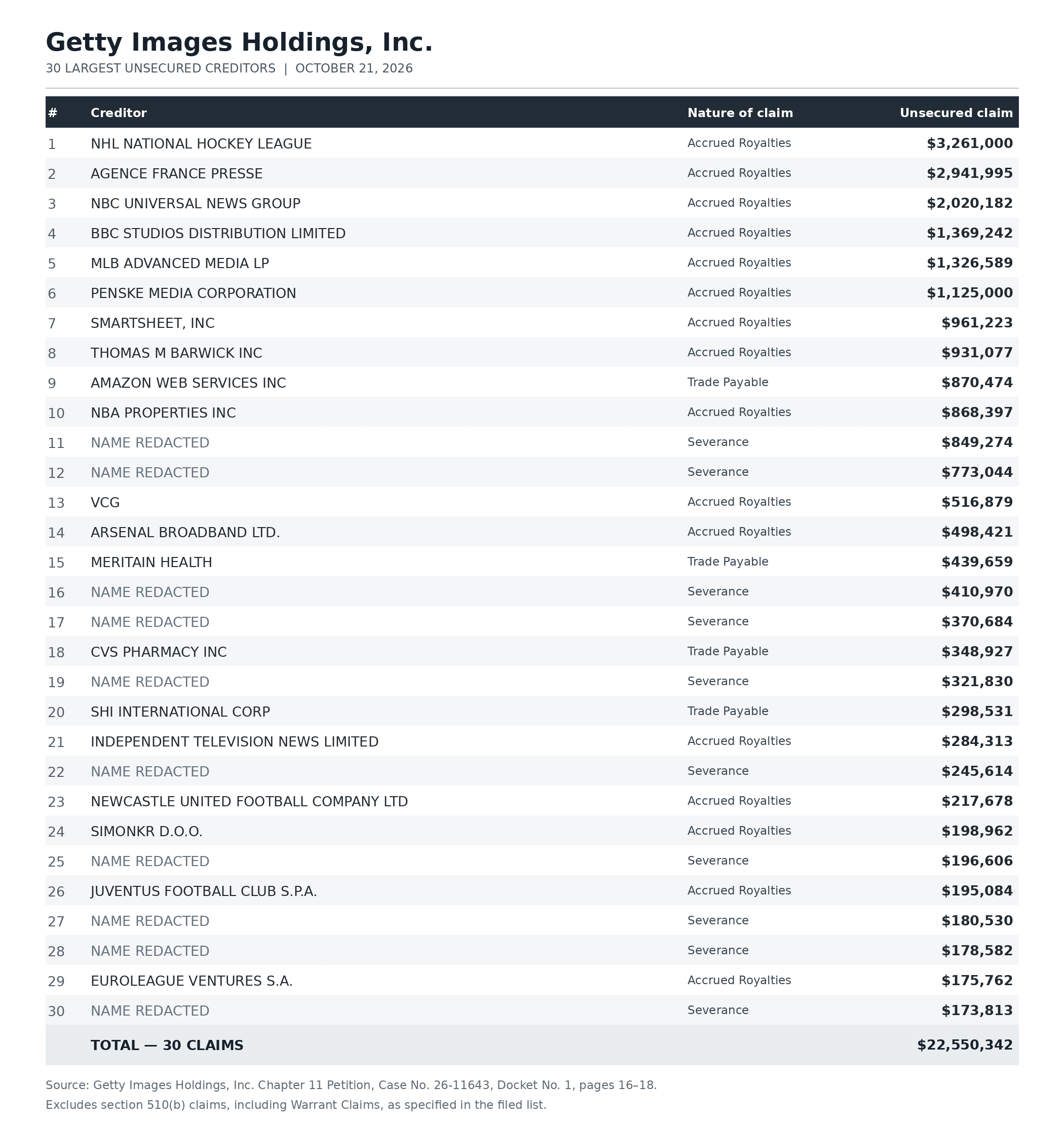
Documents filed with the Court list the Debtors’ three largest unsecured creditors as (i) NHL National Hockey League ($3.3mn accrued royalties claim), (ii) Agence France Presse ($2.9mn accrued royalties claim) and (iii) NBC Universal News Group ($2.0mn accrued royalties claim). The consolidated list of 30 largest unsecured creditors totals $22.6mn, made up principally of accrued royalties owed to content partners, severance obligations and trade payables. The list excludes claims arising from the company's public warrant litigation, which the Plan proposes to subordinate under section 510(b) and cancel without recovery.
In a press release announcing the filing, the Debtors stated: “The Company has launched a solicitation process for formal approval of the prepackaged plan of reorganization and, to implement the plan in the most efficient manner, has commenced voluntary Chapter 11 proceedings in the U.S. Bankruptcy Court for the District of Delaware.”
The Debtors' CEO Craig Peters added: “Today's filing is a procedural step to implement the financial restructuring previously announced. Getty Images continues to operate normally, serving customers and supporting contributors and partners around the world. This process addresses our capital structure and certain non-operating liabilities and supports expanded investment into our content and services.”
Petition Date Highlights
- Seattle, Washington-based Getty Images, a global visual content licensing and distribution business, files prepackaged Chapter 11 cases with $1.46bn of funded debt, comprising $1.19bn of secured debt and $270.0mn of unsecured notes; petition-listed assets and liabilities each fall between $1.0bn and $10.0bn.
- The filing follows more than $200.0mn in warrant litigation judgments and interest, the failed $3.7bn Shutterstock merger and approximately $239.0mn in annual debt-service obligations, including $154.0mn of interest. The Debtors cite a liquidity crisis, with their $150.0mn revolver fully drawn and forecasts showing liquidity falling below minimum operating requirements in the fourth quarter of 2026.
- The Debtors file pursuant to an October 12th RSA supported by 100% of revolving lenders, approximately 90% of secured funded debt holders, approximately 83% of unsecured noteholders and existing controlling shareholders affiliated with the Getty family and Koch Equity Development (“KED”).
- The restructuring contemplates more than $500.0mn of funded-debt reduction through refinancing and equitization of secured debt, repayment of revolving borrowings and retirement of $270.0mn of unsecured notes for $170.2mn in cash. Getty family and KED affiliates have committed up to $533.0mn through cash financing, including DIP funding, and conversion of approximately $100.0mn of existing secured debt into equity.
- Warrant-related claims, including approximately $99.5mn in remaining pending judgments and associated interest, would be subordinated under section 510(b) and receive no recovery. Existing common shares would also be cancelled, although the Getty family and KED would own all reorganized common equity through the restructuring transaction, subject to management incentive dilution of up to 10%.
- The Debtors seek approval of a $143.0mn KED-backed DIP facility consisting of $113.0mn of ordinary loans ($85.0mn interim and $28.0mn final) and a $30.0mn delayed-draw tranche available subject to conditions following interim approval. The financing carries Term SOFR plus 5.00% PIK interest, with no prepetition debt roll-up and no scheduled cash repayment at emergence under the Plan [Docket No. 18].
- The Debtors project $65.0mn in annual interest savings, a $133.0mn reduction in annual debt service and approximately $75.0mn of cash at emergence, before any applicable equity commitment letter closing payments, together with $150.0mn of undrawn revolving availability. The proposed timetable provides for a November 30th voting and objection deadline and a December 14th combined Disclosure Statement and confirmation hearing, with emergence required within 75 days of filing under the RSA.
UPDATE: On October 22nd, the Court hearing the Getty Images Holdings, Inc. cases issued a conditional order approving (retroactively and subject to the issuance of a Plan confirmation order): (i) the adequacy of the Debtors’ Disclosure Statement, (ii) proposed voting and solicitation procedures and (iii) a timetable culminating in a December 15th, 2026 Plan confirmation hearing [Docket No. 120]. As is customary with prepacks, the order also waives (again subject to final Court sign-off as part of Plan confirmation) the requirements to hold a creditors' meeting and to file SOFAS/financial schedules.
Approved Key Dates
- Voting Record Date: October 9, 2026
- Commencement of Solicitation: October 20, 2026
- Petition Date: October 21, 2026
- Initial Plan Supplement Filing Deadline: November 23, 2026
- Voting Deadline / Objection Deadline: November 30, 2026, at 5:00 p.m. (prevailing Eastern Time)
- Deadline to File Proposed Confirmation Order: December 9, 2026
- Deadline to File Confirmation Brief and Reply: December 9, 2026
- Combined Hearing: December 14, 2026
Filing Date Summary
Getty Images Holdings, Inc. and six affiliates commenced prepackaged Chapter 11 proceedings on October 21st to implement a recapitalization supported by major creditor groups and the company's controlling shareholders, members of the Getty family and Koch Equity Development (“KED”). The Seattle-based global visual content licensing group entered bankruptcy with approximately $1.46bn of funded debt, including $1.19bn of secured borrowings and $270.0mn of unsecured notes, after a series of 2025 refinancings extended maturities but substantially increased financing costs. The Debtors say the restructuring will reduce funded debt by more than $500.0mn, generate $65.0mn in annual interest savings and lower annual debt service by approximately $133.0mn.
The filing follows an eighteen-month deterioration in liquidity driven principally by litigation arising from the company's 2022 SPAC listing, the collapse of its proposed $3.7bn combination with Shutterstock and an annual debt-service burden that had reached approximately $239.0mn. In their October 20th prepetition Disclosure Statement, the Debtors report more than $200.0mn in adverse warrant litigation judgments and associated interest, alongside approximately $35.0mn in litigation expenses. Getty paid $110.9mn in April 2026 to satisfy judgments obtained by former warrant holders, financing much of that payment through a $120.0mn revolving loan draw. Further adverse judgments, including a New York state court award subsequently calculated by plaintiffs at approximately $92.3mn including interest, left the company with approximately $99.5mn in remaining pending judgments and associated interest, as well as estimated potential exposure exceeding $275.0mn from additional unasserted warrant claims. Getty says it was unable to obtain a bond to stay enforcement of the state court judgment while appealing.
The proposed Shutterstock merger, announced in January 2025, was terminated in July 2026 after the U.K. Competition and Markets Authority required divestiture of Shutterstock's editorial business. The Debtors say they considered potential buyers for the business but ultimately rejected the divestiture after concluding that the associated costs, delays and regulatory obligations outweighed the benefits of completing the transaction, particularly given the outstanding warrant liabilities. Getty reports spending more than $100.0mn in fees pursuing the merger, approximately $10.0mn in accelerated compliance costs and $43.6mn in net interest and financing fees associated with $628.4mn of secured notes issued into escrow for the acquisition and subsequently redeemed. Interest expense across the business rose 61% to $111.5mn in the first half of 2026.
By July, Getty had fully drawn its $150.0mn revolving facility, and management forecasts showed liquidity falling below the company's $50.0mn minimum operating requirement during the fourth quarter, with negative liquidity projected by June 2027 even before additional warrant payments or restructuring expenses. The company reported approximately $50.0mn in cash at filing, compared with $90.2mn at year-end 2025, and disclosed substantial doubt about its ability to continue as a going concern in August. Although Getty reported approximately $978.0mn in trailing twelve-month revenue and $307.0mn in adjusted EBITDA, the Disclosure Statement also acknowledges pressure on its iStock and agency businesses, including a 24% decline in purchasing customers since 2022 amid changing demand and competition from generative AI.
The October 12th RSA emerged from negotiations among secured creditors, unsecured noteholders and the Getty family and KED investors. The Debtors say an initial agreement with secured creditors was rejected by the unsecured noteholder committee, prompting negotiations that increased the sponsors' committed cash investment from approximately $280.0mn to $433.2mn. Under the resulting Plan, holders of $270.0mn in unsecured notes would receive $170.2mn in cash, approximately 63% of principal, while third-party secured loans and notes would be refinanced into instruments with extended maturities and reduced interest rates. General unsecured creditors would remain unimpaired, but claims arising from the warrant litigation would be subordinated under section 510(b) and cancelled without recovery, together with existing common shares.
Getty family and KED affiliates have committed up to $533.0mn through cash financing and the conversion of approximately $100.0mn of existing secured debt into equity. The Debtors seek approval of a $143.0mn DIP facility provided by KED or its affiliates, comprising $113.0mn of ordinary loans and $30.0mn of delayed-draw commitments [Docket No. 18]. The DIP motion states that Guggenheim Securities approached twelve potential third-party financing sources, but none provided a more favorable actionable proposal. The financing carries Term SOFR plus 5.00% PIK interest, contains no prepetition roll-up and provides for the ordinary loans to convert into reorganized common equity, with the delayed-draw loans converting into preferred equity. The participating Getty family and KED investors would acquire 100% of the reorganized company's common shares, subject to dilution through a management incentive plan of up to 10%.
The Debtors project approximately $75.0mn in cash at emergence, before any applicable equity commitment letter closing payments, and $150.0mn of undrawn revolving capacity. The proposed case calendar provides for a November 30th voting and objection deadline and a December 14th combined Disclosure Statement and confirmation hearing. The RSA requires confirmation within 55 days and emergence within 75 days of the October 21st filing, subject to extensions.
Restructuring Support Agreement
On October 13th, the Debtors disclosed an October 12th restructuring support agreement (the "RSA") in a Form 8-K filed with the SEC, supported by holders of approximately 89% of their secured funded debt, 100% of their revolving loans and 83.5% of their unsecured notes, excluding notes held by participating shareholders or their affiliates. The agreement provides for a prepackaged Chapter 11 restructuring sponsored by existing controlling shareholders affiliated with the Getty family and Koch Equity Development (“KED”), who collectively held approximately 73% of the company's Class A common stock before filing and would own all common equity in the reorganized company, subject to management incentive dilution of up to 10%.
The transaction follows negotiations among secured lenders, revolving lenders, unsecured noteholders and the proposed equity investors, overseen by independent special committees established at the parent and subsidiary levels. According to the October 20th prepetition Disclosure Statement, the Unsecured Noteholders Ad Hoc Committee rejected an initial agreement reached with the Secured Ad Hoc Group, after which the Debtors negotiated an increase in the sponsors' committed cash equity investment from approximately $280.0mn to $433.2mn. The increased contribution would finance a $170.2mn cash distribution to holders of approximately $270.0mn of unsecured notes, representing a recovery of approximately 63% of outstanding principal before accrued interest.
The broader investment commitment totals up to $533.0mn, comprising the $433.2mn cash commitment, inclusive of ordinary DIP financing, and approximately $100.0mn of existing secured debt held by the sponsors that would convert into equity. The cash contribution at emergence would be reduced dollar-for-dollar by the principal amount of up to $113.0mn of ordinary DIP loans then outstanding, resulting in approximately $320.2mn of additional cash equity funding if the entire ordinary tranche remains outstanding. The separate $30.0mn delayed-draw DIP tranche would convert into preferred equity rather than reduce the cash equity investment.
The restructuring would refinance approximately $1.2bn of existing secured debt, including the $150.0mn revolving credit facility, $40.1mn of U.S. dollar term loans, €407.0mn of euro term loans and $539.9mn of 11.25% secured notes due 2030. Revolving loan claims would initially convert into obligations under an amended $150.0mn facility on a dollar-for-dollar basis, with the outstanding borrowings repaid from the equity investment at emergence. The new revolving facility would be undrawn at emergence and mature in January 2031.
Secured term loans and notes held by creditors other than the sponsors would be refinanced into new first-lien obligations, with the U.S. dollar term loans and secured notes exchanged into approximately $580.0mn of new secured notes maturing in April 2032 and non-sponsor euro term loans exchanged into new euro-denominated term loans with the same maturity. The new secured notes would carry leverage-based interest rates ranging from 9.00% to 10.50%, while the euro term loans would bear EURIBOR plus 3.75% to 5.25%, with 5% annual amortization beginning in the second quarter of 2027. Investor-held euro term loans would instead convert into new common equity.
The Disclosure Statement also identifies approximately $50.0mn in make-whole claims associated with the secured notes and term loans that would receive no recovery, while the sponsors would equitize approximately €87.6mn in existing euro term loans. Together with the approximately $100.0mn discount accepted by unsecured noteholders, the Debtors identify these concessions as components of the negotiated restructuring. The Disclosure Statement states that an alternative transaction would have to provide up to approximately $391.0mn in additional value to address these compromises and the proposed DIP financing before producing recoveries for existing equity or claims subordinated under section 510(b).
Under the Plan, holders of the company's 9.75% senior notes due 2027 and 14.00% senior notes due 2028 would receive their pro rata share of $170.2mn in cash at emergence, while general unsecured creditors, including trade vendors, content contributors and other operating counterparties, would be paid in full, reinstated or otherwise left unimpaired. Claims arising from the company's public warrants and associated litigation would be subordinated under section 510(b) and cancelled without recovery, together with existing common equity. The Debtors estimate approximately $99.5mn in remaining pending warrant judgments and associated interest and potential additional exposure exceeding $275.0mn from unasserted warrant claims.
The Debtors project that the transaction would reduce funded indebtedness by more than $500.0mn, generate approximately $65.0mn in annual interest savings and lower annual debt service by approximately $133.0mn. They expect approximately $75.0mn in cash at emergence, before any applicable equity commitment letter closing payments, and $150.0mn of undrawn revolving availability. Getty Images would become a privately held company, with the participating Getty family and KED investors designating the new Board and retaining 100% of the reorganized common equity, subject to management incentive dilution.
The RSA also requires assumption of the February 1998 trademark option agreement involving Getty Investments L.L.C. and Getty Images, Inc. without modification. It preserves specified contractual rights relating to the Getty Images trademarks and includes termination rights tied to changes affecting those rights, the agreed releases, exculpation and injunction provisions. The agreement permits the Debtors to consider alternative restructuring proposals and terminate the RSA where proceeding with the existing transaction would be inconsistent with applicable fiduciary duties, subject to specified notice and consultation requirements.
The restructuring was reviewed by separate special committees established at Getty Images Holdings, Inc. and its filing subsidiaries. The parent committee, comprising independent directors Elizabeth Abrams and Thomas Walper, and subsidiary committees led by independent director Neal Goldman retained separate counsel and began investigating potential intercompany claims and ownership of certain legal claims. According to the Disclosure Statement, those investigations remained ongoing as of the filing.
The RSA requires interim DIP approval within three business days of October 21st, final DIP approval within 35 calendar days, confirmation within 55 days and emergence within 75 days. The Debtors have proposed a November 30th voting and objection deadline and a December 14th combined Disclosure Statement and confirmation hearing, subject to Court approval. The emergence milestone may be extended by up to 30 additional days with sponsor consent where outstanding regulatory or governmental approvals prevent closing, provided the other specified conditions have been satisfied.
Goals of the Chapter 11 Filing
The Board resolutions attached to the lead Petition describe a restructuring intended to improve liquidity, refinance portions of the existing capital structure, equitize certain secured obligations and facilitate a new equity investment from consenting shareholders [Docket No. 1].
The resolutions provide that the proposed transactions contemplate:
“(a) entry into a debtor-in-possession financing facility to be provided by certain Consenting Shareholders ... and the conversion of such DIP Facility into new common equity interests in the parent of the reorganized Company Parties ... and new preferred interests; (b) the refinancing of the allowed Revolving Loan Claims into obligations under an amended and restated senior secured revolving credit facility on a dollar-for-dollar, cashless basis; (c) the refinancing of the allowed Secured Funded Debt Claims not held by the Consenting Shareholders into new euro-denominated term loans and new senior secured notes on a dollar-for-dollar, cashless basis; (d) the conversion of the Secured Funded Debt Claims held by the Consenting Shareholders into New Interests; (e) the distribution to holders of allowed Unsecured Notes Claims of cash in an aggregate amount equal to $170,212,922.50; (f) a new equity investment by the Consenting Shareholders pursuant to an equity commitment letter ...”
The resolutions further contemplate that, following implementation of the transactions, the consenting shareholders will receive 100% of the new common equity, subject only to dilution under a management incentive plan.
DIP Financing
On October 21st, the Debtors filed a motion seeking interim and final approval of up to $143.0mn in new money DIP financing from Koch Equity Development LLC (“KED”) and/or its affiliates, together with authority to use cash collateral subject to the consent of existing secured lenders and the provision of adequate protection [Docket No. 18]. The proposed multi-draw facility comprises $113.0mn of ordinary term loans, including $85.0mn available following interim approval and $28.0mn following final approval, and a separate $30.0mn delayed-draw tranche available following interim approval subject to specified borrowing conditions. Getty Images Holdings, Inc. would serve as borrower, with the other six Debtors providing joint and several guarantees, and Cantor Fitzgerald Securities acting as administrative and collateral agent.
The motion details an immediate liquidity requirement driven by the company's continuing operating expenses and the projected costs of Chapter 11. The Debtors report approximately $15.0mn in monthly payroll and benefits for employees, freelancers and contingent workers, $20.0mn in monthly payments to content contributors and royalty partners, and another $15.0mn in payments to technology providers, licensors and other essential vendors. Without DIP financing, the initial budget projects a cash deficit of approximately $63.5mn by the week ending November 21, 2026. Including a $20.0mn minimum operating cash requirement attributable to the filing entities, the Debtors calculate a funding requirement of approximately $83.5mn through that date, supporting their request for $85.0mn in initial ordinary DIP loans.
The company distinguishes that $20.0mn requirement from the approximately $50.0mn of minimum liquidity needed by the broader consolidated group, including non-Debtor foreign affiliates. The DIP documents separately impose a $15.0mn minimum liquidity covenant, measured using cash on hand and amounts held in a segregated DIP account. According to the motion, the proposed financing is necessary because the company exhausted its $150.0mn revolving facility before filing and would otherwise lack sufficient liquidity to maintain ordinary-course operations during the initial weeks of Chapter 11.
The financing follows a process in which Guggenheim Securities approached existing secured creditors, the restructuring sponsors and twelve potential third-party DIP providers. On September 22nd, consenting secured lenders submitted a proposal that would have required cash repayment of their proposed DIP financing unless they agreed to alternative treatment. The sponsors subsequently proposed financing on more favorable economic terms, including pricing, fees and conversion into equity at emergence. Of the twelve third-party sources subsequently contacted, eight expressly declined because they did not believe they could compete with the proposed terms, two indicated no willingness to provide financing and two expressed potential interest. One of the latter sought first-priority liens on all Debtor assets, which existing secured lenders were unwilling to accommodate, while the other did not provide an actionable proposal with complete economic terms.
Because the sponsors are also existing shareholders, the proposed financing was evaluated and negotiated under the direction of special committees appointed at the parent and subsidiary levels. The Debtors say those committees, each represented by independent counsel, reviewed competing proposals and negotiated the facility through multiple exchanges of term sheets and financing documents before approving the proposed terms.
The DIP carries interest at Term SOFR plus 5.00% annually, payable in kind and capitalized into principal, with an additional 2.00% default-rate premium. The facility requires no scheduled amortization and includes no commitment fee, upfront fee, backstop premium, original issue discount or call protection. A 2.00% cash exit fee, calculated on outstanding DIP loans including capitalized interest, becomes payable only upon specified terminations of the RSA under its fiduciary-out provisions. The facility has a January 31, 2027 outside maturity, subject to earlier termination events, including consummation of a Plan, conversion or dismissal of the cases, acceleration of the debt or a sale of substantially all assets.
The financing is structured to convert into equity rather than require cash repayment upon consummation of the proposed Plan. The ordinary DIP loans, including capitalized interest, would be exchanged for reorganized common equity and reduce the cash investment required under the sponsors' approximately $433.2mn equity commitment by the principal amount outstanding. Any delayed-draw loans outstanding at emergence would convert into preferred equity, which the reorganized company may redeem at an amount equal to the delayed-draw principal, subject to new Board approval. The delayed-draw conversion would not reduce the remaining cash equity commitment. If the RSA transactions are not implemented and the Plan does not become effective, the DIP obligations would instead be repayable in cash under the financing documents.
The proposed collateral package preserves the existing secured lenders' priorities on prepetition collateral. The DIP would receive first-priority liens on previously unencumbered property, the segregated DIP account, an additional 35% of specified foreign subsidiary equity interests not already included in prepetition collateral and, subject to final approval, proceeds of avoidance and recovery actions. DIP liens on existing prepetition collateral would rank behind prepetition liens and adequate protection liens. The DIP lenders would also receive superpriority administrative expense claims, subordinate to the professional-fee carve-out and adequate protection claims. The financing does not include a roll-up of prepetition indebtedness.
The Debtors also propose continuing cash payments to prepetition secured creditors as adequate protection, including interest at applicable non-default rates, required principal amortization, administrative agency fees and reasonable professional expenses. These payments would include interest and amortization associated with prepetition secured debt held by DIP lenders or their affiliates. The proposed order grants replacement liens and superpriority claims to existing secured creditors to the extent of diminution in collateral value.
DIP proceeds would be deposited into a segregated account controlled by the DIP agent. Withdrawals would generally be limited to amounts needed to fund two weeks of expenditures under an approved thirteen-week cash-flow budget, plus a 20% cushion, or to fund the professional-fee carve-out. Updated budgets would be submitted every four weeks, subject to lender consent, with biweekly variance reporting and a covenant limiting aggregate disbursements to 120% of budgeted amounts during the applicable testing period. The $30.0mn delayed-draw tranche would be restricted to specified expenditures identified in the approved budget or reimbursement of eligible payments previously made from available cash.
The proposed order includes a professional-fee carve-out covering accrued permitted professional expenses and up to $2.5mn in additional professional fees following a carve-out trigger notice, together with statutory fees and up to $50k in Chapter 7 trustee expenses. It would prohibit the use of DIP proceeds, cash collateral or the carve-out to investigate or pursue claims against DIP lenders or prepetition secured creditors. The order also contains stipulations concerning the validity and priority of prepetition secured claims, subject to a challenge deadline set one business day before the final DIP hearing, and proposed waivers of surcharge and marshaling rights and, following final approval, the equities-of-the-case exception under section 552(b).
The DIP milestones track the RSA, requiring interim approval within three business days of filing, final approval within 35 days, confirmation within 55 days and emergence within 75 days, subject to permitted extensions. Breach of those milestones constitutes an event of default without a cure period. Other defaults include specified covenant breaches, failure of the RSA, unauthorized changes to exclusivity and cross-defaults involving postpetition debt exceeding $5.0mn. Following a termination notice, the proposed order provides a five-business-day remedies notice period, during which the Debtors could use available funds for a limited amount of essential ordinary-course expenses and to fund the carve-out while seeking an emergency hearing.
From the Filings
The Disclosure Statement [Docket No. 32] states: " The Company intends to file the Chapter 11 Cases to implement a comprehensive financial restructuring, as set forth in the Restructuring Support Agreement, that will enable the Company to continue its long history of success. The Restructuring Support Agreement enjoys the support of the vast majority of the Company’s key stakeholders, as the Consenting Stakeholders hold, in the aggregate, approximately 90 percent of the outstanding principal amount of the Secured Funded Debt Claims, 100 percent of the outstanding principal amount of the Revolving Loans, and approximately 83 percent of the outstanding principal amount of the Unsecured Notes.
… Despite their history of strong operations and continued demand for high-quality visual content, the Debtors have faced financial distress as the result of a series of non-operational events, including: (a). over $200 million in judgments and interest related to litigation brought by holders of Holdings’ Warrants; (b). the termination of a proposed merger with Shutterstock, Inc. (‘Shutterstock’) following an adverse regulatory determination by the U.K. Competition and Markets Authority; and (c). the resulting liquidity drain imposed by approximately $239 million in annual debt service on a capital structure that was designed to be a temporary bridge to the post-merger entity, and that is unsustainable for the current business.
In response to these challenges, the Company worked diligently to find a solution to restore its financial condition and allow it to focus on continued growth and success. The Company formed independent special committees of the Board to oversee the evaluation of strategic alternatives, engaged experienced financial and legal advisors, and took steps to preserve liquidity and extend the runway to negotiate a value-maximizing solution. Such measures included negotiating a standstill on enforcement of the approximately $92 million New York State court warrant judgment and utilizing the thirty-day grace period on the September 1, 2026 interest payment on the Unsecured Notes, which interest payment the Company made within the grace period on September 30, 2026.
Alongside its advisors, the Company also entered into multiple rounds of negotiation with its key stakeholders on terms of potential transactions that would help address its financial distress, which produced real and meaningful improvements for the Debtors’ creditors. The extensive negotiations culminated in the signing of the Restructuring Support Agreement which contemplates a comprehensive recapitalization of the Company’s capital structure and will position the Company for future success.
Throughout these negotiations, the Company also evaluated and pursued reasonable alternatives to ensure it achieved the most value-maximizing transaction in the limited time available. For example, Guggenheim Securities, LLC (‘Guggenheim Securities’), the Company’s investment banker, held discussions with six parties about potential financing alternatives. This included a mix of both solicited and unsolicited proposals. Of the six parties, one passed on the opportunity entirely. Others proposed transactions that fell broadly into two baskets: (i) highly structured transactions that would have required a reorganization of the Debtors’ business while leaving the Debtors highly levered with incremental, very expensive indebtedness and that assumed a consensual exchange or settlement with unsecured noteholders and/or parties with litigation Claims against the Debtors; or (ii) an amount of capital that would not have been sufficient to refinance the Debtors’ current capital structure and would have likely necessitated a bankruptcy to implement. The Debtors determined that, after considering, among other factors, the maturity extension, deleveraging and interest rate reductions in the deals reached with both Ad Hoc Groups, none of the proposals were as favorable as those available under the Restructuring Support Agreement. The Company also made a settlement proposal to the New York State court warrant plaintiffs.
Following good faith arm’s-length negotiations in the months leading up to the Petition Date, the Company and certain of its stakeholders reached an agreement on the terms of a comprehensive recapitalization to be implemented through a prepackaged chapter 11 plan of reorganization, which is memorialized in the Restructuring Support Agreement.
The key terms of the Restructuring Support Agreement include:
- a multi-draw senior secured debtor-in-possession term loan facility to be provided by the Plan Sponsors (in such capacity, the ‘DIP Lenders’) in an aggregate principal amount of $143 million (the ‘DIP Facility’), consisting of (i) $113 million of term loans, of which $85 million would be available upon interim court approval (the ‘DIP Initial Loans’) and $28 million would be available upon final court approval (the ‘DIP Final Loans’, and together with the DIP Initial Loans, the ‘DIP Loans’), and (ii) $30 million of delayed-draw term loans, which would be available upon interim court approval (the ‘DIP Delayed-Draw Loans’)
- a new equity investment of approximately $433 million by the Plan Sponsors, less the principal amount of the DIP Loans outstanding as of the Effective Date, pursuant to the Equity Commitment Letter (the ‘ECL’), with the DIP Facility converting into New Interests and, to the extent of any DIP Delayed-Draw Loans outstanding on the Effective Date, into New Preferred Interests in the new parent entity of the reorganized Company or such other entity as agreed among the Plan Sponsors and the Debtors (such, entity ‘New Getty Images,’ and such interests, the ‘New Preferred Interests’);
- the conversion of Secured Funded Debt Claims not held by the Plan Sponsors, on a dollar-for-dollar, cashless basis, into New Notes and New EUR Term Loans (or, solely to the extent a Holder of USD Term Loan Claims does not agree to receive New Notes, New USD Term Loans) with any EUR Term Loan Claims held by the Plan Sponsors converted into New Interests, and the conversion of the Revolving Loan Claims, on a dollar-for-dollar, cashless basis, into obligations under an amended and restated senior secured revolving credit facility with aggregate commitments of $150 million (the ‘New RCF’) and the repayment of the New RCF in full in cash such that, substantially contemporaneously with the Effective Date, the balance of the New RCF shall be $0, in each case in accordance with the terms of the Exit Term Sheet;
- the retirement of all Unsecured Notes in exchange for each Holder’s pro rata share of an aggregate cash payment of approximately $170.2 million;
- the cancellation of all Holdings Interests, with the Plan Sponsors owning 100 percent of the New Interests upon emergence as a result of the New Equity Investment, subject only to dilution by a management incentive plan (the ‘MIP’) of up to 10 percent on a fully diluted basis;
- the cancellation of all Section 510(b) Claims (including any Warrant Claims); and
- the payment in full, Reinstatement, or other Unimpaired treatment of all Allowed General Unsecured Claims.
… The Restructuring Support Agreement and Plan are structured to support the Company’s ongoing commitment to its customers, business partners, and stakeholders while strengthening the business as a going-concern. With the support of the Consenting Stakeholders, the Debtors seek authority to move through the chapter 11 process efficiently. The Debtors seek to proceed through these Chapter 11 Cases on a timeline that contemplates Confirmation and emergence within approximately fifty-five (55) days and seventy-five (75) days, respectively, of the Petition Date, in each case, subject to Court approval, to minimize disruption to the business and accrual of administrative expenses. The Debtors intend to use the proceeds of the DIP Facility to, among other things, facilitate a smooth landing into chapter 11 and fund go-forward business operations in the ordinary course, thereby maintaining strong customer, contributor, and vendor relationships, and preserving the value inherent in the Company without prejudicing the ability for any party to assert its rights in the Chapter 11 Cases.”
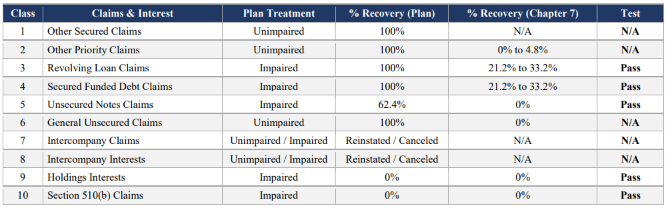
The following is a summary of classes, claims and Plan treatment (defined terms not otherwise defined below are as defined in the Plan and/or Disclosure Statement, See also Liquidation Analysis below):
- Class 1 (“Other Secured Claims”) is unimpaired, presumed to accept and not entitled to vote on the Plan.
- Class 2 (“Other Priority Claims”) is unimpaired, presumed to accept and not entitled to vote on the Plan.
- Class 3 (“Revolving Loan Claims”) is impaired and entitled to vote on the Plan. The estimated amount of claims is $150,000,000 principal, plus accrued interest, fees and other amounts and estimated recovery is 100%. Holders shall receive conversion of loans to the New RCF in an equal amount, and accrued interest and fees will be paid in full in cash.
- Class 4 (“Secured Funded Debt Claims”) is impaired and entitled to vote on the Plan. The estimated amount of claims is $539,944,389.00 of 11.25% Secured Notes, $40,055,569.96 of USD Term Loans and €407,000,000.00 of EUR Term Loans, plus accrued and unpaid interest, fees, costs, and other amounts due and owing under the Credit Agreement and the 11.25% Secured Notes Indenture as of the Effective Date and estimated recovery is 100%. Holders receive New Notes, New Term Loans, or Equitization New Interests (for Plan Sponsors), plus payment in full in cash of accrued and unpaid interest.
- Class 5 (“Unsecured Notes Claims”) is impaired and entitled to vote on the Plan. The estimated amount of claims is $270,000,000 principal, plus accrued interest as of the Petition Date and estimated recovery is 63%. Holders receive their Pro Rata share of the Unsecured Notes Recovery.
- Class 6 (“General Unsecured Claims”) is unimpaired, presumed to accept and not entitled to vote on the Plan.
- Class 7 (“Intercompany Claims”) is unimpaired/impaired, presumed to accept/deemed to reject and not entitled to vote on the Plan.
- Class 8 (“Intercompany Interests”) is unimpaired/impaired, presumed to accept/deemed to reject and not entitled to vote on the Plan.
- Class 9 (“Holdings Interests”) is impaired, deemed to reject and not entitled to vote on the Plan.
- Class 10 (“Section 510(b) Claims”) is impaired, deemed to reject and not entitled to vote on the Plan.
Definitions
- “New Interests” means the new common shares or membership interests in New Getty Images.
- “Unsecured Notes Recovery” means Cash in an aggregate amount equal to $170,212,922.50.
- "New Equity Investment" means the equity investment in New Getty Images by the New Equity Investors in Cash in an aggregate amount of $433,212,922.50 minus the principal amount of DIP Initial and Final Loans outstanding as of the Effective Date.
For further detail on the Plan, see our comprehensive data set.
Key Documents
The Disclosure Statement [Docket No. 32] attaches the following documents:
- Exhibit A: Plan of Reorganization
- Exhibit B: Restructuring Support Agreement
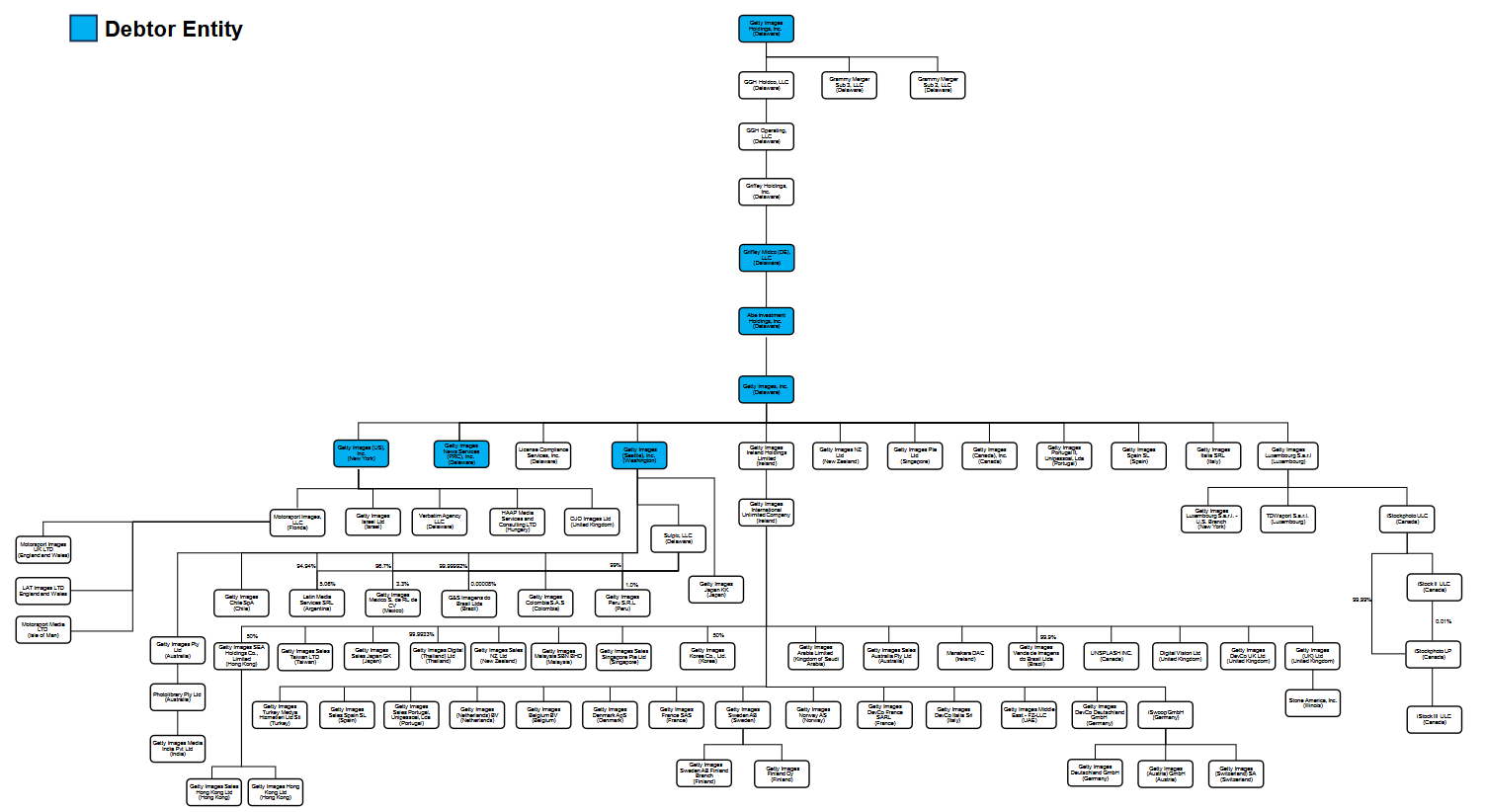
- Exhibit C: Company Organizational Chart
- Exhibit D: Financial Projections
- Exhibit E: Liquidation Analysis
- Exhibit F: Valuation Analysis
Proposed Key Dates
- Voting Record Date: October 9, 2026
- Commencement of Solicitation: October 20, 2026
- Petition Date: October 21, 2026
- Initial Plan Supplement Filing Deadline: November 23, 2026
- Voting Deadline / Objection Deadline: November 30, 2026, at 5:00 p.m. (prevailing Eastern Time)
- Deadline to File Proposed Confirmation Order: December 9, 2026
- Deadline to File Confirmation Brief and Reply: December 9, 2026
- Combined Hearing: December 14, 2026
Events Leading to the Chapter 11 Filing
Getty Images' heavily leveraged capital structure developed through successive private-equity transactions and refinancings before its return to the public markets in 2022. Hellman & Friedman took the company private in February 2008, and Carlyle acquired control in October 2012, with the Getty family retaining an ownership interest. In 2018, the Getty family bought out Carlyle's equity stake and resumed control, while Koch Equity Development (“KED”) made a non-controlling investment. A February 2019 refinancing established a credit agreement that originally included $1.04bn of U.S. dollar term loans, €450.0mn of euro term loans and an $80.0mn revolving facility, alongside $300.0mn of 9.75% senior unsecured notes.
The litigation liabilities that became a principal catalyst for Chapter 11 originated in Getty's July 2022 public listing through a merger with special purpose acquisition company CC Neuberger Principal Holdings II, a transaction valued at approximately $4.8bn. The transaction left 20.7mn public warrants outstanding, each exercisable for one common share at $11.50, subject to specified registration requirements. Following the listing, fewer than 0.2% of Getty's outstanding shares were freely tradable because of restrictions on insider holdings, contributing to extreme volatility that briefly carried the stock above $32.00.
Certain warrant holders sought to exercise while Getty's shares traded above the exercise price, but the company, acting on advice from former outside counsel, maintained that the warrants were not yet exercisable because the requisite registration statement had not become effective. Getty permitted exercises beginning September 16, 2022, after the registration statement became effective, by which time its stock had fallen below $11.50. The remaining warrants were redeemed in October 2022, prompting breach-of-contract litigation from former holders who argued they had been improperly prevented from exercising when Getty's stock traded substantially above the exercise price.
In October 2023, the U.S. District Court for the Southern District of New York awarded Alta Partners, LLC $36.9mn and CRCM Institutional Master Fund (BVI), Ltd. $51.0mn, plus 9% annual prejudgment interest. The Second Circuit affirmed the judgments on January 15, 2026 and denied rehearing on April 16th. Getty paid $110.9mn in judgments and associated interest on April 23rd, financing much of the payment through a $120.0mn draw on its previously unused $150.0mn revolving facility.
Additional litigation continued. Two other federal plaintiffs, Berner and Lapp, obtained judgments of $4.7mn and $1.5mn, respectively, while twelve New York state court actions were consolidated under Funicular Funds LP v. Getty Images Holdings, Inc. On June 9, 2026, the state court granted summary judgment to the plaintiffs and, on July 27th, directed entry of judgments totaling $67.8mn, plus 9% prejudgment interest dating from August 2022. Plaintiffs subsequently calculated the aggregate liability at approximately $92.3mn. Getty appealed but was unable to obtain a bond staying enforcement, forcing negotiations over a standstill while the company addressed its deteriorating liquidity.
According to the Debtors' October 20th Disclosure Statement, warrant litigation has generated more than $200.0mn in adverse judgments and associated interest and approximately $35.0mn in legal expenses. Getty carried a $99.5mn litigation reserve at June 30th relating to remaining claims, while the Debtors estimate potential additional exposure exceeding $275.0mn from unasserted warrant claims. The Plan proposes to subordinate the outstanding and potential warrant liabilities under section 510(b) and cancel them without recovery.
The company's financing position had meanwhile been complicated by its proposed combination with Shutterstock, Inc., announced in January 2025. The contemplated $3.7bn merger required Getty to extend existing debt maturities beyond 2027, prompting a series of refinancings that materially increased its interest burden. In February 2025, Getty refinanced its term loans into $580.0mn of U.S. dollar loans and €440.0mn of euro loans due 2030, subsequently exchanging most of the dollar tranche into $539.9mn of 11.25% senior secured notes. In October 2025, it exchanged approximately $294.7mn of its 9.75% unsecured notes due 2027 into 14.00% notes due 2028, which require semiannual mandatory principal redemptions. Getty also issued $628.4mn of 10.5% secured notes, placing the proceeds in escrow to finance cash consideration and refinance Shutterstock debt upon closing.
Regulatory review of the Shutterstock merger extended well beyond the anticipated timetable. Although the U.S. Department of Justice completed its review without objection in February 2026, the U.K. Competition and Markets Authority (“CMA”) concluded that the transaction would substantially lessen competition in the U.K. editorial content market. On May 15th, following an extended Phase 2 investigation, the CMA required divestiture of Shutterstock's entire editorial business to approved purchasers as a condition of proceeding. Getty and Shutterstock spent May and June exploring a potential sale, including identifying prospective purchasers and facilitating due diligence, but Getty's Board ultimately rejected the proposed remedy on June 30th and formally terminated the merger on July 7th.
The Disclosure Statement attributes the decision partly to the cost, time and continuing regulatory obligations associated with divesting Shutterstock's editorial business under CMA supervision, which the Board concluded outweighed the merger's benefits. The Debtors also acknowledge that the outstanding warrant liabilities created a risk that even the combined business could face insolvency, potentially extending Getty's financial problems to additional shareholders and creditors.
Getty says the approximately eighteen-month merger process consumed more than $100.0mn in fees, approximately $10.0mn in accelerated Sarbanes-Oxley compliance costs and another $43.6mn in net interest expense and financing fees associated with the escrowed secured notes. The $628.4mn notes were redeemed at par after the merger was terminated, eliminating their principal from the company's outstanding debt but leaving the financing expenses unrecovered. The Debtors say no third party subsequently approached Getty with a superior acquisition, refinancing or new-capital proposal.
The merger-related costs coincided with the increased debt-service obligations arising from the 2025 refinancings. Interest expense rose 61.1% to $111.5mn in the first half of 2026 from $69.2mn a year earlier, compared with operating income of approximately $63.9mn. Excluding the redeemed Shutterstock financing, the Debtors estimate annualized debt service at approximately $239.0mn as of the Petition date, comprising $154.0mn in interest, €22.0mn in scheduled euro term-loan amortization and $60.0mn in annual mandatory repayments on the 14.00% notes. The Disclosure Statement says those obligations exceeded the cash the business was generating from operations.
Getty's liquidity deteriorated rapidly as the warrant payments and merger expenses accumulated. Cash declined from $90.2mn at December 31, 2025 to $51.6mn at June 30, 2026, and the company drew the remaining $30.0mn available under its revolving facility in July, exhausting a credit line that had been entirely undrawn as recently as March. Internal forecasts prepared in July showed liquidity falling below the company's $50.0mn minimum consolidated operating requirement during the fourth quarter of 2026 and turning negative by June 2027, before accounting for further warrant payments or restructuring expenses. Cash and cash equivalents stood at approximately $50.0mn on the Petition date.
Getty's financial disclosures reflected the deterioration. Its 2025 annual report, filed in March 2026, stated that existing liquidity would be sufficient to fund operations for at least twelve months. By August 10th, management had disclosed substantial doubt about the company's ability to continue as a going concern, citing the warrant judgments, merger expenses, elevated financing costs and uncertainty surrounding proposed liquidity measures. S&P Global Ratings downgraded Getty to CCC+ in July following the announcement that the merger would not proceed, and Moody's lowered its corporate family rating to Caa3 in September after the company elected to use the grace periods on interest payments due under its 9.75% and 14.00% unsecured notes. Getty subsequently made those interest payments on September 30th.
The Debtors also acknowledge structural pressure in parts of the operating business, particularly iStock and agency customers affected by changing purchasing patterns and competition from generative AI. Total purchasing customers declined approximately 24%, from 835,000 in 2022 to 636,000 for the twelve months ended June 2026, while active annual subscribers fell from 321,000 to 240,000 over the preceding year. Nevertheless, Getty generated approximately $978.0mn in revenue and $307.0mn in adjusted EBITDA for the twelve months ended June 2026. The Debtors maintain that their enterprise and editorial businesses remained comparatively resilient and that the operating pressures, while requiring attention, would not independently have necessitated Chapter 11.
As liquidity tightened, Getty engaged Guggenheim Securities to evaluate financing and restructuring alternatives, while secured lenders and unsecured noteholders organized separate creditor groups. On August 6th, Getty Images Holdings established an independent special committee comprising Elizabeth Abrams and Thomas Walper, while each filing subsidiary appointed Neal Goldman to its own special committee. Negotiations with the principal creditor constituencies began in July and intensified between August 17th and September 30th. The committees retained independent counsel to address potential conflicts involving the shareholder sponsors and intercompany relationships, and their investigations into potential intercompany claims remained ongoing at filing.
By early September, the Debtors had reached an agreement in principle with the Secured Ad Hoc Group, representing approximately $830.0mn of funded debt, contemplating at least $280.0mn of new cash equity investment from the Getty family and KED sponsors and conversion of approximately $100.0mn of investor-held term loans into equity. However, the Unsecured Noteholders Ad Hoc Committee rejected a proposal to exchange its $270.0mn of outstanding notes for a combination of cash and reorganized equity, indicating that the consideration was inadequate and that it was considering making its own bid for the company. The Debtors consequently discussed a potential marketing process with secured creditors, including whether the existing sponsors would serve as stalking-horse bidders, while continuing negotiations to improve recoveries for unsecured noteholders.
By late September, the sponsors had agreed to increase their cash equity commitment by approximately $153.0mn, or 55%, to $433.0mn, allowing the Debtors to offer holders of unsecured notes $170.2mn in cash, equivalent to approximately 63% of principal. On September 28th, Getty reached an agreement in principle with both creditor groups. The Debtors also evaluated broader financing alternatives through discussions with six parties, but concluded that the proposals either imposed excessive additional debt, required other settlements or were insufficient to refinance the existing capital structure. Separately, Getty made a prepetition settlement proposal to the New York state warrant plaintiffs, which the plaintiffs neither accepted nor countered.
The negotiations occurred against increasingly immediate payment pressures. On August 25th, Getty negotiated a standstill with the New York state warrant plaintiffs through October 26th in exchange for approximately $4.2mn, but received no assurance of a further extension. The company also deferred approximately $18.8mn of interest payments due September 1st on its unsecured notes, making those payments on September 30th within the applicable grace periods. Another $30.4mn in interest was due November 2nd on the company's 11.25% secured notes. With its $150.0mn revolver fully drawn, liquidity projected to fall below the approximately $50.0mn minimum operating requirement by the end of October and the warrant standstill approaching expiration, Getty determined that it lacked sufficient time and liquidity to pursue an extended sale or refinancing process.
On October 12th, following recommendations from the independent special committees, the Debtors' unconflicted directors approved the RSA, which had the support of approximately 90% of secured funded debt holders, all revolving lenders and 83% of unsecured noteholders. The company launched solicitation of its prepackaged Plan on October 20th, following the authorization of the Chapter 11 filings by its unconflicted directors, and commenced the cases on October 21st. The proposed restructuring would address the outstanding warrant liabilities, refinance secured debt, retire the unsecured notes at a discount and provide new capital from the existing Getty family and KED shareholder groups.
Prepetition Indebtedness
Getty entered Chapter 11 with roughly $1.47bn of funded debt: about $1.20bn secured and $270.0mn unsecured. Balances below are drawn from the company’s quarterly report for the period ended June 30, 2026, adjusted for the July revolver draw and the redemption of the escrowed merger notes. The $2.6bn of total debts reported in the Petition’s SEC attachment is a total-liabilities figure. It still included the $628.4mn of 10.5% senior secured notes that were redeemed from escrow after the Shutterstock deal collapsed, as well as deferred revenue, payables and the warrant litigation reserve.
The prepetition capital structure comprises:
- Revolving Credit Facility. A $150.0mn revolver under the credit agreement dated February 19, 2019, as amended and restated, with JPMorgan Chase Bank, N.A. as administrative and collateral agent. The facility matures May 4, 2028, although Moody’s has noted that maturity springs forward to September 2, 2027 unless the 14% notes are reduced below $100.0mn. Undrawn at March 31, the revolver was tapped for $120.0mn on April 22 to help pay the warrant judgment and fully drawn in July. Under the RSA, revolving loans roll dollar-for-dollar into an amended and restated $150.0mn facility that will be repaid and undrawn at emergence. All revolving lenders support the deal.
- Term Loan Facility. Term loans under the same credit agreement, refinanced in February 2025 into a $580.0mn U.S. dollar tranche and a €440.0mn euro tranche, both due 2030. Most of the dollar tranche was later exchanged into the 11.25% notes, leaving $40.1mn outstanding. The amortizing euro tranche stood at about $470.5mn in U.S. dollar terms at June 30. Third-party holders will receive new euro term loans or new senior secured notes; dollar lenders who do not opt into the notes receive new dollar term loans.
- 11.25% Senior Secured Notes due 2030. $539.9mn issued by Getty Images, Inc. in 2025 in exchange for dollar term loans. With the term loans, the notes form the Secured Funded Debt Claims, about $1.05bn in total, of which roughly 89% have signed the RSA. Third-party claims roll dollar-for-dollar into new secured debt with longer maturities and a lower interest rate. Roughly $100.0mn of secured debt held by the Getty family and KED converts into new equity.
- 14.000% Senior Notes due 2028. Unsecured notes issued by Getty Images, Inc. in October 2025 in exchange for $294.7mn of the 9.75% notes. The notes mature March 1, 2028 and require semiannual mandatory redemptions of 10% of the original 2027 principal; the first, on June 30, 2026, reduced the balance to $264.7mn. Getty used the 30-day grace period on the September 1 coupon before paying on September 30.
- 9.750% Senior Notes due 2027. The original $300.0mn of unsecured notes issued by Getty Images, Inc. in February 2019 and due March 1, 2027. Only $5.3mn remains after the 2025 exchange, which was paired with a consent solicitation to amend the indenture.
Holders of allowed Unsecured Notes Claims across both series would share $170.2mn in cash, pro rata. That equals about 63% of the $270.0mn principal outstanding, before accrued interest; the RSA does not allocate the payout between the two series. Holders of about 83.5% of the unsecured notes, excluding notes held by the consenting shareholders, have signed the RSA.
Interest costs rose steeply as the stack was repriced. Interest expense reached $111.5mn in the first half of 2026, up from $69.2mn a year earlier. S&P estimated mandatory principal payments at about $86.0mn a year, mainly the 14% notes’ redemptions and euro term loan amortization. Markets were already discounting the debt at midyear: the company valued its term loans at about 87% of face and its unsecured notes at about 85% at June 30, and the euro term loan was quoted in the low 70s by September.
Outside funded debt, the largest contested obligation is the warrant litigation, for which Getty held a $99.5mn reserve at June 30 covering the pending cases, including the New York state action that has since produced a roughly $92.3mn judgment. Those claims are excluded from the list of 30 largest unsecured creditors and, under the Plan, would be subordinated under section 510(b) with no recovery.
The Debtors' consolidated list of 30 largest unsecured creditors totals $22.6mn, made up predominantly of accrued content royalties, severance and trade payables. General unsecured claims of this kind are to be paid in full or otherwise left unimpaired.
Key Prepetition Shareholders
The corporate ownership statement attached to the Petition identifies two principal shareholder constituencies:
- Getty Family Stockholders: Approximately 45.5% of the outstanding Class A common stock, comprising interests held by Getty Investments L.L.C., The October 1993 Trust, The Options Settlement and Mark Getty. The statement also identifies the Cheyne Walk Trust and Cheyne Walk Master Fund 2 LP as potentially having indirect beneficial ownership of shares held through Getty Investments.
- KED Icon Holdings, LLC: Approximately 27.4% of the outstanding Class A common stock. KED is the principal investment and acquisition arm of Koch, Inc.
Together, the Getty family and Koch-affiliated interests hold approximately 72.9% of the existing Class A common stock.
The proposed restructuring would result in the consenting shareholders holding 100% of the reorganized company's new common equity, subject to dilution through a management incentive plan. The materials do not specify the relative post-emergence ownership percentages of the Getty family and Koch investors.
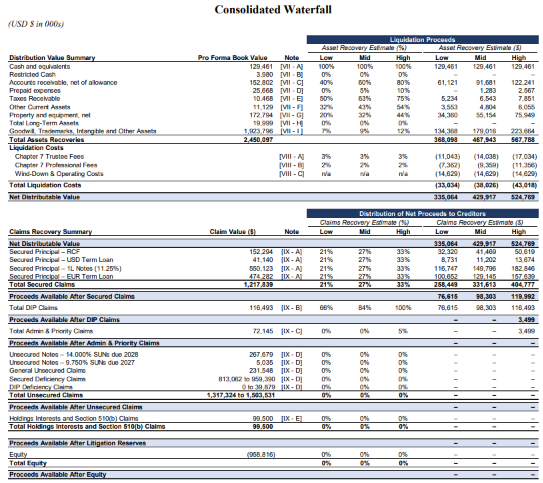
Liquidation Analysis [see Exhibit E of Docket No. 32]
Recovery Comparison
The following table compares estimated Plan recoveries versus the range of Liquidation Analysis recoveries (low to high) by Class:
About the Debtors
According to the Debtors: “Through its Getty Images, iStock and Unsplash brands, websites and APIs, Getty Images serves customers in almost every country in the world.”
Founded in 1995 by Mark Getty and Jonathan Klein, Getty Images runs a global marketplace for photographs, video, music and other visual content. It licenses material to news organizations, advertising agencies, corporations and individual creators, working with more than 600,000 content creators and over 360 content partners and covering more than 160,000 news, sports and entertainment events each year. The company reported record revenue of $981.3mn in 2025, roughly half from customers outside the United States and more than half from annual subscriptions. It paid more than $220.0mn in royalties to contributors and content partners that year.
Getty also maintains one of the largest privately owned photographic archives, including the Hulton and Bettmann collections, and offers custom content production and generative AI tools trained on its licensed library. The company had about 1,650 employees at the end of 2025.
Top Unsecured Creditors
Corporate Structure Chart (attached to lead Petition)