FIRST DAY INTELLIGENCE: FRC Balance, LLC
Scottsdale, Arizona-Based Health-Focused Restaurant Chain Files Chapter 11 With $42.1mn of Funded Debt; Pursues Court-Supervised Sale After Closing 12 Restaurants
by Nick Montgomery | Oct 5, 2026, 8:49:48 AM
October 4, 2026 – FRC Balance, LLC and eight affiliated debtors (dba True Food Kitchen and together, “True Food Kitchen” or the “Debtors”) filed for Chapter 11 protection with the U.S. Bankruptcy Court in the Southern District of Texas, lead case No. 26-90806 (Judge Christopher M. Lopez). The Debtors, a Scottsdale, Arizona-based operator of health-focused restaurants, are represented by Omar J. Alaniz of Reed Smith LLP. Further board-authorized appointments include: (i) Teneo Restructuring as financial advisor, (ii) SOLIC Capital as investment banker, (iii) Gordon Brothers as real estate advisor and (iv) Stretto, Inc. as claims agent.
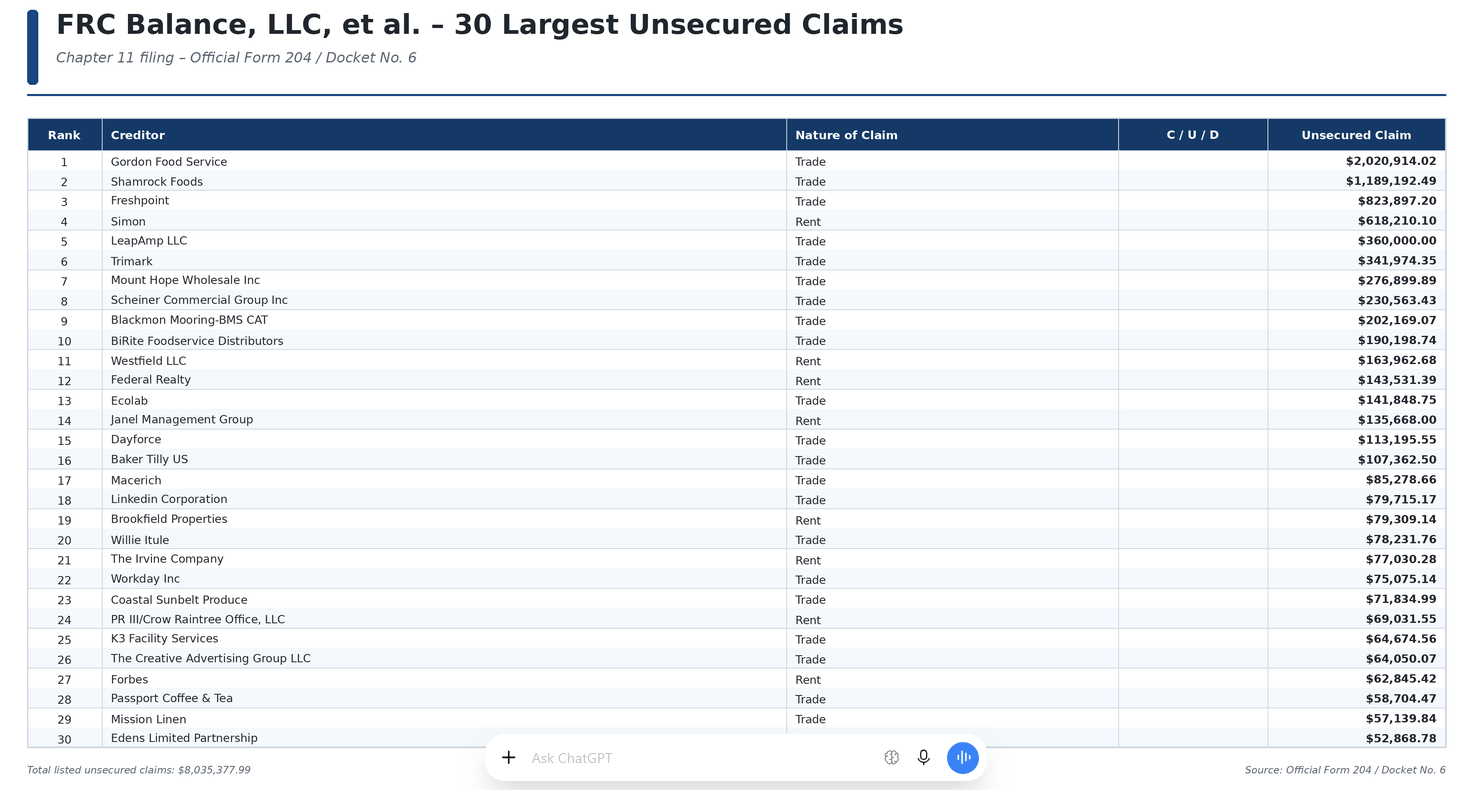
The Debtors’ lead petition notes between 200 and 999 creditors; estimated assets between $10.0mn and $50.0mn; and estimated liabilities between $10.0mn and $50.0mn ($42.1mn of funded debt). Documents filed with the Court list the Debtors’ three largest unsecured creditors as (i) Gordon Food Service ($2.0mn trade claim), (ii) Shamrock Foods ($1.2mn trade claim) and (iii) Freshpoint ($824k trade claim).
In a press release announcing the Chapter 11 filings, the Debtors stated that: "The Company intends to use the Chapter 11 process to strengthen its financial foundation, optimize its restaurant footprint and cost structure, and accelerate ongoing operational improvements....In connection with the restructuring, True Food Kitchen has closed 12 restaurants, with their final day of service on Sunday, October 4. The Company's remaining 34 restaurants across 14 states are open and serving guests as usual....As part of the Chapter 11 process, True Food Kitchen will pursue a Court-supervised sale process with the goal of identifying a long-term partner with the resources and mission alignment to support the brand's future. Any proposed transaction will be subject to Court approval and other customary conditions.
The Company has secured a commitment for approximately $20 million in debtor-in-possession financing from HumanCo TFK IV, subject to Court approval. Together with cash generated from operations, the financing is expected to provide liquidity to support the business through the Chapter 11 and sale processes."
Jeff Chandler, Chief Executive Officer of True Food Kitchen, added: "True Food Kitchen is a pioneering brand with a distinctive position in wellness-driven dining, a loyal community of guests, and a mission that is more relevant than ever. This process is the best path forward to simplify the business and focus on what we do best: delivering craveable, health-forward food and genuine hospitality. We are confident this step will help us build a stronger True Food Kitchen for the future."
Petition Date Highlights
- Scottsdale, Arizona-based True Food Kitchen files with $42.1mn of funded debt after closing 12 of its 46 restaurants, leaving 34 restaurants operating across 14 states.
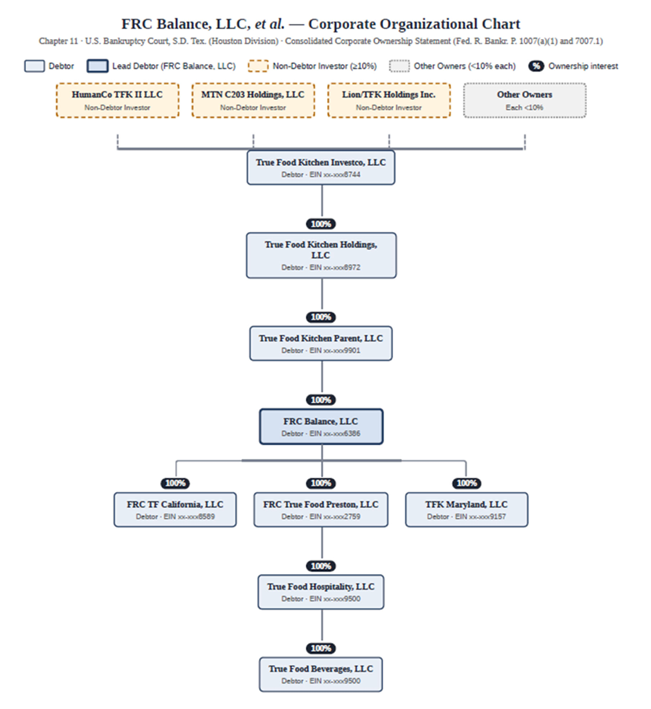
- Ultimate parent True Food Kitchen Investco, LLC is majority owned by HumanCo III and its affiliates, with approximately 42.1% of fully diluted equity, and private equity firm Manna Tree, with approximately 26.9%, giving the two investor groups approximately 69.0% combined ownership.
- Debtors attribute their financial distress to management turnover, repeated changes in expansion and brand strategy, unsuccessful investment outside their core restaurant concept, the lingering effects of COVID-19 and sustained underperformance at certain locations.
- Debtors, who increasingly relied on MCA loans in the run up to filing, enter Chapter 11 with approximately $1.6mn of unrestricted cash, which the DIP motion says would support operations and case administration for only approximately two weeks absent postpetition financing and cash collateral.
- Debtors intend to pursue a court-supervised sale of the business; no stalking horse is identified at filing, although DIP milestones contemplate execution of a stalking-horse agreement, if any, by November 30th.
- Debtors seek approval of a $20.0mn entirely new money DIP facility from HumanCo TFK IV, LLC, comprising $5.0mn available on interim approval and $15.0mn following final approval in sequential draws tied to the sale process; there is no roll-up of HumanCo affiliates’ prepetition debt.
- DIP milestones call for bidding procedures by November 7th, a December 10th bid deadline, December 17th auction, December 22nd transaction order, January 22nd sale closing and a March 31st plan effective date or repayment in full.
Filing Date Summary
Scottsdale, Arizona-based True Food Kitchen enters Chapter 11 with its ultimate parent approximately 42.1% owned by HumanCo III and its affiliates and 26.9% owned by private equity firm Manna Tree. The two investors, which together hold approximately 69.0% of True Food Kitchen Investco, LLC on a fully diluted basis, entered the ownership group in 2022 when they led a more than $100.0mn equity investment in the restaurant chain, which had previously been controlled by Centerbridge Partners.
True Food Kitchen expanded from 20 restaurants at the time of its 2017 separation from the Sam Fox restaurant group to 46 locations by 2026, with the Cook Declaration citing management turnover, shifting expansion and menu strategies, unsuccessful investments outside the company’s core concept, pandemic-era ghost-kitchen experiments and several locations suffering from weaker-than-expected traffic and changing local demographics. Twelve restaurants closed in connection with the filing, leaving 34 restaurants operating across 14 states.
Management had already begun restructuring before Chapter 11. Jeff Chandler became CEO in July, Gordon Brothers was retained to evaluate the real estate portfolio and renegotiate leases, Teneo was brought in to assess the business plan, liquidity and strategic alternatives, corporate headcount was reduced and vendor contracts were renegotiated. The Debtors also explored assignments of substantially all unexpired leases and say they have reached an agreement covering certain leases that they intend to bring before the Court.
The Debtors now intend to market the business through a court-supervised sale while maintaining the remaining restaurants. The Cook Declaration reports approximately $42.1mn of material funded debt obligations, while the DIP motion separately characterizes approximately $41.1mn as funded debt and debt-like obligations. With unrestricted cash of approximately $1.6mn at filing, the Debtors seek a $20.0mn all-new-money DIP from HumanCo TFK IV, an affiliate of their largest shareholder, to finance operations, the sale process and the eventual wind-down of the estates.
Goals of the Chapter 11 Filing
The Cook Declaration [Docket No. 22] provides: “The Debtors commenced these Chapter 11 Cases because (a) the Company’s liquidity is insufficient to fund security, asset preservation, estate administration, and the orderly wind-down outside of a court-supervised process; (b) chapter 11 provides the breathing room necessary to secure and preserve those assets, maintain only essential personnel and services, and administer and monetize the estates during the Chapter 11 Cases; (c) the automatic stay will halt creditor collection actions and permit the orderly administration of claims and disposition of assets; and (d) the debtor-in-possession financing facility described herein will provide the liquidity necessary to fund asset preservation, case administration, and the wind-down of the Debtors’ estates through closing and thereafter as necessary.”
The press release notes that True Food Kitchen will “pursue a Court-supervised sale process with the goal of identifying a long-term partner with the resources and mission alignment to support the brand’s future.”
Recent Financial Performance and Liquidity
True Food Kitchen’s first day materials do not disclose recent revenue or EBITDA figures, but they describe a business whose rapid expansion increasingly outpaced the performance of parts of its restaurant portfolio. The chain grew from 20 restaurants following its 2017 separation from the Sam Fox restaurant group to 46 locations before closing 12 in connection with the Chapter 11 filing. CRO Nathan Cook says the COVID-19 pandemic materially affected profitability, while investments in unsuccessful products and restaurant concepts and persistent underperformance at certain locations further pressured results. Although many restaurants remain profitable and occupy desirable locations, others experienced lower-than-expected traffic and changing market conditions that produced “steady decreases in profitability over time.”
Liquidity had deteriorated sharply by the Petition Date. The Debtors reported approximately $1.6mn of unrestricted cash, sufficient to fund only about two weeks of operations and case administration without postpetition financing and access to cash collateral. The company had also increasingly relied on shareholder, lender and merchant-financing arrangements during 2025 and 2026, contributing to approximately $41.1mn-$42.1mn of funded debt and debt-like obligations at filing.
That financing mix included sizeable merchant cash advance and receivables arrangements. As of September 29th, FRC Balance owed approximately $2.2mn net to Parafin, also referred to as DoorDash Capital, under a delivery advance MCA and approximately $1.7mn net to Rewards Network under a separate MCA. The company also owed approximately $7.2mn net under financing arrangements with InKind. Parafin asserts an interest in future delivery receivables, Rewards Network asserts a broad lien on property, accounts and receivables, and InKind asserts a subordinated lien on substantially all assets. The Debtors reserve their rights regarding the characterization and treatment of all three arrangements.
Events Leading to the Chapter 11 Filing
In a declaration in support of first day filings (the “Cook Declaration”) [Docket No. 22], Nathan Cook, the Debtors’ CRO, traces the filing to an expansion from 20 stores in 2017 to 46 locations that coincided with repeated management changes, shifting growth and menu strategies and capital deployment into concepts and products outside True Food Kitchen’s core health-focused business. The pandemic further pressured profitability and produced unsuccessful ghost-kitchen and delivery-only experiments, while several restaurants remained structurally underperforming. By 2026, management had installed a new CEO, cut corporate costs, renegotiated vendor arrangements and begun addressing the lease portfolio, but liquidity had deteriorated to the point that the Debtors say they could not preserve assets, administer the estates and pursue an orderly monetization outside Chapter 11.
Drilling down, Cook provides: “Following the spinoff, the chain continued to expand over the next several years to the current forty-six (46) locations across the United States. As of the Petition Date, the Debtors operate thirty-four (34) locations across the United States, having made the difficult decision to close twelve (12) restaurants concurrently with the commencement of these chapter 11 cases.
The Company’s growth was accompanied by a number of operational challenges. The Company experienced significant management turnover, which resulted in frequent changes to expansion strategy, brand direction, and menu offerings. Under successive leadership teams, the Company invested capital outside its core market areas and in new product lines and restaurant concepts that were ultimately unsuccessful and outside of the Company’s core mission and menu....Like many restaurants, the COVID-19 pandemic materially impacted the Company’s profitability and coincided with a period of the Company’s growth. To increase profitability at times when in-person dining was declining, the Company used certain locations as ghost kitchens and opened one off-site kitchen for delivery service only. These tests impaired staffing and the restaurant and service experience and have since been terminated....
Additionally, while many of the Restaurants are profitable and occupy highly desirable locations, several Restaurants have struggled. Some are in areas with lower-than-anticipated foot and driving traffic, while others were impacted by changing market forces and demographics that led to steady decreases in profitability over time.”
Cook continues: “Prior to the Petition Date, the Debtors’ management team and advisors undertook extensive efforts to address the Company’s financial distress, including (a) hiring a new Chief Executive Officer, Jeff Chandler, in July 2026; (b) retaining Gordon Brothers to assist with the evaluation of the Company’s real estate portfolio and attempts to renegotiate leases; (c) retaining Teneo as financial advisor to evaluate the Company’s business plan and liquidity profile and assess strategic alternatives; [and] (d) reducing corporate headcount; (e) renegotiating vendor contracts and limiting expenses; [and] (f) exploring assignment transactions for all or substantially all of the Company’s unexpired leases....”
DIP Financing
The press release states that True Food Kitchen “has secured a commitment for approximately $20 million in debtor-in-possession financing from HumanCo TFK IV,” which, together with operating cash flow, is expected to finance the business through Chapter 11 and the sale process.
The Debtors have filed a DIP motion seeking approval [Docket No. 8] of a $20.0mn senior secured, superpriority DIP term loan facility from HumanCo TFK IV, LLC consisting entirely of new money with a $5.0mn Tranche A becomingavailable upon entry of the interim DIP order and the $15.0mn Tranche B would becoming available following a final DIP order through six sequential advances: $2.0mn upon entry of the final order; $2.0mn upon entry of bidding procedures; $2.0mn upon execution of a stalking-horse agreement; $2.5mn upon selection of the successful bidder; $3.0mn upon entry of a sale or confirmation order; and the balance of the undrawn commitment thereafter. A competing transaction must provide replacement financing for the undrawn DIP, repayment of funded DIP obligations and sufficient financing for the remaining liquidating-plan and wind-down requirements.
The DIP bears interest at 10.00% per annum, payable in kind and capitalized monthly, with an additional 5.00% default rate. HumanCo TFK IV would receive a 3.00% commitment fee, or $600k, and a 3.00% funding fee on each advance, both payable in kind. An exit fee operates as a true-up to a target return of $1.9mn where no more than $5.0mn has been funded, increasing pro rata to $4.0mn if the full $20.0mn is drawn. Maturity is the earliest of March 31, 2027, three business days after closing of a sale of substantially all assets or equity, effectiveness of a Chapter 11 plan, conversion, dismissal or acceleration following an event of default.
The facility includes no roll-up and proceeds are not earmarked to repay HumanCo III’s prepetition claims. HumanCo TFK IV is, however, an affiliate of HumanCo TFK III, LLC, which together with its affiliates owns approximately 42.1% of ultimate parent True Food Kitchen Investco and has the right to designate certain members of Investco’s board. Manna Tree, through MTN C203, owns approximately 26.9%. Because of HumanCo’s prepetition equity and lending relationship, CRO Nathan Cook reviewed and approved the DIP on behalf of the Debtors.
SOLIC began marketing DIP financing on or about September 10th, contacting 38 potential lenders. Eleven signed confidentiality agreements and received diligence access, and two ultimately delivered term sheets. The competing $20.0mn proposal offered only $2.0mn initially, conditioned further funding on a stalking-horse agreement and purchaser-funded 10% deposit, and carried a 10% commitment fee plus a separate 9% exit fee. The Debtors selected HumanCo TFK IV’s proposal after negotiations from September 29th through October 2nd.
Case milestones require an interim DIP order by October 15th and final order by October 31st; bidding procedures by November 7th; a stalking-horse agreement, if any, by November 30th; bids by December 10th; an auction by December 17th; transaction approval by December 22nd; closing by January 22, 2027; and Plan effectiveness or repayment of the DIP in full by March 31st.
Prepetition Indebtedness
As of the Petition Date, the Cook Declaration states that the Debtors had approximately $42.1mn of material funded debt obligations. The DIP motion separately reports approximately $41.1mn of “funded debt and debt-like obligations.”
- Multi-Draw Loan. FRC Balance and True Food Kitchen Parent are co-borrowers under an August 2026 $15.0mn Fifth Amended and Restated Multi-Draw Loan with Kingswood Partners LLC and MTN C203 Holdings, LLC as lenders. The August amendment incorporated $10.0mn of existing advances and $5.0mn of new advances. As of September 29th, approximately $17.1mn of principal, including capitalized interest, plus approximately $205k of additional accrued interest was outstanding. The facility bears interest at 15% per annum, currently payable in kind, matures June 15, 2027 and is secured by senior liens on substantially all assets of the obligors.
- Note Purchase Agreement/Convertible Notes. Investco issued convertible notes under a July 2025 Note Purchase Agreement with HumanCo TFK III and MTN C203, originally providing for up to $10.0mn of unsecured convertible notes. As of September 29th, approximately $11.3mn of principal, including capitalized interest, plus approximately $428k of accrued interest was outstanding. The notes bear 15% PIK interest and mature July 8, 2027, subject to an investor extension to July 8, 2028. An August 27th amendment converted the notes to secured obligations, added guarantees from the other obligors and granted liens on substantially all obligor assets junior to the Multi-Draw liens.
- Receivables and Merchant Financing Arrangements. As of September 29th, FRC Balance owed approximately $2.2mn net to Parafin Inc., also referred to as DoorDash Capital; approximately $1.7mn net to Rewards Network; and approximately $7.2mn net to InKind Cards Inc., InKind Credit Fund LP and InKind Warehouse Facility, LLC, or approximately $11.0mn in aggregate. The Debtors reserve their rights regarding the characterization, validity and treatment of these arrangements and related asserted liens or receivables interests.
The Debtors’ list of 30 largest unsecured creditors includes unsecured claims totaling approximately $8.0mn. The three largest listed claims are Gordon Food Service at $2.0mn, Shamrock Foods at $1.2mn and Freshpoint at $824k, each identified as a trade claim. Other sizeable unsecured claims include $618k owed to Simon for rent, $360k owed to LeapAmp LLC for trade obligations and $342k owed to Trimark for trade obligations.
Key Prepetition Shareholders
True Food Kitchen Investco, LLC is the ultimate parent of the Debtors. HumanCo TFK III and its affiliates hold approximately 42.1% of Investco’s fully diluted units and HumanCo III has the right to designate certain members of Investco’s board of managers. Manna Tree, through MTN C203 Holdings, holds approximately 26.9%.
True Food Kitchen is majority owned by health-and-wellness investors HumanCo and Manna Tree, which together hold approximately 69% of ultimate parent True Food Kitchen Investco, LLC on a fully diluted basis. HumanCo and Manna Tree entered the ownership group in 2022 when they led a more than $100.0mn equity investment in the restaurant chain, then controlled by longtime private equity backer Centerbridge Partners. HumanCo and its affiliates now hold approximately 42.1% of Investco, while private equity firm Manna Tree holds approximately 26.9%. The company’s legacy investor base has also included Centerbridge, Lion Capital, Oprah Winfrey, founder Dr. Andrew Weil and former Starbucks CEO Howard Schultz.
Top Unsecured Creditors
About the Debtors
According to the Debtors: “Founded in Phoenix in 2008, True Food Kitchen pioneered wellness-driven dining around a simple belief: food that’s good for you and food you crave shouldn’t be two different orders. Today, True Food serves thoughtfully sourced, nutrient-dense food made with real ingredients, culinary technique and big flavor....True Food Kitchen operates 34 restaurants across 14 states.”
The Cook Declaration adds: "True Food Kitchen was founded in Phoenix, Arizona in 2008 and operated as a health-focused restaurant chain, focused on providing healthy, minimally processed meals for an anti-inflammatory diet. The Company’s mission has been to make fresh, delicious, and nutritious food made with wholesome, simple ingredients in restaurants across the United States. True Food Kitchen was conceived by wellness author Dr. Andrew Weil and Sam Fox as a restaurant concept serving delicious, healthy food. Today, the restaurants are 100% seed oil-free, serve grass-fed beef, antibiotic-free chicken, sustainably raised salmon, and pasture-raised eggs. By fall of 2026, True Food Kitchen had grown to forty-six (46) locations across the country, plus a test kitchen at its headquarters location in Arizona."
Corporate History
True Food Kitchen was founded in Phoenix in 2008 by restaurateur Sam Fox and Dr. Andrew Weil around Weil’s anti-inflammatory diet philosophy. The concept initially operated within Fox Restaurant Concepts and expanded nationally before separating from the broader Fox group, with FRC Balance emerging as the principal operating entity in 2017.
The company’s institutional-investor history began well before that separation. P.F. Chang’s China Bistro provided development financing beginning in 2009 through a $10.0mn facility that included rights to convert its investment into a controlling equity position. P.F. Chang’s was subsequently acquired by Centerbridge Partners in 2012, and by 2016 True Food was being separated from Fox Restaurant Concepts under Centerbridge majority ownership. Centerbridge remained publicly identified as True Food’s controlling shareholder when Oprah Winfrey made a minority equity investment and joined the board in 2018.
The ownership base changed materially in September 2022, when HumanCo and Manna Tree led a more than $100.0mn equity investment intended to finance new restaurant openings, additional formats and continued expansion. Centerbridge participated as an existing investor, while the company’s disclosed legacy investor base also included Lion Capital, Winfrey, Weil and former Starbucks CEO Howard Schultz.
A 2023 ownership disclosure showed HumanCo with approximately 24.7% of the equity and Manna Tree with approximately 12.3%, alongside Wok Member II, LLC at approximately 15.5%, Wok Member, LLC at approximately 14.9% and Lion Capital at approximately 11.2%. By the Petition Date, HumanCo III and its affiliates held approximately 42.1% of True Food Kitchen Investco on a fully diluted basis and Manna Tree held approximately 26.9%. HumanCo also has the right to designate certain members of Investco’s board.
Publicly available materials do not disclose the intervening transactions through which HumanCo and Manna Tree increased their combined ownership from approximately 37% in 2023 to approximately 69% at filing, or establish whether Centerbridge fully exited or was diluted below a material ownership threshold. HumanCo and Manna Tree continue to identify True Food Kitchen as an active portfolio investment in their public materials.
Corporate Structure