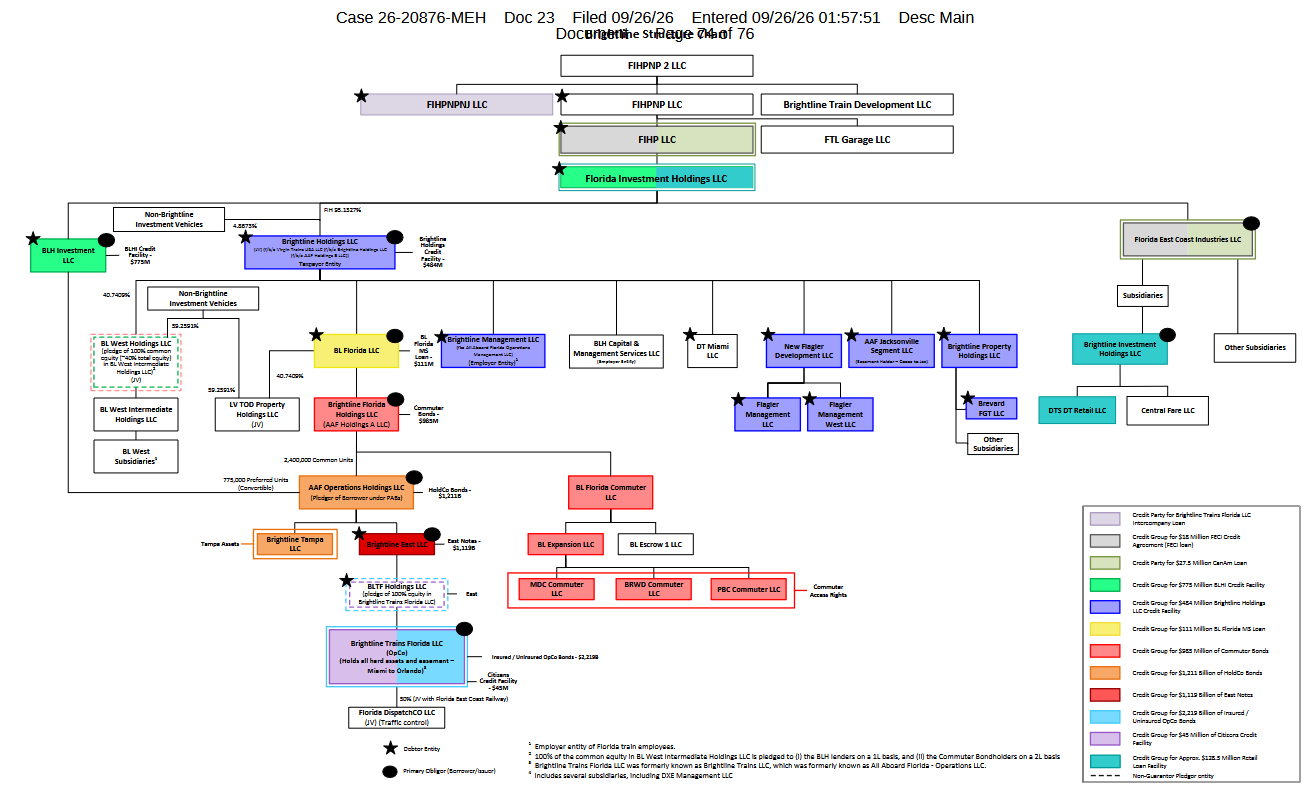
FIHPNP LLC (Brightline)
Majority Term Lender CK Opportunities Challenges $257.7mn DIP Over Priming, Adequate Protection; Seeks Scrutiny of Disputed 2022 Brightline West Transaction Involving Fortress-Controlled Entity and Wes Edens as First-Day Hearing Is Delayed 24 Hours
by Nick Montgomery | Sep 28, 2026, 12:46:06 PM
September 26, 2026 – CK Opportunities Fund I, L.P., the majority lender under Brightline Holdings LLC’s $484.0mn secured term loan, has objected to Brightline’s proposed $257.7mn postpetition financing, setting up an early fight over whether the Debtors can prime CK’s collateral and grant protections to the DIP lenders while a long-running dispute over an alleged Fortress insider transaction remains unresolved.
CK Opportunities is an investment fund jointly managed by Certares and Knighthead Capital Management, bringing together Certares’ travel-focused investment platform and Knighthead’s distressed-credit and restructuring business. CK is represented in the Chapter 11 cases by Robert J. Stark and Michael Winograd of Brown Rudnick LLP and Christopher Clark of Clark Smith Villazor LLP. The Debtors are represented by Paul D. Leake and Shana A. Elberg of Skadden, Arps, Slate, Meagher & Flom LLP and Michael D. Sirota of Cole Schotz P.C.
At the center of CK’s objection is a December 2022 transaction involving Brightline West and an entity controlled by Fortress principal Wes Edens. CK alleges that BL West Holdings issued roughly 40% of its equity to BL West Investment LLC for about $260.0mn, while simultaneously ceding board control to the Fortress-controlled investor. Brightline and Morgan Stanley subsequently treated the transaction as removing the Brightline West entities from the definition of “Subsidiaries” under the Brightline Holdings credit agreement, purportedly releasing guarantees and collateral and eliminating contractual prepayment and make-whole obligations. CK contends the transaction violated negative covenants, was completed at substantially below fair value and gives rise to fraudulent-transfer, fiduciary-duty and other estate claims. Brightline disputes that characterization and has sought dismissal and summary judgment in the pending New York litigation.
CK argues that the proposed DIP would now compound that dispute by placing senior liens and superpriority claims ahead of collateral securing the Brightline Holdings facility and potentially encumbering estate claims arising from the 2022 transaction before their ownership and value have been tested. It also opposes good-faith findings for the DIP lenders and says Morgan Stanley lacks authority to consent to priming or subordination on CK’s behalf.
The creditor separately attacks the adequate-protection package proposed for lenders under the Brightline Holdings facility. CK Fund’s claims are secured in part by pledged equity in a number of Brightline subsidiaries, and the proposed DIP would grant senior liens and superpriority claims against assets of Brightline Holdings and certain guarantors. The Debtors propose replacement liens and section 507(b) claims for the affected prepetition secured lenders, but CK Fund argues those protections are backed by the same collateral already securing its claims and would themselves rank behind the carve-out, DIP liens and DIP superpriority claims.
“The Debtors offer no evidence establishing that such a package will adequately protect CK Fund’s collateral interests,” the objection says. CK Fund acknowledges that DIP exposure at the affiliate Debtor level is generally capped at $1.5mn per entity and $5.0mn in the aggregate, but argues that the limits can be increased with lender consent and do not eliminate the Debtors’ obligation to demonstrate adequate protection.
CK Fund also maintains that Morgan Stanley, the administrative agent under the Brightline Holdings facility, cannot consent on its behalf to the incurrence of DIP debt, additional liens or subordination of existing liens. CK Fund says its majority position gives it approval rights over material amendments and that Morgan Stanley’s authority in bankruptcy is expressly limited. The lender says it notified both Brightline and Morgan Stanley before the filing that it expected to be consulted on any bankruptcy financing but received no substantive engagement.
The objection comes ahead of consideration of Brightline’s unusual $257.7mn financing structure [Docket No. 20]. Non-Debtor Brightline Trains Florida LLC, rather than one of the Chapter 11 entities, would borrow the money from Assured Guaranty, an ad hoc mutual fund group and additional consenting OpCo noteholders. Approximately $185.2mn would be available following interim approval, with the remaining $72.5mn available after final approval. Deutsche Bank National Trust Company would serve as administrative and collateral agent.
OpCo would then advance portions of the financing through intercompany notes to fund Chapter 11 administration and other permitted expenses at the Debtors. BLTF Holdings LLC would reaffirm its existing pledge of 100% of OpCo equity, while the other Debtors would guarantee only the amounts allocated to them, subject to the $1.5mn individual and $5.0mn aggregate caps. The financing bears 10% PIK interest and carries an 8% PIK commitment premium.
Although the facility does not contain a conventional roll-up, it permits repayment of prepetition bridge financing provided by Assured and affiliates. Brightline’s initial 13-week budget allocates approximately $104.2mn, or roughly 40% of the proposed $257.7mn facility, to repay that bridge financing, compared with approximately $148.9mn of face amount outstanding at filing following issuance at a 30% OID.
The financing and other first-day requests had been scheduled to be heard this morning, September 28th, at 10:00 a.m. ET before Judge Mark E. Hall. The Debtors subsequently adjourned the entire first-day hearing by approximately 24 hours, with the DIP motion and other first-day matters now scheduled for September 29th at 11:00 a.m. ET [Docket No. 58]. The adjournment notice does not state a reason for the delay.
From the Filings
The CK Opportunities Fund objection provides: "The purpose of this pleading is six-fold. First, it introduces the Court to CK Fund, its economic stake and its intended role in these bankruptcy cases. Second, it provides the narrative background – largely, the counter-narrative to what has been posited by the Debtors – giving rise to significant litigation that CK Fund initiated pre-petition against Brightline Holdings, certain of its affiliates, and Morgan Stanley. Third, it reveals sizeable fraudulent transfer and other claims held by the estates against Debtor affiliates and ‘control’ persons. Fourth, it shows how certain requested ‘first day’ relief – particularly, the post-petition financing (the ‘DIP Loan’) – intends to, among other things, surreptitiously sweep very complex issues under the rug (i.e., rendering them effectively moot) before the case has even begun, prompting CK Fund’s objection to, among other things, any ‘good faith’ finding for the proposed lenders thereunder. Fifth, it demands adequate protection for CK Fund’s collateral entitlements, holding the Debtors strictly to their burdens of proof and persuasion, for both interim and final approval of the DIP Loan. And, sixth, it reserves all rights in the case, whether they be asserted by way of contested matter or adversary proceeding.
First: Who Is CK Fund And What Is Its Stake In The Case? CK Fund is the largest secured creditor under the Brightline Holdings Credit Agreement, holding a majority in principal amount of the debt issued thereunder (as well as other claims described herein). CK Fund’s claims are guaranteed by certain subsidiaries of Brightline Holdings (many of which are Debtors in these cases) and secured by equity pledges in those subsidiaries, and certain other subsidiaries (including Brightline Holding’s equity interests in BL West Holdings LLC and other entities).
Second: What Happened Pre-Petition; Why Did CK Fund Initiate Litigation; What Is The Status Of That Litigation Today? CK Fund has been in long-standing litigation against Brightline Holdings, certain of its subsidiaries and affiliates, and Morgan Stanley respecting a 2022 stock issuance and transfer involving material and valuable subsidiaries of Brightline Holdings.
Brightline is a private company beneficially owned and ultimately controlled by investment funds managed by affiliates of Fortress Investment Group, LLC (‘Fortress’). It operates primarily in two geographic locations: Florida (sometimes referred to as ‘Brightline Florida’ or ‘Brightline East,’ the ostensible focus of these cases despite most of the key entities and the vast majority of the funded debt being omitted from these filings), and California/Nevada (sometimes referred to as ‘Brightline West’).
In sum, following CK Fund’s acquisition of the Credit Agreement debt, one of the material ‘Subsidiary’ guarantors under the Credit Agreement – BL West Holdings LLC, a wholly-owned subsidiary of Brightline Holdings and a holding company of the valuable ‘Brightline West’ business – consummated a transaction involving an impermissible equity issuance and a transfer of majority control to an entity principally owned and controlled by Fortress insiders, including Fortress principal and (at the time) Co-CEO, Wes Edens.
This transaction, according to Brightline, removed the Brightline West entities as ‘Subsidiaries’ and guarantors under the Credit Agreement (despite Brightline Holdings maintaining, at the time, a majority equity stake in Brightline West), not only depriving CK Fund of the guarantees and security interests granted under the Credit Facility and other Loan Documents relating to Brightline West, but also eliminating contractual prepayment obligations associated with future investments in Brightline West (which soon followed). CK Fund filed a lawsuit in New York state court respecting these events in September 2023 (motions for summary judgment and dismissal have been fully briefed and are pending), and maintains that, notwithstanding the purported transaction, it holds guarantee claims against and security interests in the purportedly released ‘Subsidiaries.’
Third: What Fraudulent Transfer And Other Estate Claims Arise From This Nucleus Of Operative Fact? The improper equity issuance and challenged 2022 transfer of Brightline West gives rise to a multitude of valuable estate claims and causes of action. It bears many hallmarks of an intentional fraudulent transfer (e.g., transfer to an insider, concealed from CK Fund, and seemingly done with the intent to avoid contractual obligations under the Credit Agreement). It transferred from Brightline Holdings both control over and a significant (nearly 40%) equity stake in highly-valuable subsidiaries for well below fair market value. And, it eliminated potentially valuable rights of contribution that the remaining Guarantors under the Loan Documents held against the purportedly ‘released’ Guarantors. Corporate decision-making surrounding the transfer is also an obvious subject for investigation, particularly given the insider nature of the transaction.
Fourth: What Is Objectionable About The Proposed DIP Loan? CK Fund objects to the DIP financing and any other relief insofar as it seeks to encumber, hypothecate, control, or interfere with CK Fund’s realization of value (including through any Debtor that is a Guarantor under the Loan Documents) based on claims sounding in, among other things, fraudulent transfer, equitable subordination, tortious interference, or breach of fiduciary duty.
Relatedly, CK Fund objects to any proposed ‘good faith’ finding under Section 364(e) or 363(m) to the extent that any proposed DIP financing or other transaction impairs or affects any rights or interests of CK Fund (including by seeking to encumber estate fraudulent transfer claims respecting any Brightline West entities). CK Fund’s pending lawsuit against Brightline Holdings has been heavily and openly litigated for nearly 3 years (since September 2023). Opportunistic DIP lender arrangements or dealmaking in this context is not entitled to a ‘good faith’ finding.
Fifth: CK Fund’s Demand For Adequate Protection. As the Debtors acknowledge, CK Fund’s claims are secured by liens on certain pledged equity in various Brightline subsidiaries. Through the DIP Loan, the Debtors seek to (among other things) prime CK Fund’s collateral interests, both by granting senior DIP Liens and DIP Superpriority Claims against the assets of Brightline Holdings (including the pledged equity held by Brightline Holdings that secures CK Fund’s claims) and in granting DIP Liens and DIP Superpriority Claims against the assets of the Guarantors, whose equity secures CK Fund’s claims.
CK Fund does not consent to being primed; therefore, under 11 U.S.C. §§ 364(d)(2) and 363(p)(1), the Debtors bear the burden of demonstrating that CK Fund’s collateral interests are adequately protected.
The concept of ‘adequate protection’ is a fundamental protection mandated under the Bankruptcy Code. It is rooted in the Fifth Amendment’s ‘takings’ clause. The Bankruptcy Code respects that Constitutional entitlement by prohibiting a debtor from: (i) using, selling, or leasing property that is subject to a security interest; and/or (ii) ‘priming’ a secured creditor’s lien, in each instance, without providing the affected secured creditor with adequate protection of their collateral interests. A debtor’s failure to provide adequate protection requires termination of the continued use of the collateral and is grounds to terminate the automatic stay.
Here, the Debtors fail to satisfy their burden. The ‘adequate protection’ package offered by the Debtors consists of replacement liens on the same collateral already securing CK Fund’s claims and superpriority administrative expense claims recoverable against those same assets, in each instance, subordinated to the Carve Out, DIP Liens, and DIP Superpriority Claims. The Debtors offer no evidence establishing that such a package will adequately protect CK Fund’s collateral interests. Indeed, of the declarations offered by the Debtors, one merely reiterates (in a single sentence) what the Debtors are offering without any substantive analysis, and the others do not address the matter at all. Absent evidence establishing a sufficient ‘equity cushion’ in CK Fund’s prepetition collateral, replacement liens and superpriority claims against those same assets cannot serve as adequate protections.
The Debtors may respond that the priming DIP Liens are capped at $5 million in the aggregate (and $1.5 million per Guarantor). But, this self-imposed cap (i) is subject to increase with the Required Lenders’ consent, and (ii) more importantly, does not eliminate the Debtors’ fundamental obligation to provide adequate protection.
Additionally, CK Fund observes that Morgan Stanley, still the administrative agent, does not have the authority to agree to DIP financing arrangements, lien subordination/priming, or any other relief adversely affecting CK Fund’s interests under the Credit Agreement absent CK Fund’s express consent, which, to be clear, it has not provided.
Sixth: CK Fund’s Reservation of Rights. CK Fund reserves all rights with respect to the Debtors’ Chapter 11 filings and any relief requested therein, whether through a contested matter or an adversary proceeding, including, without limitation, to seek: (i) appointment of a Chapter 11 trustee given, among other things, the ‘strategic’ positioning and nature of the Debtors’ bankruptcy filings (e.g., evading the mandatory requirements of Subchapter IV in a railroad bankruptcy case), and apparent efforts to insulate issues impacting CK Fund’s rights; and (ii) relief from the automatic stay (to the extent applicable).
On June 17, 2026, following news reports that Brightline was preparing for a potential bankruptcy filing (including soliciting DIP financing proposals), counsel to CK Fund contacted counsel to Brightline to engage on bankruptcy matters. Letters and emails from CK Fund to Brightline went unanswered. This suggested to CK Fund that Brightline had little interest in discussing matters that CK Fund wanted to address, to wit, how the Debtors intended to address CK Fund’s claims and interest in any bankruptcy case, including how the Debtors proposed to provide CK Fund with adequate protection, as required under the Bankruptcy Code. Despite CK Fund’s good faith efforts to engage, it was effectively shut out of any discussions. CK Fund again sought to engage with the Debtors in early September respecting the foregoing issues, and was again ignored. CK Fund, therefore, is compelled to hold the Debtors to their burdens of proof and persuasion in open court.
After reviewing the recently-filed Restructuring Support Agreement (‘RSA’), the Debtors’ refusal to engage with CK Fund prepetition is even more puzzling. Consider this: Under the RSA (which CK Fund continues to analyze), the Debtors propose that CK Fund (as a ‘Brightline Holdings Lender’) will receive its share of ‘(a) 100% of the equity of Brightline Holdings LLC’s pledged subsidiaries and (b) a portion of the Junior Stakeholder Consideration to be agreed to by the Company Parties and the Required Supporting Holders.’
This would presumptively include 100% of the pledged equity in Brightline Management LLC (‘Brightline Management’), a guarantor under the Credit Agreement and issuer of pledged equity securing CK Fund’s claims. According to the Debtors, as of the Petition Date, Brightline Management ‘serves as the dedicated day-to-day operations manager for non-Debtors OpCo, Brightline Tampa, and the Commuter Designees’ pursuant to ‘two General Operations, Management and Administrative Services Agreements,’ and employs ‘approximately 520 employees’ – seemingly the entire workforce – nearly all of whom ‘are engaged in operating the Rail System, including train operations, stations and hospitality services, and corporate functions,’ including, specifically: ‘90 Employees engaged in train operations, such as train engineers, conductors, and related crew positions,’ ‘340 Employees engaged in stations, maintenance, engineering, safety and security, ticket counter and guest services, baggage handling, café and commissary services, and other operational support roles,’ and ‘90 Employees in corporate functions, including executive, sales and marketing, finance and accounting, legal, human resources, and information technology.’
How, exactly, is this supposed to work? If CK Fund understands correctly, it is proposed to be the majority owner of the entity that employees the OpCo’s (and other affiliated entity’s) entire work force. Yet, the Debtors never picked up the phone to discuss this arrangement before filing?"
Background
DIP Summary
On September 26th, the Debtors sought approval of a $257.7mn financing package structured around non-Debtor Brightline Trains Florida, the entity that owns and operates Brightline’s 235-mile Miami-to-Orlando passenger rail system. Approximately $185.2mn would become available with an interim DIP order and the remaining $72.5mn after entry of a final order. Rather than placing OpCo into Chapter 11, the proposed structure makes OpCo the borrower while using the Debtors’ ownership interests and intercompany funding arrangements to support both the railroad’s operations and the holding-company cases. BLTF Holdings would reaffirm its existing pledge of 100% of OpCo equity, while the other Debtors would guarantee only amounts of financing proceeds allocated to them, capped at $1.5mn for any individual affiliate and $5.0mn collectively.
The financing is being provided in connection with Brightline’s September 24th RSA with Assured Guaranty and the Ad Hoc Mutual Fund Group. Assured, which insures approximately 51% of the $2.2bn OpCo bond issue, is purchasing its allocated portion and backstopping notes allocated to additional consenting OpCo bondholders that do not fund; Assured, the additional consenting bondholders and the mutual fund group will otherwise purchase the notes ratably under the commitment schedule. The Debtors do not propose a conventional roll-up. The facility does, however, expressly permit repayment of approximately $148.9mn face amount of prepetition Bridge Financing, which was provided to OpCo by Assured and affiliates at a 30% OID. The 13-week budget contemplates a $104.2mn bridge paydown, excluding that OID.
The notes bear 10.0% PIK interest, with an additional 2.0% default rate, and carry an 8.0% commitment premium that is also capitalized into principal. The facility matures at the earliest of one year from the Petition Date, Plan effectiveness or substantial consummation, acceleration or termination following a default, or 45 days after interim approval if a final order has not been entered. Proceeds may fund OpCo and Debtor expenses, Chapter 11 administration, financing fees and repayment of the Bridge Financing.
A&M Managing Director Gaurav Malhotra says Brightline has an “acute and immediate need for liquidity” and would otherwise lack sufficient cash for near-term operating and working-capital requirements. More than 97% of the Debtors’ own liquidity requirements are restructuring-related professional fees expected to be funded from OpCo, while OpCo must continue covering payroll, track and rolling-stock maintenance, fuel, rent, insurance and other operating expenditures. The initial budget forecasts approximately $129.5mn of net cash burn over 13 weeks and approximately $65.7mn of restructuring-adviser payments.
PWP tested the financing market in August, contacting 11 institutional and special-situations financing sources. Three executed NDAs and entered discussions, including over structures that would have placed OpCo itself into Chapter 11, but none expressed willingness to lend on an unsecured or junior basis or engage in a priming contest over BLTF’s collateral. The Debtors consequently returned to the RSA creditor groups for the proposed financing.
The facility also ties financing availability to the restructuring timetable. The Debtors must obtain interim approval within four business days of the Petition Date and final approval within 40 days after the interim order, file the Plan and Disclosure Statement within 60 days of the Petition Date, obtain Disclosure Statement approval within 105 days, begin solicitation within three business days thereafter, obtain confirmation within 45 days of solicitation and reach effectiveness within 14 days after confirmation, subject to specified lender extensions.
Key Terms of DIP Financing
- DIP Borrower: Non-Debtor Brightline Trains Florida LLC.
- DIP Pledgor: Debtor BLTF Holdings LLC.
- DIP Guarantors: Each Debtor other than BLTF Holdings, but only for its allocated portion of proceeds. An individual Affiliate Debtor DIP Guarantor is capped at $1.5mn, with aggregate allocations to all Affiliate Debtor DIP Guarantors capped at $5.0mn. Those caps may be increased with the written consent of the Required Purchasers.
- DIP Agent: Deutsche Bank National Trust Company serves as administrative agent and collateral agent.
- DIP Lenders: Assured Guaranty, the Ad Hoc Mutual Fund Group and Additional Consenting OpCo Noteholders. Assured is also backstopping Senior Secured Notes allocated to Additional Consenting OpCo Noteholders to the extent those holders do not fund their commitments. The notes are otherwise purchased ratably under the Senior Secured Notes Commitment Schedule.
- Facility / Commitments: $257.7mn senior secured note facility, with $185.2mn available upon entry of the interim DIP order and the remaining $72.5mn available following entry of the final DIP order, subject to applicable conditions precedent.
- New Money: Up to $257.7mn of new secured financing issued by non-Debtor OpCo.
- Roll-Up: None. The financing does, however, permit proceeds to repay the prepetition Bridge Financing. The initial 13-week budget provides for a $104.2mn bridge paydown, excluding the 30% OID.
- Cash Collateral: The Debtors seek authority to use prepetition collateral, including cash collateral, in accordance with the Approved Budget and permitted variances. The financing parties and prepetition secured creditors receive adequate protection for diminution in value.
- Collateral / Priority: BLTF Holdings reaffirms its existing pledge of 100% of the equity interests in OpCo to secure the full Senior Secured Brightline Facility. Each Affiliate Debtor DIP Guarantor grants liens and superpriority claims only for its allocated portion of the DIP obligations. First-priority liens extend to unencumbered Affiliate Debtor property, while liens on avoidance-action proceeds require entry of a final order; avoidance actions themselves are excluded.
- Adequate Protection: The prepetition BLTF secured parties receive replacement liens and section 507(b) claims, current cash payment of Assured’s bond-insurance premiums, current postpetition interest on the OpCo Bonds and Citizens loans at applicable non-default rates, payment of specified professional fees and expenses and continued reporting. Prepetition affiliate secured parties receive replacement liens and section 507(b) claims against the applicable Affiliate Debtor DIP Guarantors.
- Interest Rate: 10.0% per annum, payable entirely in kind through capitalization of accrued interest.
- Default Rate: 2.0% per annum above the otherwise applicable 10.0% interest rate.
- Fees: An 8.0% commitment premium on aggregate commitments, earned and payable in kind on the closing date by capitalization into the principal amount of the notes. Administrative-agent fees are also payable pursuant to a separate fee letter, with the amounts not disclosed in the motion.
- Maturity: The earliest of: (i) one year from the Petition Date, subject to extension by the Required Purchasers; (ii) the earlier of the effective date and substantial consummation of the Plan; (iii) acceleration of the notes or termination of commitments following an event of default; and (iv) 45 days after entry of the interim DIP order if the final DIP order has not been entered.
- Use of Proceeds: General corporate expenses of OpCo, BLTF Holdings and the Affiliate Debtor DIP Guarantors; fees, costs and expenses of administering the Chapter 11 cases; repayment of the Bridge Financing; financing fees and expenses; and other uses permitted under the Approved Budget and financing documents.
- Budget / Variance Covenant: The Company must provide the administrative agent and purchasers with an updated 13-week forecast every fourth Friday after closing. A new budget supersedes the existing budget upon Required Purchaser approval. Weekly budget-variance reports are due no later than the third business day after the end of each test period. The motion’s material-terms summary does not specify the permitted variance percentage.
- Milestones: Interim DIP approval within four business days of the Petition Date; final DIP approval within 40 days after entry of the interim order; filing of the Plan, Disclosure Statement, Disclosure Statement motion and solicitation materials within 60 days of the Petition Date; Disclosure Statement approval within 105 days of the Petition Date; solicitation beginning within three business days thereafter; confirmation within 45 days after solicitation commences; and Plan effectiveness within 14 days after confirmation. Assured may extend the effectiveness milestone to as late as 315 days after the Petition Date and, with required mutual fund group consent, no later than 365 days after the Petition Date.
- Credit Bid / Plan Linkage: The administrative agent, acting at the direction of the Required Purchasers, receives rights to credit bid DIP obligations in a sale or other disposition of Debtor assets, limited for an Affiliate Debtor to its allocated portion. The prepetition BLTF collateral agent also receives rights to credit bid the prepetition BLTF secured obligations against BLTF’s pledged collateral. The facility is expressly linked to implementation of the RSA and the Plan milestones.
- Challenge Period / Stipulations: For Affiliate Debtors, the proposed order generally provides a 60-day challenge period after appointment of an official Committee. If no Committee is appointed, and in all events with respect to BLTF Holdings, the deadline is 75 calendar days following entry of the interim order. Absent a timely successful challenge, the Debtors’ stipulations concerning prepetition liens and obligations become binding.
- Limitation on Investigation Funding: The proposed order prohibits use of proceeds of the Senior Secured Brightline Facility, DIP collateral, prepetition BLTF collateral or any portion of the carve-out to investigate or prosecute specified claims or challenges against the DIP lenders and identified prepetition creditor groups.
- Carve-Out: The carve-out covers statutory fees and pre-trigger professional fees, together with a $7.5mn post-trigger cap for hourly estate and OpCo professionals. Amounts attributable to Affiliate Debtor DIP Guarantors remain subject to the $5.0mn aggregate and $1.5mn individual caps.
- 506(c) Waiver / Avoidance Proceeds: The proposed final relief would waive section 506(c) surcharge rights against prepetition collateral and provide liens on proceeds of avoidance actions, although the avoidance actions themselves remain excluded from collateral.
- Remedies: Following an event of default and delivery of a termination notice, the administrative agent may exercise remedies after five business days’ notice. During that period, additional draws cease, although cash may continue to be used in accordance with the Approved Budget, and the Debtors, parties in interest and U.S. Trustee may seek an emergency hearing to contest the asserted default.
From the Filings
The Debtors' DIP motion [Docket No. 20] provides: "...the Debtors seek this Court’s approval of a financing package—the Senior Secured Brightline Facility—providing critically needed liquidity, to (i) maximize the value of non-Debtor OpCo, the operating entity from which the value in these cases
flows and (ii) implement a restructuring of the Debtors’ upper-tier holding companies’ obligations. The Senior Secured Brightline Facility will be effectuated pursuant to the Senior Secured Note Agreement, under which non-Debtor OpCo will issue Senior Secured Notes in the aggregate principal amount of up to $257.7 million, with proceeds available for non-Debtor OpCo’s operating expenses and to fund through one or more intercompany notes the Debtors’ administration of the Chapter 11 Cases. Approximately $185.2 million of the Senior Secured Brightline Facility would be available upon entry of the Interim Order and the remainder will be available following entry of the Final Order.
In accordance with the terms of the Senior Secured Note Documents, Debtor BLTF will take necessary actions to authorize non-Debtor OpCo, the Borrower, to enter into the Senior Secured Brightline Facility, and Debtor BLTF will reaffirm its existing pledge of 100% of the equity interests in non-Debtor OpCo under the Prepetition Pledge Agreement, pursuant to a reaffirmation agreement to be entered into in connection with the Senior Secured Note Agreement. Under the proposed DIP Orders, the reaffirmed pledge will be designated DIP Collateral, and the Senior Secured Note Secured Parties will receive a first priority secured DIP claim for the interim and final amounts of $185.2 million and $257.7 million, respectively, on the shares Debtor BLTF holds of non-Debtor OpCo. This structure is consistent with that of the existing OpCo Bonds under which currently a pledge of the OpCo stock secures OpCo’s $2.2 billion in obligations. In addition, under the Senior Secured Brightline Facility, affiliate Debtor DIP Guarantors will provide guarantees on account of any proceeds allocated to those entities, subject to certain individual and aggregate caps further described below.
Access to the Senior Secured Brightline Facility is critical to the success of these cases and the Company’s intercity passenger rail system in Florida (the 'Rail System'), which serves thousands of customers daily and employs more than 500 employees. The Senior Secured Brightline Facility enables OpCo, which is not itself in chapter 11, to continue operating the Rail System and avoids the costs, delays, and operational disruption that would result from subjecting OpCo, an active railroad operator, to the bankruptcy process, thereby preserving value at OpCo for the benefit of the Debtors’ estates. The Debtors require access to Senior Secured Brightline Facility proceeds through intercompany loans from non-Debtor OpCo to fund the administrative costs of the Chapter 11 Cases, and maintain the corporate infrastructure necessary to effectuate the proposed restructuring and support non-Debtor OpCo’s operations since there was no other financing available after testing the market. Simply put, the Senior Secured Brightline Facility provides the financial stability necessary for the Debtors to maximize the value of their central operating asset and the relief sought herein should thus be approved.
In simple terms, the Senior Secured Brightline Facility is a third-party, arm’s-length loan to non-Debtor OpCo, the Company’s main operating entity. The full amount of the loan is secured by (1) the assets of non-Debtor OpCo and (2) Debtor BLTF’s reaffirmation of its existing pledge of 100% of the equity interests in non-Debtor OpCo.
Secured Parties will hold a first priority DIP claim against the Pledged Collateral (as defined in the Prepetition Pledge Agreement) for the full amount of the new loan on account of this reaffirmed pledge. All other Debtors, the Affiliate Debtor DIP Guarantors, are not guaranteeing the full loan amount. Instead, each Affiliate Debtor DIP Guarantor is providing a limited guarantee, and granting a lien on its assets, only to the extent that it actually receives or benefits from loan proceeds through intercompany transfers from non-Debtor OpCo. Furthermore, the amount each Affiliate Debtor DIP Guarantor can receive under the Senior Secured Brightline Facility is subject to an individual cap of $1,500,000 per entity and an aggregate cap of $5,000,000 across all Affiliate Debtor DIP Guarantors.
Moreover, given that OpCo is a non-debtor, the relief requested of the Court is narrowly tailored. In sum, there are four key features for which the Court’s imprimatur is sought:
- authorizing Debtor BLTF, to the extent applicable, to take any actions necessary to authorize OpCo to enter into the Senior Secured Brightline Facility;
- approving the priming liens at Debtor BLTF for the Senior Secured Brightline Facility obligations vis-à-vis the OpCo stock pledge through the Senior Secured Brightline Facility’s reaffirmation of its existing pledge of such stock;
- authorizing the intercompany loans from non-Debtor OpCo to the Debtors, primarily to fund these Chapter 11 Cases; and
- approving the priming liens up to an aggregate cap of $5 million in connection with the intercompany loans to the Affiliate Debtor DIP Guarantors.
Each of these features is fundamental to the bargain struck with the Senior Secured Note Purchasers to ensure funding of non-Debtor OpCo for the benefit of the Debtors’ estates and, as described more fully below, represents a sound exercise of the Debtors’ business judgment. And while the Court is not specifically being asked to approve the Senior Secured Note Purchasers loan to OpCo itself, it is important for the Debtors to present the entire package to apprise the Court of the inter-connected nature of the Debtors’ relief with that of the key non-debtor in these cases.
In his declaration supporting the DIP motion [Docket No. 21], PWP Partner Bruce Mendelsohn says the financing search extended beyond the RSA creditor groups: “During August 2026, the Company, with the assistance of PWP, contacted eleven (11) different prospective financing sources across the institutional lending and special situations markets, including sophisticated hedge funds and large asset managers, many of which have experience with DIP financing facilities and/or the railroad industry.... Of the eleven (11) different prospective financing sources contacted by PWP, three (3) such parties signed non-disclosure agreements and engaged in discussions with the Debtors’ advisors.”
Mendelsohn says those discussions considered both a Chapter 11 filing by OpCo itself and a holding-company-only filing, but: “Ultimately, none of these prospective financing sources expressed any willingness to lend on an unsecured or junior basis, or to engage in a priming contest with respect to the Prepetition BLTF Liens on Debtor BLTF’s assets. Accordingly, the Company, with the assistance of their advisors, focused their efforts on the currently proposed Senior Secured Brightline Facility backstopped by Assured and the Ad Hoc Mutual Fund Group.”
On the structure, Mendelsohn says: “In simple terms, the Senior Secured Brightline Facility is a third-party, arm’s-length loan to non-Debtor OpCo, the Company’s main operating entity.... All other Debtors, the Affiliate Debtor DIP Guarantors, are not guaranteeing the full loan amount. Instead, each Affiliate Debtor DIP Guarantor is providing a limited guarantee, and granting a lien on its assets, only to the extent that it actually receives or benefits from loan proceeds through intercompany transfers from non-Debtor OpCo.”
A&M Managing Director Gaurav Malhotra separately adds: “The Company has an acute and immediate need for liquidity. Specifically, without immediate access to the Senior Secured Brightline Facility proceeds, the Company does not have sufficient liquidity to maintain or satisfy its near term operating expenses in the ordinary course of business.... Furthermore, over 97% of the Debtors’ liquidity needs are primarily restructuring related professional fees that are expected to be funded from transfers from non-Debtor OpCo.”
On marketing, the Debtors' investment banker PWP adds [Docket No. 21]: "Based on my review of relevant documents and materials and my discussions with Company management and the Company’s other advisors, I understand that over a period of more than twelve (12) months before the filing of these Chapter 11 Cases, the Company and its advisors explored multiple options to raise out-of-court financing or engage in other strategic alternatives to address the Company’s financial position. For example, based on that review and those discussions, I understand that beginning in 2025 and continuing into early 2026, the Company with the assistance of certain other advisors, solicited interest from third parties for a potential equity investment. The process involved two separate outreaches to 32 global infrastructure investors, transportation operators, and financial sponsors, but the process generated limited interest. A total of four investors advanced to the diligence stage, but the Company received only one preliminary non-binding offer. Although negotiations with such party remained ongoing for a period of several months, such party ultimately elected not to pursue a transaction with the Company.
Subsequently, in January 2026, the Company engaged PWP to assist it with raising capital and evaluating strategic alternatives, including a comprehensive restructuring. In early May 2026, certain of the Company’s advisors including PWP launched a new marketing process seeking proposals to sell (i) all or a portion of the equity in non-Debtor OpCo or Debtor BLTF Holdings LLC (“BLTF”), (ii) the assets of non-Debtor OpCo, the assets or equity of non-Debtor Brightline Tampa, the equity of the Debtor entities that directly or indirectly hold the Commuter Access Rights, or (iii) some combination thereof. Sixty-four (64) global infrastructure investors, transportation operators, and institutions were contacted, twenty-two (22) of which were granted access to the virtual data room. Of such potential investors, only one submitted a written non-binding indication of interest, but shortly thereafter that party informed the Company that it had determined not to proceed with a transaction."
Prepetition Indebtedness
As of the Petition date, the Debtors had approximately $2.5bn of consolidated long-term funded debt. The Goddard Declaration separately identifies approximately $2.4bn of funded debt at non-Debtor OpCo and approximately $2.2bn at other non-Debtor affiliates, bringing the funded debt shown in the declaration’s capital-structure table to approximately $7.1bn.
The following is a summary of the Debtors’, non-Debtor OpCo’s and certain other non-Debtors’ funded debt obligations as of the Petition Date:
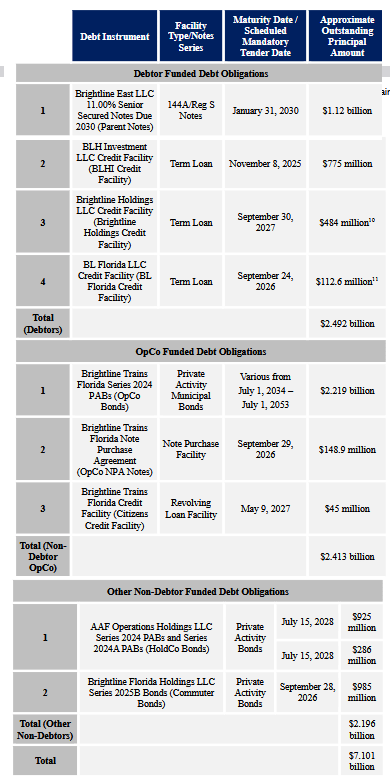
- Brightline East Parent Notes. In May 2024, Brightline East’s predecessor issuer issued $1.325bn of 11.00% Senior Secured Notes due 2030, with Deutsche Bank National Trust Company serving as trustee. Following a $206.2mn repurchase in December 2024, approximately $1.1bn remained outstanding at filing. The notes mature January 31, 2030 and are secured by substantially all personal property of Brightline East, including its equity interest in BLTF Holdings. Brightline East also held approximately $48.0mn in debt-service reserves associated with the notes.
- BLH Investment Credit Facility. BLH Investment entered into the facility in May 2024 with Morgan Stanley Senior Funding, Inc. as administrative agent. Approximately $775.0mn was outstanding at filing. The facility matured November 8, 2025; an earlier July 2025 interest payment and August 2025 10% mandatory prepayment also went unpaid, according to the declaration.
- Brightline Holdings Credit Facility. Brightline Holdings entered into the term-loan facility in June 2022 with Morgan Stanley Senior Funding as administrative agent. Approximately $484.0mn, including capitalized interest, remained outstanding at filing. The debt carries 20% PIK interest and matures September 30, 2027.
- BL Florida Credit Facility. BL Florida entered into the facility in February 2025 with Morgan Stanley Senior Funding as administrative agent. Approximately $112.6mn was outstanding at filing. The loans bear prime plus 2.5% or SOFR plus 3.5%; after multiple extensions, the facility matured on the September 24th Petition Date.
- OpCo Bonds. Non-Debtor Brightline Trains Florida has approximately $2.2bn outstanding under its May 2024 Series 2024 tax-exempt private activity bonds, with maturities ranging from July 2034 through July 2053. The obligations are secured by substantially all OpCo real and personal property and by BLTF Holdings’ pledge of 100% of OpCo equity. Assured insures 50.1% of the outstanding principal and holds voting rights for those insured bonds.
- OpCo NPA Notes. Non-Debtor OpCo entered into the note purchase agreement with Assured and affiliates in May 2026. The notes were issued at a 30% OID, mature September 29, 2026 and were used for critical vendors, employee obligations, professional fees and working capital. Approximately $148.9mn of principal was outstanding at filing, secured pari passu with the OpCo Bonds and Citizens facility.
- Citizens Credit Facility. OpCo’s May 2024 revolving facility with Citizens Bank, N.A. had $45.0mn outstanding at filing and matures May 9, 2027 following a 2026 extension. It shares the OpCo collateral package pari passu with the OpCo Bonds and NPA Notes.
- HoldCo Bonds. Non-Debtor AAF Operations Holdings has approximately $1.2bn outstanding under $925.0mn of Series 2024 bonds and $285.7mn of Series 2024A bonds. The bonds have a July 15, 2028 mandatory tender date. A July 15, 2026 cash interest payment remains subject to a grace period extended through the earlier of September 24, 2027 and five business days after termination of the RSA, absent a different date directed by the requisite holders.
- Commuter Bonds. Non-Debtor Brightline Florida has $985.0mn outstanding under the Series 2025B Commuter Bonds remarketed in August 2025. The February 15, 2026 interest payment was not made; its grace period, together with the current term period, was ultimately extended to September 28th, with a 2% interest-rate step-up during the grace period.
The Debtors’ consolidated list of their 20 largest unsecured claims separately totals approximately $14.2mn, led by Virgin Enterprises Limited’s $8.6mn legal settlement claim.
About the Debtors According to Brightline, the passenger rail business connects Miami, Aventura, Fort Lauderdale, Boca Raton, West Palm Beach and Orlando. The operating railroad itself, Brightline Trains Florida LLC, is not a Debtor. Brightline Florida Holdings LLC, which indirectly holds rights associated with commuter service in Miami-Dade, Broward and Palm Beach counties, and AAF Operations Holdings LLC, which indirectly holds Tampa development rights, are also outside Chapter 11. Corporate Structure (see Docket No. 23)